On This Page
Description
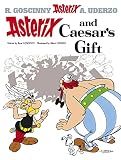
When Caesar offers a gift, be suspicious...very suspicious. Upon his release from the Roman Army, Tremensdelirius gets the deed to Asterix's little Gaulish village. But he swaps it for a drink in the tavern--and soon the owner and his family are off to claim their prize. What's going to happen? Surprisingly, Asterix has a different view of the situation than his friends.Tags
Recommendations


















Member Reviews
Un álbum muy divertido y con un dibujo espectacular (Uno de los mejores trabajos de [a:Uderzo|26082|Albert Uderzo|https://images.gr-assets.com/authors/1599054885p2/26082.jpg]) y con un trasfondo de sátira política que se presta a múltiples lecturas.
Un álbum muy divertido y con un dibujo espectacular (Uno de los mejores trabajos de [a:Uderzo|26082|Albert Uderzo|https://images.gr-assets.com/authors/1599054885p2/26082.jpg]) y con un trasfondo de sátira política que se presta a múltiples lecturas.
Un álbum muy divertido y con un dibujo espectacular (Uno de los mejores trabajos de [a:Uderzo|26082|Albert Uderzo|https://images.gr-assets.com/authors/1599054885p2/26082.jpg]) y con un trasfondo de sátira política que se presta a múltiples lecturas.
Un álbum muy divertido y con un dibujo espectacular (Uno de los mejores trabajos de [a:Uderzo|26082|Albert Uderzo|https://images.gr-assets.com/authors/1599054885p2/26082.jpg]) y con un trasfondo de sátira política que se presta a múltiples lecturas.
The 21st of the Asterix chronicles, the story follows an innkeeper, Orthapedix and his wife and daughter, as they travel to the little Gaulish village we all know and love to claim ownership...how this happens is after the inn-keeper takes the village as payment for a bottle of wine and a meal from a drunken Roman soldier who has had it gifted to him by Caesar for his 20 years loyal service.
This obviously does not sit well with the chief and what is loosely based on democracy the two battle it out to become chief of the village, only to have the Roman soldier come back to claim what is his. When refused he visits the nearest camp and they agree to invade for the pride of the Empire (somewhat hesitatingly) when they suspect there is no show more magic potion. Of course all hell breaks loose and normal transmission resumes.
This is not a bad book and has some great little snippets with the new 'villagers' and parodies the skullduggery and backhanders of modern political battles.
As usual there are some great takes on names including;
Legionnaire Egganlettus who resigns with the army after finding farming lettuces dull
Centurion Tonsilittus, commander of the fortified camp of Laudanum
Angina, wife of the inn-keeper
Influenza (also referred to as Zaza), the innkeeper's daughter
And though I had forgotten it, Bacteria, wife of Unhygenix the fish monger.
Interesting facts from this story include the reference to Zsa Zsa Gabor and in a sword fight between Asterix and the drunk Legionnaire (Tremensdelerius) he carves a "Z" into his shirt which she takes as a sign of his love for her which isn't clear in the story, however makes reference to the TV series "Zorro" which was playing in Europe at the time of publication. The sword fight also pays reference to Hamlet with prose from the play, although in the French publication is quotes Cyrano de Bergerac. While Asterix always has his sword with him, this is one of only a few scenes he actually uses it.
Cacofonix the Bard is not tied up at the end of this episode, and in fact can be seen chatting to Influenza at the banquet, possibly as they both have an interest in all things from the city (in this book, referring to the city of Lutetia). show less
This obviously does not sit well with the chief and what is loosely based on democracy the two battle it out to become chief of the village, only to have the Roman soldier come back to claim what is his. When refused he visits the nearest camp and they agree to invade for the pride of the Empire (somewhat hesitatingly) when they suspect there is no show more magic potion. Of course all hell breaks loose and normal transmission resumes.
This is not a bad book and has some great little snippets with the new 'villagers' and parodies the skullduggery and backhanders of modern political battles.
As usual there are some great takes on names including;
Legionnaire Egganlettus who resigns with the army after finding farming lettuces dull
Centurion Tonsilittus, commander of the fortified camp of Laudanum
Angina, wife of the inn-keeper
Influenza (also referred to as Zaza), the innkeeper's daughter
And though I had forgotten it, Bacteria, wife of Unhygenix the fish monger.
Interesting facts from this story include the reference to Zsa Zsa Gabor and in a sword fight between Asterix and the drunk Legionnaire (Tremensdelerius) he carves a "Z" into his shirt which she takes as a sign of his love for her which isn't clear in the story, however makes reference to the TV series "Zorro" which was playing in Europe at the time of publication. The sword fight also pays reference to Hamlet with prose from the play, although in the French publication is quotes Cyrano de Bergerac. While Asterix always has his sword with him, this is one of only a few scenes he actually uses it.
Cacofonix the Bard is not tied up at the end of this episode, and in fact can be seen chatting to Influenza at the banquet, possibly as they both have an interest in all things from the city (in this book, referring to the city of Lutetia). show less
Ok, no matter that this is #21 as there is an introduction.
But also no matter that this is the only one my library has. If they had more I'd probably read them because it was kinda cute & clever and I do tend to explore my inclinations more deeply than just one 15 min. episode. But since I'd have to actually hunt for more, I won't, as it wasn't that engaging. To me.
But also no matter that this is the only one my library has. If they had more I'd probably read them because it was kinda cute & clever and I do tend to explore my inclinations more deeply than just one 15 min. episode. But since I'd have to actually hunt for more, I won't, as it wasn't that engaging. To me.
A better-than-usual Asterix story in which Caesar, to spread discord among the Gauls, gives their village as a gift to a Roman family, who move to the village and find a mixed welcome. More emphasis on character interaction than bust-'em-ups this time. Even a small bit of romance for Obelix.
Members
- Recently Added By
Lists

Recommended Comics / Graphic Novels
595 works; 122 members
Author Information


Albert Uderzo was born on April 25, 1927 in Fismes, France as Alberto Aleondro Uderzo. In 1940, when he was just 13, he worked for Paris Publishing Society where he learned the basics for his profession - designing text and letters and editing photos. During World War II he worked on a farm and later as a furniture maker with his father. His show more drawing skills were put aside until 1945 when he entered a comic strip competition and later worked on a cartoon film titled Clic Clac. In the mean time he moved to Paris and worked on the magazine O.K. where he created several comics such as Arys Buck and Belloy. It was then that he met Rene Goscinny and the two worked on new comic book characters like Ompah-pah, Jehan Pistolet and Luc Junior. In 1959 they started a magazine called Pilote aimed at older children. It was the first issue that introduced the character Asterix and it was a big hit. By 1967 the comic became so popular that they decided to devote all their time to the series. Albert Uderzo was the illustator of all thirty Asterix adventures and the writer of the last eight adventures. show less
Some Editions
Series

Belongs to Publisher Series
Work Relationships
Common Knowledge
- Canonical title
- Asterix and Caesar's Gift
- Original title
- Le Cadeau de César
- Alternate titles*
- Astérix : Le cadeau de César
- Original publication date
- 1974
- People/Characters
- Astérix; Obélix; Idéfix; Obelix
- Important places*
- Pentre'r Galiaid
- Important events
- Roman Empire
- Related movies*
- Astérx y la sorpresa del César
- Epigraph*
- Y flwyddyn yw 50 cyn Crist. Mae Gâl i gyd yn nwylo'r Rhufeiniaid ... I gyd? Nage! Erys o hyd un pentref Galiaid anorchfygol sy'n llwyddo i ddal eu tir yn erbyn yr imperialwyr. Ac nid yw bywyd yn hawdd i'r llengfilwyr Rhufein... (show all)ig sy'n gorfod gwarchod gwersylloedd milwrol Bagiatrum, Ariola, Cloclarum a Bolatenae ...
- Dedication*
- [Dim]
- First words*
- Mae ein hanes yn dechrau ar gywair cerddorol mewn ty^ tafarn yn un o'r ardaloedd lleiaf parchus Rhufain.
- Last words*
- (Click to show. Warning: May contain spoilers.)Y cwmni cyfan ... oherwydd rhaid cofio i hyn oll ddigwydd amser maith maith yn ôl, tua 50CC, ac yn y dyddiau hynny, doedd ne yn poeni'n ormodol am ddim byd ...
- Original language*
- Ffrangeg
*Some information comes from Common Knowledge in other languages. Click "Edit" for more information.
Classifications
- Genre
- Graphic Novels & Comics
- DDC/MDS
- 741.5 — Arts & recreation Drawing & decorative arts Drawing Comic books, graphic novels, fotonovelas, cartoons, caricatures, comic strips
- LCC
- PN6747 — Language and Literature Literature (General) Literature (General) Collections of general literature Comic books, strips, etc.
- BISAC
Statistics
- Members
- 1,573
- Popularity
- 14,418
- Reviews
- 14
- Rating
- (3.96)
- Languages
- 21 — Catalan, Czech, Danish, Dutch, English, Estonian, Finnish, French, German, Greek, Hungarian, Italian, Norwegian (Bokmål), Norwegian, Polish, Portuguese, Slovak, Spanish, Swedish, Turkish, Welsh
- Media
- Paper, Ebook
- ISBNs
- 79
- ASINs
- 20