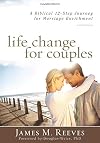
Life Change for Couples: A Biblical 12-Step Journey for Marriage Enrichment
by James Reeves
On This Page
Description
Healthy people build healthy marriages. With that truth in mind, author and pastor James Reeves guides couples to find long-term healing, closeness, joy, and the strength of a marriage rooted in Christ. Based on a sound biblical context and the proven 12-step model of recovery, Life Change for Couples brings scriptural principles into personal focus, to increase the emotional and spiritual health of both individuals in the marriage. Couples will build their own "toolkit" of nine memorable, show more life-changing principles that will continue to guide their daily relationship long after this workbook is completed. Designed for use within guided small groups, the workbook moves individual participants to personal introspection, giving them a chance to record their thoughts, questions, and discoveries. Participants are then invited to interact with their discussion group and with their spouse, creating opportunity for growth and learning. Motivated couples can benefit from using this in-depth guide on their own as well. show lessTags
Member Reviews
Life Change is a philosophy/theology/psychology book on becoming emotionally healthy oneself, more than a workbook for couples in marital crisis. That doesn’t mean it is not valuable. The premise of Life Change is that no relationship, especially that of marriage, can grow beyond an individual’s ability to receive healing for the emotional wounds which began in childhood and continue to the present day. This may seem heretical to the evangelical Christian audience for whom the book is written, who may believe that an increase in spiritual disciplines is the only true path to emotional healing. “Just pray more, study more, give more, serve more. Just love Jesus more and it’s all going to get better.” But those disciplines, show more while extremely important, will only help within the barriers of old hurt, until the wounds/barriers are dealt with and removed.
The first four chapters of the book deal with this relationship between emotional and spiritual growth, setting up a safe group environment, “owning” one’s own baggage before trying to “fix” the spouse, and discovering where/when each marriage went wrong. The last ten chapters each isolate one of the Twelve Steps, applying it to marriage, e.g. Step A—Admit Powerlessness “We admitted that we were powerless over (spouse’s name) and that our lives had become unmanageable.” Step D—Discover Responsibility “Made a searching and fearless moral inventory of ourselves.”, etc.
This is a 14-week study, but as those in Alcoholics Anonymous and other groups which use the Steps know, it can take years to work through the Steps. For success in a church-based small group, there would be necessary a very savvy facilitator, a very open timeline, and very willing spouses. For individuals unfamiliar with the Twelve Steps, or the emotional/spiritual barriers, it is eye-opening, and could be foundational reading for assessing one’s own negative reactions in relationships, and help provide the tools for healthy responses. show less
The first four chapters of the book deal with this relationship between emotional and spiritual growth, setting up a safe group environment, “owning” one’s own baggage before trying to “fix” the spouse, and discovering where/when each marriage went wrong. The last ten chapters each isolate one of the Twelve Steps, applying it to marriage, e.g. Step A—Admit Powerlessness “We admitted that we were powerless over (spouse’s name) and that our lives had become unmanageable.” Step D—Discover Responsibility “Made a searching and fearless moral inventory of ourselves.”, etc.
This is a 14-week study, but as those in Alcoholics Anonymous and other groups which use the Steps know, it can take years to work through the Steps. For success in a church-based small group, there would be necessary a very savvy facilitator, a very open timeline, and very willing spouses. For individuals unfamiliar with the Twelve Steps, or the emotional/spiritual barriers, it is eye-opening, and could be foundational reading for assessing one’s own negative reactions in relationships, and help provide the tools for healthy responses. show less
 This review was written for LibraryThing Early Reviewers.
I am always on the hunt for resources which will help me minister effectively. The good news of the gospel is not (just) about eternal salvation; it also impacts every part of our lives: finances, relationship, family, work, etc. James Reeves has written a new book which aims at bringing about the sort of life change that will impact your marriage. Utilizing a twelve step approach Reeves urges husbands and wives to work through baggage and emotional issues. The end result is healthier, humble people who have submitted their lives to Christ. This will impact your marriage. Life Change for Couples is a workbook which helps couples work through the personal struggles they bring into marriage.
Most of this book walks through the twelve steps show more of alcoholics anonymous (and other recovery programs), slightly recast in a specifically Christian direction. Reeves first four chapters set the tone for the book. Reeves envisions that this book would be used in a group setting with other couples. Thus he lays out guidelines for ‘freedom groups,’ and talks about the need for safe, healing environment. Reeves also lays out two guiding principles: the Emotional/Spiritual Principle and the Pile Principle. The Emotional/Spiritual Principle states that your spiritual maturity will never exceed your emotional maturity (37). This means that if you want to grow in your spiritual life. You need to work through your emotional issues. The ‘pile principle’ asserts that we all carry our own pile of emotional garbage which impacts our relationship with God and others (49,ff). The rest of the book follows the twelve steps with an eye to where our marriages are impacted.
In Reeves parlance, the twelve steps are:
“A” Admit Powerlessness
“B” Believe the Truth
“C” Commit to Christ
“D” Discover Responsibility
“E” Expose Secrets
“F” Focus on Faith
“G” Go Get Right
“H” Heed the Weeds
“I” Increase God Contact
“J” Just do it.
This modification of the traditional twelve steps emphasizes a biblically revealed understanding of God. God is not just ‘a higher power,’ but the God revealed in Jesus Christ. This is an important difference because Reeve challenges popular deficient views of God (see chapter six). Also there are only ten steps by Reeves’s reckoning. The substance of the twelve steps is there, but it isn’t actually ‘a twelve step journey.’
While this is a workbook intended to help couples and is designed for a group setting, its focus is on personal healing. When husbands and wives submit to the process laid out here, there is an opportunity for emotional healing and a deepening faith, which leads to personal responsibility, forgiveness and active reconciliation.. This is the sort of resource that will set people free to love and honor their spouse. This is good stuff.
However I offer two words of caution. First, there are no guarantees in marriage or life and I would be careful of overpromising. Ideally both wife and husband would work through their issues, have a healthy, growing faith and a deepening love for one another. But reading this book or any other and trying to practice it, is not a formula to get what you want out of your marriage. God may deepen your dependence on Him and your spouse may still leave, cheat or remain emotionally distant. This book will help you process through your own issues but it is not a ‘silver bullet’ for successful marriage. Secondly, I would demur from Reeves on his emphasis on “facts” and reason and mistrust of feelings. He reproduces the familiar diagram of a train where the engine (Fact) pulls faith behind it, which is followed by feelings (183). I agree with Reeves that feelings are fallen and should not be trusted. People with emotional baggage create a world of hurt. Yet our reason is also fallen and sometimes God works in our hearts in surprising ways. I can point to numerous experiences where feelings drove my faith to healthy places (and only later did I have an intellectual account). I like Reeves’s approach and commend it, but the privileging of reason is overly simple.
These two cautionary words should not dissuade you from making use of this fine resource. I think it will be a great tool for small groups, pre-marital and marital counseling. The twelve-step approach puts an emphasis on personal responsibility which will contribute to healthier, happier marriages as we submit ourselves one to another. I give this book four stars.
Thank you to Kregel Ministry for providing me a copy of this book in exchange for my honest review. show less
Most of this book walks through the twelve steps show more of alcoholics anonymous (and other recovery programs), slightly recast in a specifically Christian direction. Reeves first four chapters set the tone for the book. Reeves envisions that this book would be used in a group setting with other couples. Thus he lays out guidelines for ‘freedom groups,’ and talks about the need for safe, healing environment. Reeves also lays out two guiding principles: the Emotional/Spiritual Principle and the Pile Principle. The Emotional/Spiritual Principle states that your spiritual maturity will never exceed your emotional maturity (37). This means that if you want to grow in your spiritual life. You need to work through your emotional issues. The ‘pile principle’ asserts that we all carry our own pile of emotional garbage which impacts our relationship with God and others (49,ff). The rest of the book follows the twelve steps with an eye to where our marriages are impacted.
In Reeves parlance, the twelve steps are:
“A” Admit Powerlessness
“B” Believe the Truth
“C” Commit to Christ
“D” Discover Responsibility
“E” Expose Secrets
“F” Focus on Faith
“G” Go Get Right
“H” Heed the Weeds
“I” Increase God Contact
“J” Just do it.
This modification of the traditional twelve steps emphasizes a biblically revealed understanding of God. God is not just ‘a higher power,’ but the God revealed in Jesus Christ. This is an important difference because Reeve challenges popular deficient views of God (see chapter six). Also there are only ten steps by Reeves’s reckoning. The substance of the twelve steps is there, but it isn’t actually ‘a twelve step journey.’
While this is a workbook intended to help couples and is designed for a group setting, its focus is on personal healing. When husbands and wives submit to the process laid out here, there is an opportunity for emotional healing and a deepening faith, which leads to personal responsibility, forgiveness and active reconciliation.. This is the sort of resource that will set people free to love and honor their spouse. This is good stuff.
However I offer two words of caution. First, there are no guarantees in marriage or life and I would be careful of overpromising. Ideally both wife and husband would work through their issues, have a healthy, growing faith and a deepening love for one another. But reading this book or any other and trying to practice it, is not a formula to get what you want out of your marriage. God may deepen your dependence on Him and your spouse may still leave, cheat or remain emotionally distant. This book will help you process through your own issues but it is not a ‘silver bullet’ for successful marriage. Secondly, I would demur from Reeves on his emphasis on “facts” and reason and mistrust of feelings. He reproduces the familiar diagram of a train where the engine (Fact) pulls faith behind it, which is followed by feelings (183). I agree with Reeves that feelings are fallen and should not be trusted. People with emotional baggage create a world of hurt. Yet our reason is also fallen and sometimes God works in our hearts in surprising ways. I can point to numerous experiences where feelings drove my faith to healthy places (and only later did I have an intellectual account). I like Reeves’s approach and commend it, but the privileging of reason is overly simple.
These two cautionary words should not dissuade you from making use of this fine resource. I think it will be a great tool for small groups, pre-marital and marital counseling. The twelve-step approach puts an emphasis on personal responsibility which will contribute to healthier, happier marriages as we submit ourselves one to another. I give this book four stars.
Thank you to Kregel Ministry for providing me a copy of this book in exchange for my honest review. show less
I love this book! I love the analogies used in the book and that it teaches from a Christian perspective. I like the way it gives you everything you need to start a group for this study, including guidelines for being a part of the group, such as keeping what people say in group private. It lists the rules in the beginning of the book. It would be so easy to use the book to keep guidelines rather than the leader being the strict rule maker. This book is wonderfully written. I would definitely recommend this book! It is a workbook style so you answer questions right in the book. I give it an A+!
This review was written for LibraryThing Early Reviewers.Life Change for Couples by James M. Reeves was my most recent book granted me for early reviewers on librarything.com. This Christian based workbook for marriages includes a 12 -Step approach for marital enrichment. I am a Psychologist and highly recommend working through this workbook with a skilled facilitator in a small group format. This book has good material and as I read it I often saw how these chapters were good starts to build on for digging deeper. When surrounded by other married couples, in a safe environment, with Christ as the focus I can really see this bringing spouses closer together. Thank you for selecting me for reviewing this book.
This review was written for LibraryThing Early Reviewers.Interesting introduction from the author. I was intrigued enough so I desired to see what else he had to say. Actually felt like he was talking to us guys and not just the girls. I was impressed enough that I already have recommended it to the leader of couples group at church.
This review was written for LibraryThing Early Reviewers.To get conflicted couples to unpack the grief and shame and grudges with one another is a difficult task. This book in the hands of a skilled group leader will help couples on their own and within a group setting guide their hearts, minds and conversations toward restoration.
This review was written for LibraryThing Early Reviewers.I received this book through a Librarything.com Early Reviewer giveaway. It turned out to be a workbook that would work best in a therapy session, with someone who is well acquainted with the processes described.
This review was written for LibraryThing Early Reviewers.Members
- Recently Added By
Author Information
2 Works 19 Members
James M. Reeves (DMin, Southwestern Baptist Theological Seminary) is senior pastor of City on a Hill in Fort Worth, Texas. He regularly helps wounded people find hope and restoration through Jesus Christ. In addition to his pastoral responsibilities, James speaks at seminars and mentors other churches seeking to help married couples. He has show more written Refuge: How "Hospital Church" Ministry Can Change Your Church Forever. show less
Classifications
- Genres
- Nonfiction, Religion & Spirituality
- DDC/MDS
- 152.4 — Philosophy & psychology Psychology Sensory perception, movement, emotions, physiological drives Emotions
- LCC
- BV835 .R43 — Philosophy, Psychology and Religion Practical Theology Practical Theology Ecclesiastical theology Sacraments. Ordinances Marriage
- BISAC
Statistics
- Members
- 13
- Popularity
- 1,766,883
- Reviews
- 8
- Rating
- (3.75)
- Languages
- English
- Media
- Paper
- ISBNs
- 1