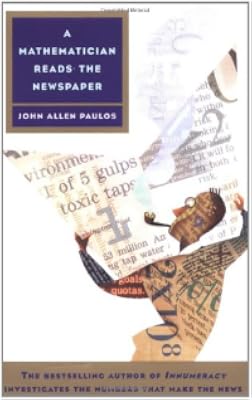
A Mathematician Reads the Newspaper
by John Allen Paulos
On This Page
Description
Mathematician John Allen Paulos employs his singular wit to guide us through an unlikely mathematical jungle--the pages of the daily newspaper. From the Senate and sex to celebrities and cults, Paulos takes stories that may not seem to involve math at all and demonstrates how mathematical naivete can put readers at a distinct disadvantage. Whether he's using chaos theory to puncture economic and environmental predictions, applying logic to clarify the hazards of spin doctoring and news show more compression, or employing arithmetic and common sense to give us a novel perspective on greed and relationships, Paulos never fails to entertain and enlighten. show lessTags
Recommendations















Member Recommendations
heidialice GEB is a thousand times as intense, but if you enjoyed the parts about self-referentiality it's worth a skim. Conversely, if GEB is just too much, Paulos' concise introduction to the theme is very accessible.
Member Reviews
I love mathematics. I love newspapers. I also love facts, and separating those from fiction, and clarity, and healthy skeptical thinking, and a vigorous dose of humor. This book satisfies all those interests. What's fascinating is that each chapter could be exploded not into just into an entire book, but volumes of books. His brevity though, keeps your interest, although he runs way too short on some very interesting topics (only four pages on baseball? Criminal!). Great fun. I have to read more of his work.
Sadly dated; what we need now is A Mathematician Surfs the Web. Paulos is reasonably non-doctrinaire, with examples that should annoy or outrage any political persuasion – although he’s careful not to say he actually advocates some of the positions that are statistically justifiable (example: an estimate that if all smokers switched to chewing tobacco, there would be a 98% reduction in tobacco-related deaths). His chapter on non-linear dynamics and chaos is directed at Reagonomics – it’s ironic that the substitution of a few words would make it equally applicable to climate change. (A later chapter on the logistic formula for animal population growth is also applicable to climate change as well as endangered species, show more demonstrating that apparently minor changes in input parameters can make dramatic differences in outcome).
Overall, though, it’s a collection of interesting essays of variable quality rather than a coherent book. Most of the mathematical discussions are too brief; a reader might remember the point made but not the method. I suppose it’s a variant on the claim that “The correct answer to Creationism is a geology textbook”; the correct answer to most media innumeracy is not a clever little selection of essays but a statistics textbook. show less
Overall, though, it’s a collection of interesting essays of variable quality rather than a coherent book. Most of the mathematical discussions are too brief; a reader might remember the point made but not the method. I suppose it’s a variant on the claim that “The correct answer to Creationism is a geology textbook”; the correct answer to most media innumeracy is not a clever little selection of essays but a statistics textbook. show less
A mathematician who loves to read his paper every day goes over some of the common errors, misconceptions, and misinterpretations of data and how those impact newspaper articles. The book is formatted into bite-sized essays about specific issues. It is peppered with graphs, diagrams and word problems. It's definitely not a text book, but I could see it being used as one.
I expected this to be a little more easy access. I could tell the author was trying to adopt a casual tone that would allow the uninitiated to understand, but there was a lot that went over my head. There was also a lot that gave me flashbacks to story problems in high school. Basically, it was just a reminder to me that statistics can be made to say almost anything you show more want. show less
I expected this to be a little more easy access. I could tell the author was trying to adopt a casual tone that would allow the uninitiated to understand, but there was a lot that went over my head. There was also a lot that gave me flashbacks to story problems in high school. Basically, it was just a reminder to me that statistics can be made to say almost anything you show more want. show less
Paulos is a witty mathematician and makes excellent points in his analyses of newspapers focusing on the numbers, statistics, ignorance and misrepresentations. Arranged as newspaper content, with politics and current topics first, followed by local news, lifestyles, science, and sports, he writes short "articles" with composite made up headlines to draw you in; not any different than any newspaper. Published in 1995, the topics and references are dated, but the message is not.
I would be curious to ask him what he thinks of Internet news and the Fox News Network. He had faith then that a newspaper was of more value than a television newscast, but that pre-dated the tabloid TV of Murdoch's empire and the deceptive pseudo-statistics they show more use, so I'm sure he's even more convinced of his original premise. show less
I would be curious to ask him what he thinks of Internet news and the Fox News Network. He had faith then that a newspaper was of more value than a television newscast, but that pre-dated the tabloid TV of Murdoch's empire and the deceptive pseudo-statistics they show more use, so I'm sure he's even more convinced of his original premise. show less
This book is a comprised of a series of vignettes which analyze common newspaper stories from the perspective of mathematics, formal logic and human psychology, most of them interesting and worthwhile, although a few meander back and forth, only to deliver commonplace conclusions not particularly related to mathematics.
One of the things I learned from this book is the notion of conditional probability. E.g., “the conditional probability that someone is wealthy given that he or she is a cardiologist is very high. The converse conditional probability that someone is a cardiologist given that he or she is wealthy is very low.” This seems obvious, but somehow I’ve never realized before that this also means that although the show more probability of an innocent person’s fingerprints matching a sample from a crime scene may be one in a million, the probability that a person whose fingerprints do produce a match is nonetheless innocent may still be two in three. However, when Paulos writes that the same is true of DNA samples, I was less prepared to take it at face value. I can well imagine fingerprints to be “a bit hazy and subject to interpretation,” but I have always assumed the data from DNA samples to be precise. (It’s just an assumption, though. I’m not a biologist and don’t have any experience with such samples.)
I agree with Paulos that when journalists use numbers far removed from most people’s everyday life they should “compare them with quantities that are more viscerally appreciated. For example, estimates of the cost of the savings-and-loan bailout have ranged up to $500 billion (including interest payments over time). This translates into $2,000 for every man, woman and child in the United States (again, over time).... Or… $500 billion could buy a transcontinental gold bar weighing about 5.5 pounds a foot.” We could “stretch this gold bar into a rainbow extending from Capitol Hill 1,500 miles up, above the Midwestern prairies and over the Phoenix headquarters of Charles Keating’s failed savings-and-loan empire.... It would take a decade to spend $500 billion at $1,585 a second.” (This book was published in 1995.) However, the author points out in another chapter that a linear measure of a number makes it appear large, while a volume measure of the same number makes it seem small: “although a single tower of nickels stretching from sea level to the height of Mount Everest would contain more than 4 million coins, you can easily verify that this pile would fit comfortably into a cubical box about 6 feet to a side.” This seems hard to believe, but my calculations did confirm it.
Paulos also writes that what’s important is not how many seats a party has in a legislative chamber or what percent of stock somebody owns in a company, but how often that number can be crucial in a vote, which depends on how many other parties/stockholders there are and how many seats/stocks each of them has. That’s probably obvious to businesspersons or people who live in multiparty state systems, but it’s just not something I ever thought about. Similarly, the author discusses that what’s important to politicians is not how many of their constituents are for and how many are against a particular measure, but how many will make a voting choice based on the candidate’s position on this issue. For instance, if the majority of the electorate is for stricter gun control, but among those against it, far more feel so strongly about it that they will vote against any candidate in favor of tighter gun control, a “prudent politician” won’t tackle the issue.
Although not particularly related to mathematics, I think Paulos makes a relevant point when he says:
"…reporters naturally gravitate to where the news is made, and on the federal level that place is Washington, D.C. On the state and local levels, the news comes from the state legislature and City Hall, respectively. Business, being decentralized, is largely invisible. (This is why the $12 million salary of the head of Equitable Life Insurance, for example, is seldom mentioned, even though it just about covers the salary of the entire U.S. Senate – 100 salaries at $138,000 each.) More conspicuous are those businesses synonymous with their locales: Wall Street, Hollywood, Detroit. No longer synonymous with beer, my hometown of Milwaukee almost never makes the national news unless a particularly grisly crime or some natural disaster takes place there; the same holds for most other American cities."
There’s been more attention devoted to private businesses recently, thanks to them getting government bail-outs, but I think largely Paulos’s observation is still current. Personally, I disapprove of the reporters’ habit of congregating in the government offices at all, or of regular press conferences. I don’t think it’s important what politicians say, only what they do, and that’s a matter of public record. (Not to mention that covering a government entity favorably is often a prerequisite for access to its officials.) So I agree with Paulous that newspapers and TV channels would have done us a better service if they fanned out their reporters across the country to actually gather some news instead of lazily writing down whatever platitudes and excuses politicians and government PR staff hand down to them. Nor should foreign news be confined to elections, wars, coups, riots and natural disasters. And, yes, I’ve heard that newspapers don’t have money to keep regular oversee correspondents anymore, but I don’t think keeping them in Washington is any cheaper, and I agree with Paulous that there are too many of them in Washington.
On the other hand, I disagree with him when he writes that environmental hazards, such as “benzene in Perrier water, pesticide residues on vegetables, Alar on apples, asbestos in schools, and chemicals in soil, water and air” are greatly overrated: “Although some of the countless contaminations we hear about may warrant action and justify fear, most are sensationalizing what are essentially trivial hazards.” He suggests “a warning in the same spirit” that reads, “apple seeds contain easily detectable amounts of cyanide, a chemical known to be harmful to humans.” But like the journalists whose work he bemoans in his book, he neglects to point out that a) people normally don’t eat apple seeds when they eat apples; b) apple seeds have tough protective shells to allow them to pass through birds’ and rodents’ stomachs undigested and be ready to germinate; and c) if people actually chewed on as great a volume of apple seeds as the volume of water they drink, they would get poisoned. Personally, I think there’s not anywhere enough emphasis on safe food, water and air, partly because most studies don’t take into account the effect of continual exposure to industrial chemicals over decades and generations, let alone a continual exposure to a combination of countless such chemicals in various combinations. So I was disappointed by the author’s repeated undermining of environmental concerns in this book. However, for the most part, it proved an interesting and useful book. show less
One of the things I learned from this book is the notion of conditional probability. E.g., “the conditional probability that someone is wealthy given that he or she is a cardiologist is very high. The converse conditional probability that someone is a cardiologist given that he or she is wealthy is very low.” This seems obvious, but somehow I’ve never realized before that this also means that although the show more probability of an innocent person’s fingerprints matching a sample from a crime scene may be one in a million, the probability that a person whose fingerprints do produce a match is nonetheless innocent may still be two in three. However, when Paulos writes that the same is true of DNA samples, I was less prepared to take it at face value. I can well imagine fingerprints to be “a bit hazy and subject to interpretation,” but I have always assumed the data from DNA samples to be precise. (It’s just an assumption, though. I’m not a biologist and don’t have any experience with such samples.)
I agree with Paulos that when journalists use numbers far removed from most people’s everyday life they should “compare them with quantities that are more viscerally appreciated. For example, estimates of the cost of the savings-and-loan bailout have ranged up to $500 billion (including interest payments over time). This translates into $2,000 for every man, woman and child in the United States (again, over time).... Or… $500 billion could buy a transcontinental gold bar weighing about 5.5 pounds a foot.” We could “stretch this gold bar into a rainbow extending from Capitol Hill 1,500 miles up, above the Midwestern prairies and over the Phoenix headquarters of Charles Keating’s failed savings-and-loan empire.... It would take a decade to spend $500 billion at $1,585 a second.” (This book was published in 1995.) However, the author points out in another chapter that a linear measure of a number makes it appear large, while a volume measure of the same number makes it seem small: “although a single tower of nickels stretching from sea level to the height of Mount Everest would contain more than 4 million coins, you can easily verify that this pile would fit comfortably into a cubical box about 6 feet to a side.” This seems hard to believe, but my calculations did confirm it.
Paulos also writes that what’s important is not how many seats a party has in a legislative chamber or what percent of stock somebody owns in a company, but how often that number can be crucial in a vote, which depends on how many other parties/stockholders there are and how many seats/stocks each of them has. That’s probably obvious to businesspersons or people who live in multiparty state systems, but it’s just not something I ever thought about. Similarly, the author discusses that what’s important to politicians is not how many of their constituents are for and how many are against a particular measure, but how many will make a voting choice based on the candidate’s position on this issue. For instance, if the majority of the electorate is for stricter gun control, but among those against it, far more feel so strongly about it that they will vote against any candidate in favor of tighter gun control, a “prudent politician” won’t tackle the issue.
Although not particularly related to mathematics, I think Paulos makes a relevant point when he says:
"…reporters naturally gravitate to where the news is made, and on the federal level that place is Washington, D.C. On the state and local levels, the news comes from the state legislature and City Hall, respectively. Business, being decentralized, is largely invisible. (This is why the $12 million salary of the head of Equitable Life Insurance, for example, is seldom mentioned, even though it just about covers the salary of the entire U.S. Senate – 100 salaries at $138,000 each.) More conspicuous are those businesses synonymous with their locales: Wall Street, Hollywood, Detroit. No longer synonymous with beer, my hometown of Milwaukee almost never makes the national news unless a particularly grisly crime or some natural disaster takes place there; the same holds for most other American cities."
There’s been more attention devoted to private businesses recently, thanks to them getting government bail-outs, but I think largely Paulos’s observation is still current. Personally, I disapprove of the reporters’ habit of congregating in the government offices at all, or of regular press conferences. I don’t think it’s important what politicians say, only what they do, and that’s a matter of public record. (Not to mention that covering a government entity favorably is often a prerequisite for access to its officials.) So I agree with Paulous that newspapers and TV channels would have done us a better service if they fanned out their reporters across the country to actually gather some news instead of lazily writing down whatever platitudes and excuses politicians and government PR staff hand down to them. Nor should foreign news be confined to elections, wars, coups, riots and natural disasters. And, yes, I’ve heard that newspapers don’t have money to keep regular oversee correspondents anymore, but I don’t think keeping them in Washington is any cheaper, and I agree with Paulous that there are too many of them in Washington.
On the other hand, I disagree with him when he writes that environmental hazards, such as “benzene in Perrier water, pesticide residues on vegetables, Alar on apples, asbestos in schools, and chemicals in soil, water and air” are greatly overrated: “Although some of the countless contaminations we hear about may warrant action and justify fear, most are sensationalizing what are essentially trivial hazards.” He suggests “a warning in the same spirit” that reads, “apple seeds contain easily detectable amounts of cyanide, a chemical known to be harmful to humans.” But like the journalists whose work he bemoans in his book, he neglects to point out that a) people normally don’t eat apple seeds when they eat apples; b) apple seeds have tough protective shells to allow them to pass through birds’ and rodents’ stomachs undigested and be ready to germinate; and c) if people actually chewed on as great a volume of apple seeds as the volume of water they drink, they would get poisoned. Personally, I think there’s not anywhere enough emphasis on safe food, water and air, partly because most studies don’t take into account the effect of continual exposure to industrial chemicals over decades and generations, let alone a continual exposure to a combination of countless such chemicals in various combinations. So I was disappointed by the author’s repeated undermining of environmental concerns in this book. However, for the most part, it proved an interesting and useful book. show less
I can’t recall when first I picked up John Allen Paulos’ A Mathematician Reads the Newspaper, but it has remained one of my favorite non-fiction books for years. The basic premise is that Paulos takes a typical newspaper and comments on the mathematical aspects of the kinds of stories that appear.
(Full review at my blog)
(Full review at my blog)
Paulos takes the reader on a mathematical tour of the newspaper. From the headline stories and elections to recipes and celebrity stories, it's all included in the sketches in this book. Paulos is certain to touch on something that is found in the newspaper that each person will enjoy -- celebrity gossip, election results, recipes, crime stories, health care, education, books and reading, top 10 lists, maps, gun control, forensics, etc. Some stories can be enjoyed by the average reader; others require a little more of a mathematical background to understand how math is involved in the story. It was quite an interesting book. He designed to be read like a newspaper -- where one can skip to whichever section interests him most. While I show more may not agree with Paulos' position on certain issues in the book, the book is an interesting read. show less
Members
- Recently Added By
Lists

HS Mathematics class library
79 works; 6 members
Author Information

14+ Works 6,299 Members
John Allen Paulos is professor of mathematics at Temple University and the author of eight previous books, including the bestselling Innumeracy and A Mathematician Reads the Newspaper.
Awards and Honors
Notable Lists
Series
Belongs to Publisher Series
Common Knowledge
- Original publication date
- 1995
- Epigraph
- I read the news today, Oh Boy. -- John Lennon
- Dedication
- To storytelling number-crunchers and number-crunching storytellers.
- Last words
- (Click to show. Warning: May contain spoilers.)Buy one and read all about it.
- Blurbers
- Stewart, Ian; Hofstadter, Douglas; Casti, John L.
Classifications
Statistics
- Members
- 1,078
- Popularity
- 23,898
- Reviews
- 22
- Rating
- (3.53)
- Languages
- Dutch, English, Italian, Spanish
- Media
- Paper, Ebook
- ISBNs
- 10
- ASINs
- 4