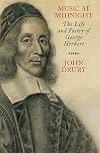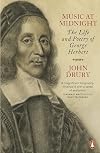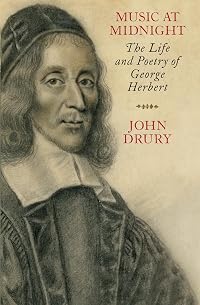
Music at Midnight: The Life and Poetry of George Herbert
by John Drury
On This Page
Description
Though he never published any of his English poems during his lifetime, George Herbert (1593-1633) is recognized as possibly the greatest religious poet in the language. Few English poets of his age still inspire such intense devotion today. In this richly perceptive biography, John Drury for the first time integrates Herbert's poems fully into his life, enriching our understanding of both the poet's mind and his work. --from publisher descriptionTags
Recommendations















Member Reviews
George Herbert (1593-1633) is not one of those obscure poets you only ever meet in lecture courses about 17th-century poetry: we can still read him with the barest minimum of editorial support, because his language is so astonishingly simple, clear, and almost "timeless" as to leap the barrier of 400 years effortlessly; several of his poems have become well-loved fixtures in the hymn-books of English-speaking Christian denominations; ordinary readers still turn to his religious poetry for spiritual consolation; poets from Richard Crashaw to Seamus Heaney and Elizabeth Bishop have cited him as an inspiration and exemplar of how to write; Vikram Seth loves his work so much that he bought and restored the rectory where Herbert used to show more live...
On the other hand, ill-health and an early death apart, Herbert's life doesn't seem to have had any of the difficulties in it that mark someone out to be a genius. He came from a minor, but still prosperous, branch of a powerful aristocratic family. George Herbert's relative the Earl of Pembroke was married to the poet Mary Sidney, dedicatee of Arcadia. Herbert's mother was a friend of William Byrd and John Donne. His headmaster at Westminster School (and later friend and mentor) was Lancelot Andrewes, the most distinguished of the translators of the Authorised Version.
Unlike most self-respecting poets, Herbert did very well at school and at Cambridge, being elected at a young age to a fellowship of his college and to the important university office of Orator. He served for a while as MP for a constituency that belonged to the Herbert clan. In an age of highly-charged political and religious turmoil, he appears to have managed not to get involved in any conflicts worth speaking of. When it all got a bit too much, he elegantly stepped aside from academia and politics, married a relative of his stepfather's, and became a country rector at Bemerton in Wiltshire, conveniently halfway between the musical life of Salisbury Cathedral and the Earl of Pembroke's seat at Wilton. And then, just as everything was about to descend into chaos and civil war, he died peacefully and in an aura of sanctity just before his 40th birthday.
Despite all this High Tory silver-spoonery, you only have to look into one or two of Herbert's poems to get a feeling for what a lovely, modest man he must have been. The debate in his poems is always between Herbert and God, and you get the feeling that God must be enjoying it far too much to let either side achieve a decisive result. They're probably still at it...
John Drury evidently loves Herbert very dearly, although not too dearly to point out the occasional weakness in his writing. And, as an academic and a clergyman himself, he's also in a very good position to look critically at Herbert as a priest and as a religious writer. He's found a very interesting way to construct this biography, mixing detailed discussions of individual poems with passages of historical and biographical material thematically rather than chronologically. To some extent this might have been forced upon him by the fact that we know very little about when Herbert wrote what - almost the first anyone knew of his poems was when he handed over a pile of manuscript to a friend on his deathbed with a request to see if there was anything worth publishing. But it works very well - we aren't allowed to get too deeply involved in the trivia of the life or too abstractly pedantic about the texts and their theology, but always keep the one in the context of the other. This is basically an author who doesn't have any need to profile himself any more, sharing with us his private pleasure in a poet he admires, and it's therefore a book you can read with pleasure without being a literary scholar, a Christian theologian, or an expert on the 17th century (although it probably helps if you're at least a little bit inclined to those things!). show less
On the other hand, ill-health and an early death apart, Herbert's life doesn't seem to have had any of the difficulties in it that mark someone out to be a genius. He came from a minor, but still prosperous, branch of a powerful aristocratic family. George Herbert's relative the Earl of Pembroke was married to the poet Mary Sidney, dedicatee of Arcadia. Herbert's mother was a friend of William Byrd and John Donne. His headmaster at Westminster School (and later friend and mentor) was Lancelot Andrewes, the most distinguished of the translators of the Authorised Version.
Unlike most self-respecting poets, Herbert did very well at school and at Cambridge, being elected at a young age to a fellowship of his college and to the important university office of Orator. He served for a while as MP for a constituency that belonged to the Herbert clan. In an age of highly-charged political and religious turmoil, he appears to have managed not to get involved in any conflicts worth speaking of. When it all got a bit too much, he elegantly stepped aside from academia and politics, married a relative of his stepfather's, and became a country rector at Bemerton in Wiltshire, conveniently halfway between the musical life of Salisbury Cathedral and the Earl of Pembroke's seat at Wilton. And then, just as everything was about to descend into chaos and civil war, he died peacefully and in an aura of sanctity just before his 40th birthday.
Despite all this High Tory silver-spoonery, you only have to look into one or two of Herbert's poems to get a feeling for what a lovely, modest man he must have been. The debate in his poems is always between Herbert and God, and you get the feeling that God must be enjoying it far too much to let either side achieve a decisive result. They're probably still at it...
John Drury evidently loves Herbert very dearly, although not too dearly to point out the occasional weakness in his writing. And, as an academic and a clergyman himself, he's also in a very good position to look critically at Herbert as a priest and as a religious writer. He's found a very interesting way to construct this biography, mixing detailed discussions of individual poems with passages of historical and biographical material thematically rather than chronologically. To some extent this might have been forced upon him by the fact that we know very little about when Herbert wrote what - almost the first anyone knew of his poems was when he handed over a pile of manuscript to a friend on his deathbed with a request to see if there was anything worth publishing. But it works very well - we aren't allowed to get too deeply involved in the trivia of the life or too abstractly pedantic about the texts and their theology, but always keep the one in the context of the other. This is basically an author who doesn't have any need to profile himself any more, sharing with us his private pleasure in a poet he admires, and it's therefore a book you can read with pleasure without being a literary scholar, a Christian theologian, or an expert on the 17th century (although it probably helps if you're at least a little bit inclined to those things!). show less
Widely regarded as an important and perceptive biography, John Drury's "Music at Midnight: The Life and Poetry of George Herbert" provides a thorough and captivating examination of the 17th-century metaphysical poet. Instead of presenting a simple cradle-to-grave account, Drury skillfully combines Herbert's life story with insightful criticism of his poetry, showing how his enduring verse was significantly influenced by his own experiences, spiritual challenges, and the sociopolitical climate of early 17th-century England.
Without compromising academic rigor, Drury does a commendable job of making Herbert and his world understandable to modern readers. Both seasoned Herbert scholars and those unfamiliar with his work will find his prose show more appealing, often characterized as eloquent and devoid of complex academic jargon. Drury's insightful analysis of Herbert's poems, exploring their formal and stylistic mastery, theological profundity, and emotional resonance, is one of the book's main strengths. The book effectively reveals the "autobiographical implications" of Herbert's poetry, demonstrating how his poems "obviously and confessedly arise from his life experiences," according to numerous critics. show less
Without compromising academic rigor, Drury does a commendable job of making Herbert and his world understandable to modern readers. Both seasoned Herbert scholars and those unfamiliar with his work will find his prose show more appealing, often characterized as eloquent and devoid of complex academic jargon. Drury's insightful analysis of Herbert's poems, exploring their formal and stylistic mastery, theological profundity, and emotional resonance, is one of the book's main strengths. The book effectively reveals the "autobiographical implications" of Herbert's poetry, demonstrating how his poems "obviously and confessedly arise from his life experiences," according to numerous critics. show less
Ratings
Members
- Recently Added By
Published Reviews
ThingScore 75
Drury, then, does not have an awful lot to go on as a biographer. Not only is there not much in the way of event, the records themselves are patchy; yet he has managed to produce a very useful and good book indeed. It's not full of padding: rather, he quotes the poetry substantially and then takes us through it . . . It makes you wish more biographies were like this: free from silly show more speculation, concentrating on the works, and the social and religious circumstances that lay behind them. show less
added by inge87
Lists

historical biographies : great lives, well told
64 works; 4 members
Author Information

17+ Works 629 Members
John Drury is Dean of Christ Church, Oxford: head of a dual institution made up of an Oxford college and a cathedral.
Awards and Honors
Common Knowledge
- People/Characters
- George Herbert
- Dedication
- To Caroline
- First words
- Herbert's masterpiece 'Love (III)' is saturated in the conditions of life in seventeenth-century England.
- Last words
- (Click to show. Warning: May contain spoilers.)Ah my dear angry Lord, / Since thou dost love, yet strike; / Cast down, yet help afford; / Sure, I will do the like. // I will complain, yet praise; / I will bewail, approve: / And all my sour-sweet days / I will lament, and love.
- Blurbers
- Worden, Blair; Reid, Christopher
Classifications
Statistics
- Members
- 170
- Popularity
- 193,182
- Reviews
- 2
- Rating
- (4.38)
- Languages
- English
- Media
- Paper, Ebook
- ISBNs
- 5
- ASINs
- 3