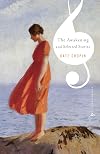
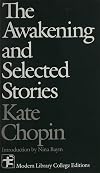
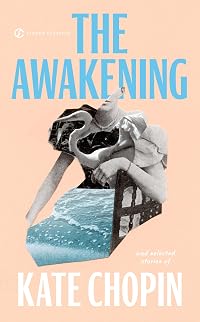
The Awakening and Selected Stories
by Kate Chopin
On This Page
Description
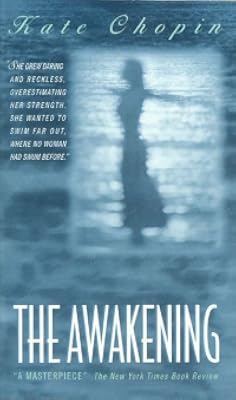
When a Louisiana woman meets a young resort owner while on vacation, she begins to fall in love with him despite her own marriage.Tags
Recommendations













Member Reviews
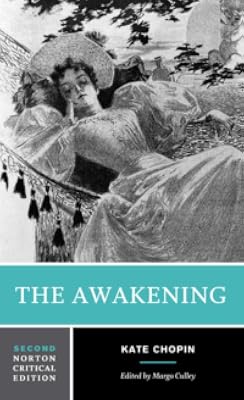
I always knew that this book is considered a feminist classic. What I did not know, however, is that Chopin writes with such flair, genuine emotion, and amazing local color. Even her earlier, less polished short stories shine with an amazing sincerity and clarity of energy. She was ahead of her time and continues to be relevant, and it's a shame that she wasn't able to become properly renown in her lifetime.
Substance: The short stories are entertaining, in the 19th century style, with interesting views of the Louisiana Creole milieu. The sentiments exhibited are conventional romances, although with wit and some insight.
The novel "The Awakening" might better be termed "The Abandonment."
I suggest that it was considered unacceptable as much for for its denigration of the roles of wife and mother (at that time) as for its restrained sensuality and "coded" adultery, although I'm sure Eulalie Mackecknie Shinn would have disapproved of the book.
Style: Chopin writes smoothly and easily, with succulent descriptive passages. The use of dialect is not overly intrusive (compare "Uncle Tom's Cabin" and a host of grade-B writings from the period up show more through the 1950s).
In re Edna Pontellier's detachment from her children, despite claiming "she would die for them" - it is a mistake to drug women in childbirth, and then turn the kids over to nannies. The mothers have no opportunity to bond with them, or learn how to relate to them. Also, Edna had no mother herself to learn from.
The self-indulgent protagonist seems never to have outgrown her youthful fantasies, and certainly made no effort to extend herself to understand her husband or care for her children (which she admitted).
There have always been women with no desire to be encumbered by a family (her family removed her from a convent at some age, if I remember rightly). To accept the task and then shirk it, as Edna did, does not become justified by the claim that she didn't understand herself until later.
NOTES:
p. 368: Society, by moving further along Chopin's path, has fixed the wrong problem, as usual. Although individual development should not be unrighteously hindered by family roles, it also should not constitute the whole of life.
See Jane Smiley's book about reading 100 novels, in which she details (approvingly) the contribution of "classic" novels to the destruction of the traditional family and marriage.
SPOILER ALERT for the novel
She exhibited the ultimate self-centered act in choosing death over her obligations to them, rather than remain "unfulfilled", although it is not really clear what she might have been missing out on other than some vague feeling that she was somehow "entitled to more" than she had (Chopin never admits that Edna was just randy for a younger man).
Even so, her actual adultery was not with the man she hankered after, and involved no passion at all, rather an ennui induced by not taking her job as wife and mother seriously.
Depriving her children of their mother is not a noble act, although they probably won't ever miss her, since she interacted with them as little as possible. (At least she didn't kill herself in front of them, compare "The Horse Whisperer".)
see page 364 on her desertion of her family.
The novel "The Awakening" might better be termed "The Abandonment."
I suggest that it was considered unacceptable as much for for its denigration of the roles of wife and mother (at that time) as for its restrained sensuality and "coded" adultery, although I'm sure Eulalie Mackecknie Shinn would have disapproved of the book.
Style: Chopin writes smoothly and easily, with succulent descriptive passages. The use of dialect is not overly intrusive (compare "Uncle Tom's Cabin" and a host of grade-B writings from the period up show more through the 1950s).
In re Edna Pontellier's detachment from her children, despite claiming "she would die for them" - it is a mistake to drug women in childbirth, and then turn the kids over to nannies. The mothers have no opportunity to bond with them, or learn how to relate to them. Also, Edna had no mother herself to learn from.
The self-indulgent protagonist seems never to have outgrown her youthful fantasies, and certainly made no effort to extend herself to understand her husband or care for her children (which she admitted).
There have always been women with no desire to be encumbered by a family (her family removed her from a convent at some age, if I remember rightly). To accept the task and then shirk it, as Edna did, does not become justified by the claim that she didn't understand herself until later.
NOTES:
p. 368: Society, by moving further along Chopin's path, has fixed the wrong problem, as usual. Although individual development should not be unrighteously hindered by family roles, it also should not constitute the whole of life.
See Jane Smiley's book about reading 100 novels, in which she details (approvingly) the contribution of "classic" novels to the destruction of the traditional family and marriage.
SPOILER ALERT for the novel
She exhibited the ultimate self-centered act in choosing death over her obligations to them, rather than remain "unfulfilled", although it is not really clear what she might have been missing out on other than some vague feeling that she was somehow "entitled to more" than she had (Chopin never admits that Edna was just randy for a younger man).
Even so, her actual adultery was not with the man she hankered after, and involved no passion at all, rather an ennui induced by not taking her job as wife and mother seriously.
Depriving her children of their mother is not a noble act, although they probably won't ever miss her, since she interacted with them as little as possible. (At least she didn't kill herself in front of them, compare "The Horse Whisperer".)
see page 364 on her desertion of her family.
Thoughts on the stories only: Chopin did a great job of capturing people and characters in little space. Some of her stories are incredibly short, but the two characters’ thoughts are foremost. I most enjoyed the stories about women in distinct situations, and some of Chopin's stories are ones I intend to revisit many times. I wasn’t, overall, impressed with the short stories that were in dialect, as the setting, the French, and the unfamiliar themes were not interesting to me.
Ratings
Members
- Recently Added By
Author Information

196+ Works 21,078 Members
Kate Chopin was born Katherine O'Flaherty in St. Louis, Missouri, on February 8, 1851. Although she was brought up in a wealthy and socially elite Catholic family, Chopin's childhood was marred by tragedies. Her father was killed in a train accident when Chopin was just four years old, and in the following years she also lost her older brother, show more great-grandmother, and half-brother. In 1870, at the age of 19, she married Oscar Chopin, the son of a wealthy cotton-growing family in Louisiana. The couple had seven children together, five boys and two girls, before Oscar died of swamp fever in 1883. The following year, Chopin packed up her family and moved back to St. Louis to be with her mother, who died just a year later. To support herself and her family, Chopin started to write. Her first novel, At Fault, was published in 1890. Her most famous work, The Awakening, inspired by a real-life New Orleans woman who committed adultery, was published in 1899. The book explores the social and psychological consequences of a woman caught in an unhappy marriage in 19th century America, is now considered a classic of the feminist movement and caused such an uproar in the community that Chopin almost entirely gave up writing. Chopin did try her hand at a few short stories, most of which were not even published. Chopin died on August 22, 1904, of a brain hemorrhage, after collapsing at the World's Fair just two days before. (Bowker Author Biography) show less
All Editions
Series
Belongs to Publisher Series
Common Knowledge
- Canonical title
- The Awakening and Selected Stories
- Original publication date
- 2000-11-14; 1899
- Important places
- Louisiana, USA
- Disambiguation notice
- Contains the novel The Awakening and 12 other short stories, including "Love on the Bon-Dieu" (see description for exact titles)
Classifications
Statistics
- Members
- 450
- Popularity
- 68,275
- Reviews
- 3
- Rating
- (3.80)
- Languages
- English
- Media
- Paper, Ebook
- ISBNs
- 11
- ASINs
- 1