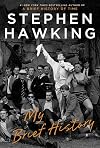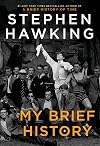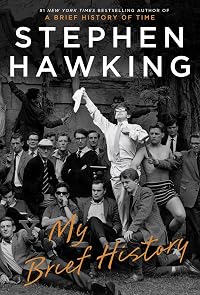
My Brief History
by Stephen Hawking
On This Page
Description
Stephen Hawking has dazzled readers worldwide with a string of bestsellers exploring the mysteries of the universe. Now, for the first time, perhaps the most brilliant cosmologist of our age turns his gaze inward for a revealing look at his own life and intellectual evolution.My Brief History recounts Stephen Hawking's improbable journey, from his postwar London boyhood to his years of international acclaim and celebrity. This concise, witty, and candid account introduces listeners to a show more Hawking rarely glimpsed in previous books: the inquisitive schoolboy whose classmates nicknamed him Einstein; the jokester who once placed a bet with a colleague over the existence of a particular black hole; and the young husband and father struggling to gain a foothold in the world of physics and cosmology.
Writing with characteristic humility and humor, Hawking opens up about the challenges that confronted him following his diagnosis of ALS at age twenty-one. Tracing his development as a thinker, he explains how the prospect of an early death urged him onward through numerous intellectual breakthroughs, and talks about the genesis of his masterpiece A Brief History of Time—one of the iconic books of the twentieth century.
Clear-eyed, intimate, and wise, My Brief History opens a window for the rest of us into Hawking's personal cosmos. show less
Tags
Recommendations
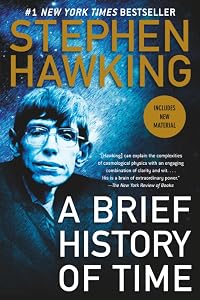

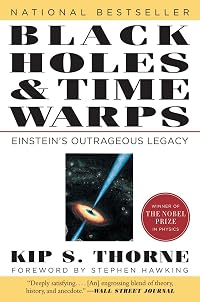
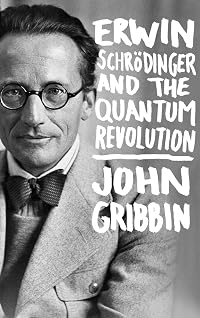
Member Recommendations
Limelite Delve into these two delightful semi-autobiographical books about Stephen Hawking's most admired physicist of the 20th C.
themulhern Virtually contemporaries, somewhat similar backgrounds, and careers, followed by international celebrity, and the writing of memoirs.

Member Reviews
I loved reading this little book Stephen Hawking wrote about himself. It is richly illustrated. I have always loved photos from a person's life because they can deepen understanding of that person. His writing is very honest.
I enjoyed finding out that he was bored with physics but enjoyed chemistry because of the explosions. Also, he revealed that he was not able to read until the age of 8 and that his sister taught him a different, more traditional way at the age of four. I agree with him that it may have been the method. It reminded me of when my son's teacher said that my son was not progressing in reading. I asked him about reading, and he told me what he was reading was boring! I contacted his teacher and he was switched to show more different texts, and he became much better in reading. I really think you need to ask children about their particular situation, then proceed.
I also liked how Stephen Hawking did not like the hierarchical way that the English school system was set up. I have a feeling that he could have been a force for change in education if he choose to go that way.
He mentioned that he had two marriages and three great children and went a little into his private life, in particular how his spouses reacted to the knowledge that he might not live long. He felt that some of the public were intrusive about his marital life. I felt bad that he experienced that! Pain in relationships is hard enough without strangers demanding the details.
I learned that he was at Caltech in Pasadena, and I am sorry that I missed the chance of meeting him and Einstein. Caltech is such a unique institution. I went on a tour of it one time and learned about some of the ways that they made accommodations for different students.
The biggest message of this book for me was don't give up when you have been given a devastating diagnosis. Find out what you can do and ways to help you achieve what you want to do!. show less
I enjoyed finding out that he was bored with physics but enjoyed chemistry because of the explosions. Also, he revealed that he was not able to read until the age of 8 and that his sister taught him a different, more traditional way at the age of four. I agree with him that it may have been the method. It reminded me of when my son's teacher said that my son was not progressing in reading. I asked him about reading, and he told me what he was reading was boring! I contacted his teacher and he was switched to show more different texts, and he became much better in reading. I really think you need to ask children about their particular situation, then proceed.
I also liked how Stephen Hawking did not like the hierarchical way that the English school system was set up. I have a feeling that he could have been a force for change in education if he choose to go that way.
He mentioned that he had two marriages and three great children and went a little into his private life, in particular how his spouses reacted to the knowledge that he might not live long. He felt that some of the public were intrusive about his marital life. I felt bad that he experienced that! Pain in relationships is hard enough without strangers demanding the details.
I learned that he was at Caltech in Pasadena, and I am sorry that I missed the chance of meeting him and Einstein. Caltech is such a unique institution. I went on a tour of it one time and learned about some of the ways that they made accommodations for different students.
The biggest message of this book for me was don't give up when you have been given a devastating diagnosis. Find out what you can do and ways to help you achieve what you want to do!. show less
For me one of the most appealing aspects of this book is its brevity. And that is not intended as any sort of dig at Hawking. Really, I want to learn a bit about him, but I don't want the messy details of anyone else's romantic life (and they are all messy). This is a bit about his parents, his childhood, his education (college was important to him), his marriages. his kids, his career, a bit about working around his disability. I don't feel like I know him, but I feel I've gotten a pretty good introduction.
I like his sense of humor, which is dry and understated. I like that he makes bets about cosmology with his peers, that those bets have clearly defined pay-offs, that he remembers those bets, and who won them, and that they were show more properly paid. I like that he says nothing but good things about his family. I like that he included family pictures of the various homes he lived in, and that meeting the Queen was a big deal, and was getting to experience gravity-free flight. I really like that he remembered that he had a eureka moment getting ready for bed. And that he pursued theoretical physics because he wasn't that good at maths and experiments were too much work.
Really, a good memoir. The perfect mix of self-deprecating and delight at how well his life turned out.
Review copy provided by publisher via NetGalley. show less
I like his sense of humor, which is dry and understated. I like that he makes bets about cosmology with his peers, that those bets have clearly defined pay-offs, that he remembers those bets, and who won them, and that they were show more properly paid. I like that he says nothing but good things about his family. I like that he included family pictures of the various homes he lived in, and that meeting the Queen was a big deal, and was getting to experience gravity-free flight. I really like that he remembered that he had a eureka moment getting ready for bed. And that he pursued theoretical physics because he wasn't that good at maths and experiments were too much work.
Really, a good memoir. The perfect mix of self-deprecating and delight at how well his life turned out.
Review copy provided by publisher via NetGalley. show less
Stephen Hawking: the man and the human being. It is extremely difficult to see Stephen Hawking as a person with love, fear and loneliness as things he possibly suffers through. In his autobiography we learn about Stephen’s life leading up to his grand successes and beyond. As a child he loved trains, was curious how machines worked, and was not skilled with his hands when rebuilding the machines he dissected.
Professor Hawking is revered for his “genius” in the theoretical physics realm and heavily involved in cosmology. He is the Director of Research at the Centre for Theoretical Cosmology at the University of Cambridge. His most prized work explains how matter is emitted from black holes as radiation, and was a forerunner in show more the research into space temperature. He does not believe that time tourists are among us, unless they are microscopic: reasoning is described in detail within the biography.
Hawking’s autobiography is terse which probably is the reason for the short book. There is little unnecessary information and contains the bare bones of Stephen’s life up to present time. He describes his marriages with factual information (before this book I didn’t realize Stephen had been married, let alone TWICE) and expressed pride in his three children. This is without doubt the most human I have ever seen Hawking, making him less of an immortal, overarching being and someone who struggled through his diagnosis with Lu Gehrig’s aka ALS, and still continues to struggle with the disease. He fills us on where he started, how he got to where he is, and the people who helped him get there. Hawking even remembers to accredit his students for their physical and theoretical aid while Stephen developed his career.
I am deeply impressed with this memoir, where it lacked warmth and was overly concise, it also developed a better picture of a man who has a sense of humour (entertaining bets with fellow scientists including a subscription of Penthouse), and a survivor. This is a man who has quietly suffered while doing great things for theoretical physics without much desire for fame or fortune. It is most fortunate that Hawking has used ALS to spur him on to develop countless theories, and is someone who can write his own life with such humility while making such a huge impact on the world. show less
Professor Hawking is revered for his “genius” in the theoretical physics realm and heavily involved in cosmology. He is the Director of Research at the Centre for Theoretical Cosmology at the University of Cambridge. His most prized work explains how matter is emitted from black holes as radiation, and was a forerunner in show more the research into space temperature. He does not believe that time tourists are among us, unless they are microscopic: reasoning is described in detail within the biography.
Hawking’s autobiography is terse which probably is the reason for the short book. There is little unnecessary information and contains the bare bones of Stephen’s life up to present time. He describes his marriages with factual information (before this book I didn’t realize Stephen had been married, let alone TWICE) and expressed pride in his three children. This is without doubt the most human I have ever seen Hawking, making him less of an immortal, overarching being and someone who struggled through his diagnosis with Lu Gehrig’s aka ALS, and still continues to struggle with the disease. He fills us on where he started, how he got to where he is, and the people who helped him get there. Hawking even remembers to accredit his students for their physical and theoretical aid while Stephen developed his career.
I am deeply impressed with this memoir, where it lacked warmth and was overly concise, it also developed a better picture of a man who has a sense of humour (entertaining bets with fellow scientists including a subscription of Penthouse), and a survivor. This is a man who has quietly suffered while doing great things for theoretical physics without much desire for fame or fortune. It is most fortunate that Hawking has used ALS to spur him on to develop countless theories, and is someone who can write his own life with such humility while making such a huge impact on the world. show less
Some lives of scientists are incredibly interesting. Newton’s personal life is the source of endless debate and fascination, and there are whole cults devoted to the life of Richard Feynman. (Even Hawking recounts some amusing anecdotes told by Feynman.) So I had high expectations for hearing about the life of Stephen Hawking.
This memoir, however, struck me as uneven in quality. Some of it had too much detail given to the most quotidian events. For example, Hawking names every friend he ever played with as a child, and provides a detailed history of his early toys.
He talks a bit about his personal experience with having what has been diagnosed as ALS, or amyotrophic lateral sclerosis (called motor neurone disease in the U.K.). He show more doesn’t address however the differences between the type of ALS that most people with the disease have, which gives them approximately 2 or 3 years to live, and his own slow-progressing form, estimated to be characteristic of fewer than 1% of those who develop ALS. He does tell us though a little about the effect it has had on his marriages and on his work.
Then there are the scientific parts.... I actually stuck with him through black hole thermodynamics, but when he went on to discuss cosmic strings, quantum gravity, negative energy, and imaginary time, well, I was - let’s just say not able to grasp his meaning very well. He does try though, and his explanations are much simpler than his writing for scientific audiences. But most of it was lost on me.
Discussion: Hawking has a pleasant, self-deprecating sense of humor, but in terms of writing memoirs, he is not Richard Feynman. As mentioned above, he doesn’t seem to have a good sense of what to include and what not to include. Moreover, in spite of having written books presumably for lay audiences, I did not think he did a good job at all at making his scientific theories understandable. Yes, it could be that I am just incredibly dense, and I don’t deny that for a moment, but aren’t I a typical member of the intended audience? On the one hand, it is probably not possible for a scientist to feel comfortable compressing theories enough so that the gist of them can be gotten by almost anyone, because inaccuracies are inevitable that way. But I think that could be handled with a disclaimer.
My final complaint is with an odd feature about the audio narration. Since 1985 Hawking has had to speak through his trademark computer system which he operates with his cheek. Most people know this, or can find this out in the course of the biography. He provides interesting background on how the system works. But I don’t get why the audio producers chose to begin every chapter with the reading being done first by Hawking’s computer-generated voice, and then with the narrator, Matthew Brenher, slowly taking over as Hawking’s voice fades out. I found it totally distracting. If this had been done with one chapter at the beginning, it would have been sufficient to acquaint us with what his computerized voice sounds like. show less
This memoir, however, struck me as uneven in quality. Some of it had too much detail given to the most quotidian events. For example, Hawking names every friend he ever played with as a child, and provides a detailed history of his early toys.
He talks a bit about his personal experience with having what has been diagnosed as ALS, or amyotrophic lateral sclerosis (called motor neurone disease in the U.K.). He show more doesn’t address however the differences between the type of ALS that most people with the disease have, which gives them approximately 2 or 3 years to live, and his own slow-progressing form, estimated to be characteristic of fewer than 1% of those who develop ALS. He does tell us though a little about the effect it has had on his marriages and on his work.
Then there are the scientific parts.... I actually stuck with him through black hole thermodynamics, but when he went on to discuss cosmic strings, quantum gravity, negative energy, and imaginary time, well, I was - let’s just say not able to grasp his meaning very well. He does try though, and his explanations are much simpler than his writing for scientific audiences. But most of it was lost on me.
Discussion: Hawking has a pleasant, self-deprecating sense of humor, but in terms of writing memoirs, he is not Richard Feynman. As mentioned above, he doesn’t seem to have a good sense of what to include and what not to include. Moreover, in spite of having written books presumably for lay audiences, I did not think he did a good job at all at making his scientific theories understandable. Yes, it could be that I am just incredibly dense, and I don’t deny that for a moment, but aren’t I a typical member of the intended audience? On the one hand, it is probably not possible for a scientist to feel comfortable compressing theories enough so that the gist of them can be gotten by almost anyone, because inaccuracies are inevitable that way. But I think that could be handled with a disclaimer.
My final complaint is with an odd feature about the audio narration. Since 1985 Hawking has had to speak through his trademark computer system which he operates with his cheek. Most people know this, or can find this out in the course of the biography. He provides interesting background on how the system works. But I don’t get why the audio producers chose to begin every chapter with the reading being done first by Hawking’s computer-generated voice, and then with the narrator, Matthew Brenher, slowly taking over as Hawking’s voice fades out. I found it totally distracting. If this had been done with one chapter at the beginning, it would have been sufficient to acquaint us with what his computerized voice sounds like. show less
Oh dear! I recall reading, enjoying, and being impressed by Hawking’s A Brief History of Time shortly after it was published. At the time, I was able to understand a lot of what he wrote about…the Big Bang, black holes, etc. I’ve always wanted to read more about his personal history because I find him truly inspirational. He was diagnosed with the debilitating disease of ALS in his early 20’s. Yet he has not only overcome what would likely devastate many, but has gone on to achieve worldwide acclaim and continues his scientific endeavors at age 72.
This very short book is a wonderful, but truly brief memoir of Stephen Hawking. However, interspersed with vignettes on his personal life are many discourses on his cosmological show more theories—most of which flew right over my head. Clearly most of what I knew in the 1980’s is long gone from my brain. I listened to this on audio, and loved that each chapter began with Stephen Hawking narrating the first few sentences in his well-known and distinctive synthesized voice. The narrator for the bulk of the book is Matthew Brenher. He does an admirable job, however every time he started narrating the scientific theories I zoned out. At a short 144 pages (two and one-quarter hours on audio), these sections were not overly long and did not result in my giving up. Ultimately, I felt I got a nice glimpse into Hawking’s life—a witty man with great humor—but much of what he wrote was more about his professional achievements and “what I did and who I did it with” rather than a look inside his personal world. Likely, he felt obligated to write a memoir to appease his fans, but I don’t think he’s ready to “share” much of his personal life with the general public. Nevertheless, I still recommend it to anyone interested in learning a bit about the man—just be aware that this book may only be fully appreciated by those with more than just a passing interest in cosmology and physics. show less
This very short book is a wonderful, but truly brief memoir of Stephen Hawking. However, interspersed with vignettes on his personal life are many discourses on his cosmological show more theories—most of which flew right over my head. Clearly most of what I knew in the 1980’s is long gone from my brain. I listened to this on audio, and loved that each chapter began with Stephen Hawking narrating the first few sentences in his well-known and distinctive synthesized voice. The narrator for the bulk of the book is Matthew Brenher. He does an admirable job, however every time he started narrating the scientific theories I zoned out. At a short 144 pages (two and one-quarter hours on audio), these sections were not overly long and did not result in my giving up. Ultimately, I felt I got a nice glimpse into Hawking’s life—a witty man with great humor—but much of what he wrote was more about his professional achievements and “what I did and who I did it with” rather than a look inside his personal world. Likely, he felt obligated to write a memoir to appease his fans, but I don’t think he’s ready to “share” much of his personal life with the general public. Nevertheless, I still recommend it to anyone interested in learning a bit about the man—just be aware that this book may only be fully appreciated by those with more than just a passing interest in cosmology and physics. show less
3.5 out of 4 stars.
Nothing earth shattering here. And, indeed, brief. Brief. I read it in one sitting. The Wikipedia article on Hawking offers more detail and, in some places, more depth and breadth. Still, it is neat to hear Hawking's self-deprecating humor and his sometimes illuminating insights into his life. The science is not too tough to understand, especially if you've seen NOVA or read Hawking's other books. Some of the pictures are neat. But in-depth biography or autobiography this is not. Jane Hawking offers more personal stuff in her memoir. A definitive biography of Hawking has not, I think, been written yet. Glad I snagged this for $3.
Nothing earth shattering here. And, indeed, brief. Brief. I read it in one sitting. The Wikipedia article on Hawking offers more detail and, in some places, more depth and breadth. Still, it is neat to hear Hawking's self-deprecating humor and his sometimes illuminating insights into his life. The science is not too tough to understand, especially if you've seen NOVA or read Hawking's other books. Some of the pictures are neat. But in-depth biography or autobiography this is not. Jane Hawking offers more personal stuff in her memoir. A definitive biography of Hawking has not, I think, been written yet. Glad I snagged this for $3.
Well, when he titled it My Brief History, Stephen Hawking wasn't kidding. It was very brief. It's difficult to review because I felt like it only skimmed the surface of his life. It started with his childhood and made its way up to the present and all of his scientific and personal victories in between. The illustrations were the icing on the cake (I'm a sucker for family photographs by the way) and lent a personal touch to an otherwise very straightforward autobiography. Hawking's writings are witty and self-deprecating and this was no different. However, I would have preferred that it wasn't written a little more personally. At times, it felt like he would get caught up in science excitement only to remember that he was supposed to be show more writing about himself. (Not that I don't like science excitement, guys.) I liked it but it didn't hold a candle to A Brief History in Time (which is currently residing on my desk at work 3/4 finished) in my opinion. show less
Members
- Recently Added By
Lists

Dishonourable Mentions of 2014
80 works; 23 members

Books Read in 2016
4,666 works; 199 members
Author Information

135+ Works 55,077 Members
Stephen William Hawking was born in Oxford, England on January 8, 1942. He received a first class honors degree in natural science from Oxford University and a Ph.D. from Cambridge University. He was a theoretical physicist and has held the post of Lucasian Professor of Mathematics at Cambridge University from 1982 until his death. In 1974, he was show more elected a Fellow of the Royal Society, the world's oldest scientific organization. In 1963, he learned he had amyotrophic lateral sclerosis, a neuromuscular wasting disease also known as Lou Gehrig's disease. The disease confined him to a wheelchair and reduced his bodily control to the flexing of a finger and voluntary eye movements, but left his mental faculties untouched. He became a leader in exploring gravity and the properties of black holes. He wrote numerous books including A Brief History of Time: From the Big Bang to Black Holes, Black Holes and Baby Universes, On the Shoulders of Giants, A Briefer History of Time, The Universe in a Nutshell, The Grand Design, and Brief Answers to the Big Questions. In 1982, he was named a commander of the British Empire. A film about his life, The Theory of Everything, was released in 2014 and was based on his first wife Jane Hawking's book Traveling to Infinity: My Life with Stephen. He died on March 14, 2018 at the age of 76. (Bowker Author Biography) show less
Some Editions
Awards and Honors
Awards
Common Knowledge
- Canonical title
- My Brief History
- Original publication date
- 2013-09-10
- People/Characters
- Stephen Hawking; Robert Graves; John Elder; Fred Hoyle; Jayant Narlikar; Dennis Sciama (show all 27); Jane Wilde; Hermann Bondi; Joseph Weber; Martin Ryle; Roger Penrose; John Michell; Albert Einstein; Werner Israel; Kip Thorne; Pope Paul VI; Paul Dirac; Richard Feynman; Jonathan Jones; Walt Woltosz; David Mason; Elaine Mason; Peter Guzzardi; Brian Whitt; Kurt Gödel; Jim Hartle; Thomas Hertog
- Important places
- St. Albans, Hertfordshire, England, UK; Cambridge, Cambridgeshire, England, UK; Oxford, Oxfordshire, England, UK; California Institute of Technology [Caltech], Pasadena, California, USA
- Dedication
- For William, George, and Rose
- First words
- My father, Frank, came from a line of tenant farmers in Yorkshire, England.
Classifications
Statistics
- Members
- 630
- Popularity
- 46,460
- Reviews
- 27
- Rating
- (3.43)
- Languages
- 15 — Chinese, traditional, Dutch, English, Estonian, Finnish, French, German, Italian, Polish, Portuguese, Romanian, Serbian, Spanish, Swedish, Turkish
- Media
- Paper, Audiobook, Ebook
- ISBNs
- 48
- ASINs
- 8