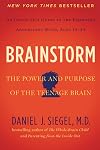
Brainstorm: The Power and Purpose of the Teenage Brain
by Daniel J. Siegel
On This Page
Description
Between the ages of 12 and 24, the brain changes in important, and oftentimes maddening and challenging ways. In this book, the author, a psychiatrist busts a number of commonly held myths about adolescence. He shows that, if parents and teens can work together to form a deeper understanding of the brain science behind all the tumult, they will be able to turn conflict into connection and form a deeper understanding of one another. According to the author, during adolescence we learn show more important skills, such as how to leave home and enter the larger world, how to connect deeply with others, and how to safely experiment and take risks, thereby creating strategies for dealing with the world's increasingly complex problems. Here he presents an inside-out approach to focusing on how brain development affects our behavior and relationships. Drawing on important new research in the field of interpersonal neurobiology, he explores exciting ways in which understanding how the brain functions can improve the lives of adolescents, making their relationships more fulfilling and less lonely and distressing on both sides of the generational divide. show lessTags
Recommendations






Member Reviews
A friend recommended another book by Daniel Siegel called Mindsight, but my library didn't have that on audio so I picked this up instead. Brainstorm turned out to be a tour de force of psychology in its own right, showing how the adolescent mind and brain work, and why, and drawing valuable lessons for the adult mind as well. Siegel covers a lot of territory, and in quite a bit of depth, and most of the material is first rate.
I particularly appreciated his discussion of the importance of integration, both in the brain and the mind, and even in our interpersonal relationships. He did take it a bit far in his conclusion with his concept of "MWe", but he does qualify it somewhat in response to a student's objection, and most of the show more material is so good that I can let it slide with only this slight demur. I will definitely be picking up Mindsight now.
http://www.amazon.com/review/R31SQHZL7FZ13V show less
I particularly appreciated his discussion of the importance of integration, both in the brain and the mind, and even in our interpersonal relationships. He did take it a bit far in his conclusion with his concept of "MWe", but he does qualify it somewhat in response to a student's objection, and most of the show more material is so good that I can let it slide with only this slight demur. I will definitely be picking up Mindsight now.
http://www.amazon.com/review/R31SQHZL7FZ13V show less
This book was recommended to me to help me get some better insight into the teenage mind, and in that regard, it did its job well. In fact, the third part of the book was likely the most helpful. Like other reviews, I found it took a while to actually get to the meat of the issues, and I was hoping for a little more on what the average parent can do specifically to cope with teens going through this stage of life. The examples helped put things in perspective a bit, but on the other hand, I couldn't help thinking, as I always have, that a lot of dealing with the teenage mind is garnering the patience and control to simply wait it out. I didn't necessarily need a book to tell me that.
Firstly and as usual, I received this book for the ripe sum of nothing via a giveaway, this time from Shelf Awareness. Despite that kind consideration from all involved my candid opinions follow below. To extend the preamble a bit, this book wasn't quite what I expected. Because of that I'm going to keep the value judgments to a minimum and instead just try to describe what the book tries to be. It's up to you whether it's what you want to be reading or not. I just make with the descriptions.
What I expected out of this book was something rather harder and more rooted in science. The book jacket says it's based on the latest research and I have no doubt that's the case but none of that research seems to have made its way directly into show more the book. Instead what you have is very soft and results-based approach to the topic. So if you're expecting data on brain chemistry changes through the adolescent years then, like me, you'll likely be disappointed. Instead you'll get instruction through analogy with concepts like "Mindsight" and the "Wheel of Awareness". This all seemed a bit soft to me but I suspect that for the majority of the population this sort of 'softness' is actually a ringing endorsement. Siegel has made a decidedly complex topic easily readable and provides parents with the tools they need to deal with a historically difficult period of parenthood.
Even more usefully, the doctor doesn't just dole out information but provides mental exercises the reader can perform to help internalize the lesson being taught and make it easier to implement personal changes. His text is also filled with abundant anecdotes from his own practice to reinforce the idea that the situations parents face are far from unique and have been dealt with successfully in the past. All in all this is an exceptionally well-balanced book unless you're looking for something a bit more dense and scientific. show less
What I expected out of this book was something rather harder and more rooted in science. The book jacket says it's based on the latest research and I have no doubt that's the case but none of that research seems to have made its way directly into show more the book. Instead what you have is very soft and results-based approach to the topic. So if you're expecting data on brain chemistry changes through the adolescent years then, like me, you'll likely be disappointed. Instead you'll get instruction through analogy with concepts like "Mindsight" and the "Wheel of Awareness". This all seemed a bit soft to me but I suspect that for the majority of the population this sort of 'softness' is actually a ringing endorsement. Siegel has made a decidedly complex topic easily readable and provides parents with the tools they need to deal with a historically difficult period of parenthood.
Even more usefully, the doctor doesn't just dole out information but provides mental exercises the reader can perform to help internalize the lesson being taught and make it easier to implement personal changes. His text is also filled with abundant anecdotes from his own practice to reinforce the idea that the situations parents face are far from unique and have been dealt with successfully in the past. All in all this is an exceptionally well-balanced book unless you're looking for something a bit more dense and scientific. show less
Stylistically, difficult to read. Great content, could have been covered in 50 pages though.
Blah. The author uses many words to convey some pretty simple and much previously covered thoughts and ideas. The message is basically "reflect, meditate and connect" along with some acronym-powered tools and exercises to accomplish that. You can probably find a 2000 word blog post somewhere that is just as helpful as this 300 page book.
Neuroscience based parenting guide. Brainstorm refers to the explosive brain growth teenagers experience. The rapid growth of brain wiring is followed by severe "pruning", the dying off of unused neural wires. New neural structures which hold newly learned information die off if they don't get reinforced.
Entre los 12 y los 24 años el cerebro se transforma de manera decisiva y, con frecuencia, complicada. En Tormenta cerebral Daniel J. Siegel desmantela una serie de mitos populares sobre la adolescencia, por ejemplo, que es una simple fase de «inmadurez» llena de comportamientos a menudo «enloquecidos, para descubrir cómo, en realidad, es una etapa trascendental de nuestras vidas a la hora de trazar la trayectoria del adulto que acabaremos siendo. Basándose en sólidas investigaciones recientes en el campo de la neurobiología interpersonal, explora emocionantes caminos en los que entender cómo funciona el cerebro puede mejorar las vidas de los adolescentes y hacer sus relaciones más satisfactorias y menos solitarias y show more perturbadoras a ambos lados de la brecha generacional. show less
May 13, 2019Spanish
Members
- Recently Added By
Lists

Career
86 works; 1 member

Books parents
30 works; 1 member
Author Information

Daniel J. Siegel was born on September 2, 1957. He is a clinical professor of psychiatry at the UCLA School of Medicine and executive director of the Mindsight Institute. He received a medical degree from Harvard Medical School and his post-graduate medical education at UCLA. His training is in pediatrics and child, adolescent, and adult show more psychiatry. Siegel was the recipient of the UCLA psychiatry department's teaching award and several honorary fellowships for his work as director of UCLA's training program in child psychiatry and the Infant and Preschool Service at UCLA. He is the author of several books on parenting and child development including The Mindful Brain: Reflection and Attunement in the Cultivation of Well-Being, The Developing Mind: Toward a Neurobiology of Interpersonal Experience, Brainstorm: The Power and Purpose of the Teenage Brain, and Parenting from the Inside Out, which he co-wrote with Mary Hartzell. Siegel is known as a mindfulness expert and for his work developing the field of Interpersonal Neurobiology which is an interdisciplinary view of life experience. He is the author of Aware: The Science and Practice of Presence--The Groundbreaking Meditation Practice. (Bowker Author Biography) show less
Awards and Honors
Common Knowledge
- Canonical DDC/MDS
- 155.5
Classifications
Statistics
- Members
- 574
- Popularity
- 51,495
- Reviews
- 7
- Rating
- (3.72)
- Languages
- 10 — English, Estonian, Finnish, French, Italian, Polish, Portuguese, Slovenian, Spanish, Turkish
- Media
- Paper, Audiobook, Ebook
- ISBNs
- 27
- UPCs
- 1
- ASINs
- 4