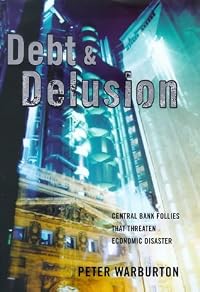
Debt and Delusion: Central Bank Follies That Threaten Economic Disaster
by Peter Warburton
On This Page
Description
Warburton examines the economic timebomb created by unchecked credit expansion, in this book. The potential havoc it could wreak in the global economies and our personal finances is described here as well.Tags
Recommendations


















Member Reviews
How have the American and European economies managed to combine a 30 year boom with low interest rates and a tame money supply?
In this excellent book, Peter Warburton convincingly shows that massive asset price inflation ( - not consumer price inflation) has been funded by corporate and government bond issues on an unprecedented scale. Private individuals are also heavy borrowers as interest rates have fallen and bank deposits provide low returns in comparison to speculative investments in stocks and property.
He wrote the book in 1999 and identifies various scenarios under which the debt mountain could unwind, leading to falling bond prices and rising interest rates.
In fact two of his scenarios have come to pass, namely loan quality show more problems in mortgage backed securities causing a seizure in the credit markets, and the collapse of property lending in the face of falling collateral values. However, in both cases, governments chose to provide liquidity and protect creditors (bondholders) from their bad investments.
Following the argument of the book, continual low interest rate bond issuance leads to repeated boom and bust asset bubbles until it becomes impossible to refinance the astronomic level of debt. At this point we get default or fast inflation (repayment in devalued currency).
In theory, governments and citizens could stop the process and settle down to deflation, debt reduction and many years of high unemployment, but this is more of a political question. show less
In this excellent book, Peter Warburton convincingly shows that massive asset price inflation ( - not consumer price inflation) has been funded by corporate and government bond issues on an unprecedented scale. Private individuals are also heavy borrowers as interest rates have fallen and bank deposits provide low returns in comparison to speculative investments in stocks and property.
He wrote the book in 1999 and identifies various scenarios under which the debt mountain could unwind, leading to falling bond prices and rising interest rates.
In fact two of his scenarios have come to pass, namely loan quality show more problems in mortgage backed securities causing a seizure in the credit markets, and the collapse of property lending in the face of falling collateral values. However, in both cases, governments chose to provide liquidity and protect creditors (bondholders) from their bad investments.
Following the argument of the book, continual low interest rate bond issuance leads to repeated boom and bust asset bubbles until it becomes impossible to refinance the astronomic level of debt. At this point we get default or fast inflation (repayment in devalued currency).
In theory, governments and citizens could stop the process and settle down to deflation, debt reduction and many years of high unemployment, but this is more of a political question. show less
Ratings
Members
- Recently Added By
Author Information
2 Works 30 Members
Common Knowledge
- Canonical title
- Debt and Delusion: Central Bank Follies That Threaten Economic Disaster
Classifications
Statistics
- Members
- 29
- Popularity
- 949,738
- Reviews
- 1
- Rating
- (4.33)
- Languages
- English, German
- Media
- Paper
- ISBNs
- 4