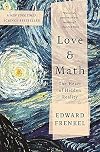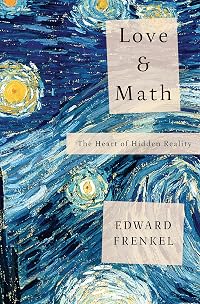
Love and Math: The Heart of Hidden Reality
by Edward Frenkel
On This Page
Description
"Love and Math tells the two intertwined stories of mathematics and the adventure of one man in learning it. The result is a story about how he became one of the twenty-first century's leading mathematicians, working on one of the biggest ideas to come out of mathematics in the last 50 years: the Langlands Program. As Frenkel proves, a mathematical formula can be as elegant and beautiful as a painting, a poem, or a piece of music. And the process of creating new mathematics is just that, an show more artistic pursuit--a deeply personal experience, which requires passion, dedication, and love. In Love and Math, Frenkel shows readers the aesthetic--and the truly powerful--side of mathematics, and enables appreciation of the field even from those who have long been terrified by it."-- show lessTags
Recommendations

Member Reviews
I picked this book up at the library because I have been interested in pure and applied math for a long time now, although I was unacquainted with the author. He has two main subjects he wanted to convey in the book. The first one the story of how hard he had to struggle in the old Soviet system with its semi-official anti-semitism when it came to career advancement and which ended up forcing him to leave just at the time when the country was opening up to the West under Gorbachev. He had some references to mathematical ideas in this section, to provide background on the kinds of problems he was trying to solve, but at a relatively popular level. The second subject begins when he starts to work as a professional full-time mathematician show more in the West pursuing the Langlands program of unifying three far-flung fields in math along with the allied field of quantum physics. This was quite a bit more technical. At the very end, he talks about a couple of collaborative art projects he has been involved with. He wrote for a film project giving the proper context for the word "Love" in title of the book: which refers not to the ordinary emotion between people but the feeling a mathematician has for the beauty of mathematical truths.
I thought the book was interesting, though it seemed odd to think that it would be of widespread appeal with the rather lengthy technical sections with many pages of footnotes. He steers well clear from talking much about his domestic life with his parents and at home during his marriage, preferring to concentrate on what he did professionally. I didn't really know anything about the Langlands program as such before I read this book but had read with interest something about recent theorems connecting number theory, harmonic analysis, and Riemannian surfaces, so this was a good introduction. show less
I thought the book was interesting, though it seemed odd to think that it would be of widespread appeal with the rather lengthy technical sections with many pages of footnotes. He steers well clear from talking much about his domestic life with his parents and at home during his marriage, preferring to concentrate on what he did professionally. I didn't really know anything about the Langlands program as such before I read this book but had read with interest something about recent theorems connecting number theory, harmonic analysis, and Riemannian surfaces, so this was a good introduction. show less
This book had a split personality. It was a mix of history and insights on the author's journey to becoming a world-class mathematician and solving difficult mathematical issues. However, much of it was was incomprehensible and the author does a poor job explaining the math that he is obsessed with. He uses words in atypical ways with no explanation and the reader is left puzzled. For example, what is "gauge theory" and why the word "gauge"? Why "Program" in "Langlands Program"? Some stuff is well-explained (string theory) but much isn't. I was a math major but I have trouble believing that more than a very limited # of mathematicians in the entire world can understand everything in this book - and they surely aren't bothering to read show more this book as they already know the material.
As a computer scientist, I was also disappointed in the passing references to the value of his field in secure banking. He says this several times but with no explanation leading me to believe he's overinflating a claim, doesn't understand it, or can't explain it. Another passing reference to Haskell, again with no explanation, was a disappointment.
In summary, I recommend the early chapters of the book. The rest is a waste of time. show less
As a computer scientist, I was also disappointed in the passing references to the value of his field in secure banking. He says this several times but with no explanation leading me to believe he's overinflating a claim, doesn't understand it, or can't explain it. Another passing reference to Haskell, again with no explanation, was a disappointment.
In summary, I recommend the early chapters of the book. The rest is a waste of time. show less
I very much enjoyed Frenkel's book, but although I am eager to re-read it I am intent on doing so using a paper copy: whether it was due to poor Kindle formatting or my own (lack of) familiarity with how Kindle deals with foot/end-notes, reading the notes was a chore and I ultimately gave up on it -- and without reading the notes, understanding the mathematical side of this was a losing battle.
Frenkel's English is very very good, but the occasional lapse made me return to my oft-visited complaint: where was the copy editor? Do such people even exist any more? Are they just too expensive?
Frenkel's English is very very good, but the occasional lapse made me return to my oft-visited complaint: where was the copy editor? Do such people even exist any more? Are they just too expensive?
Aside from the autobiographical parts, an attempted popularization of group theory and its role in the Langlands Program for connecting disparate branches of mathematics. Especially when the extensive endnotes are taken into account, I think the author underestimates how difficult the many abstract concepts (Kac-Moody algebras, automorphic sheaves, dual toric fibrations, etc) will be for lay readers. (Or maybe it's just that my brain is the only one in the world (?) congenitally incapable of appreciating the glories of group theory.) Well worth reading, as long as one doesn't start out expecting to understand all the technicalities.
Frenkel, a world-renowned mathematician, combines his autobiography with an overview of his work on the Langlands Program, a unified theory of mathematics.
The author, a Russian Jew, has had a remarkable life, first trying to educate himself while being blocked by Soviet prejudice from getting an advanced degree despite his brilliance, and then, after Perestroika, working and teaching in the U.S., to which he was invited by Harvard at age 20. The autobiography, which is scattered throughout the book, is quite amazing. The mathematical explanations, though, are very tough going and far more difficult than I had the energy (or intention) to work through. I read this for the biographical component and just skipped the math, and his is show more quite a story, well-worth the read. show less
The author, a Russian Jew, has had a remarkable life, first trying to educate himself while being blocked by Soviet prejudice from getting an advanced degree despite his brilliance, and then, after Perestroika, working and teaching in the U.S., to which he was invited by Harvard at age 20. The autobiography, which is scattered throughout the book, is quite amazing. The mathematical explanations, though, are very tough going and far more difficult than I had the energy (or intention) to work through. I read this for the biographical component and just skipped the math, and his is show more quite a story, well-worth the read. show less
It is hard for me decide what is more infectious : Frenkel's passion for the subject matter or the over-arching implications of the Langlands program. A fantastic book. Part of me wants to believe that this book would enter the public imagination the way, say, Feynman's QED might have. But, the reviews here suggest that the mathematical parts of the book might not have been as transparent as Frenkel intended. So, one will have to wait & see ...
I echo the remarks of the other reviewers concerning the math portions of the book. As well meaning as the author's intention may have been to make areas of math accessible, I'm afraid the technical sections of the book were pitched at too high a level for the average reader such as myself. I enjoyed the autobiographical portions and his ideas on the nature of mathematical reality, but unless you have a very strong math background large portions of this book will be lost to you, with or without explanatory notes.
Members
- Recently Added By
Lists

HS Mathematics class library
79 works; 6 members

The r/AskScience Reading List
159 works; 3 members
Author Information

5 Works 600 Members
Edward Frenkel is a professor of mathematics at the University of California, Berkeley, member of the American Academy of Arts and Sciences, and winner of the Hermann Weyl Prize. He lives in Berkeley, California.
Awards and Honors
Awards
Distinctions
Classifications
Statistics
- Members
- 584
- Popularity
- 50,359
- Reviews
- 13
- Rating
- (3.57)
- Languages
- 10 — Czech, Dutch, English, French, German, Greek, Italian, Polish, Portuguese, Spanish
- Media
- Paper, Audiobook, Ebook
- ISBNs
- 21
- ASINs
- 6