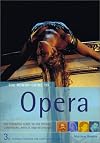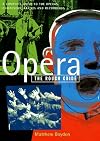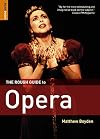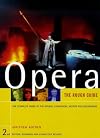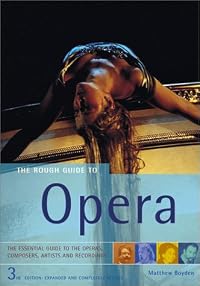
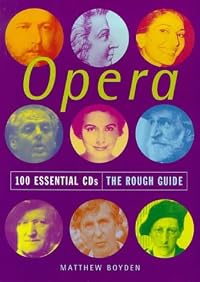
The Rough Guide to Opera
by Matthew Boyden
Rough Guide Music Reference, Rough Guides (Music Reference — )
On This Page
Description
Sketches of opera composers, opera synopsises, and CD reviews.Tags
Recommendations














Member Recommendations
Member Reviews
As an entry into the Rough Guide canon, Opera: The Rough Guide offers a slightly breezy approach to the art form, along with a touch of attitude and a tendency toward British idioms. Like its sibling Classical Music on CD: The Rough Guide, it gives brief biographies of composers, plot outlines of significant works, and recommendations for which recordings are best. Oddly, the book takes a number of strange stabs at politically incorrect figures of the past--comparing Wagner to Hitler because of their shared vegetarian eating habits--and makes some downright erroneous statements: Maria Callas was never a student of Rosa Ponselle at all, much less her "most famous student."
Most of the recordings recommended are fine, though there is a show more limit on how many compact discs are suggested for any given opera (the maximum seems to be three each), and the authors have a strong prejudice in favor of older recordings. These have the advantage of being generally cheaper and often offer great singing, but the sound is usually far superior on more recent releases, and accurate chorus work is a rarity on many vintage sets. Bearing that in mind, this is a useful volume for someone building an opera collection or learning more about the art form. It might be useful to consult this volume, along with other guides, before investing a lot of money in opera CDs.
Opera has countless loyal fans for whom the Rough Guide will be a beacon for its modern, spirited coverage of the composers, artists, recordings and the operas themselves. This is the definitive handbook on the subject, spanning nearly four centuries from Monteverdi to the avant-garde. Includes biographical sketches on composers, incisive accounts of hundreds of operas and a who's who of the finest singers on record.
The combination of music and drama is a thrillingly potent mix, but opera remains off-putting for too many people. Partly this is due to an incorrect attribution of social exclusivity, especially in the English-speaking world, but also the sheer diversity of the music. Thousands of operas have been written since Monteverdi and his colleagues pioneered the genre some four hundred years ago, and though many of these are no longer performed the repertoire can still seem daunting. Opera-house schedules place late-Renaissance pageants alongside Italian melodramas or modern psychodramas, and the situation is even more perplexing when you look at the CD catalogue, where you'll find more than two hundred complete recordings of Verdi's operas, for example, and around thirty of La traviata alone. Whether you're new to opera or are already familiar with many of its masterpieces, THE ROUGH GUIDE TO OPERA is a good guide through this mass of music, providing concise biographies of all the significant composers, incisive discussions of their major works, and detailed surveys of the recordings.
The entire history of opera is covered here, from its beginnings in late-Renaissance Italy to the latest exciting work from contemporary names such as John Adams and Judith Weir. Mozart, Wagner, Verdi, Puccini, Strauss and all the other greats are discussed in depth, as are lesser-known figures from Auber to Zimmerman. Of course, a completely comprehensive guide to opera, even one that restricted itself to opera on CD, would be impossibly unwieldy, so peripheral figures have been excluded, and they have been selective with the output of many composers, concentrating on the key operas. Gaetano Donizetti, for example, wrote more than seventy operas, but the focus is on the ones you're likeliest to encounter either on disc or on stage. Similarly, they pick up Strauss's career with Salome, because it's this opera, his third, that marks the beginning of the work that makes him one of the most successful opera composers of the first half of the twentieth century. show less
Most of the recordings recommended are fine, though there is a show more limit on how many compact discs are suggested for any given opera (the maximum seems to be three each), and the authors have a strong prejudice in favor of older recordings. These have the advantage of being generally cheaper and often offer great singing, but the sound is usually far superior on more recent releases, and accurate chorus work is a rarity on many vintage sets. Bearing that in mind, this is a useful volume for someone building an opera collection or learning more about the art form. It might be useful to consult this volume, along with other guides, before investing a lot of money in opera CDs.
Opera has countless loyal fans for whom the Rough Guide will be a beacon for its modern, spirited coverage of the composers, artists, recordings and the operas themselves. This is the definitive handbook on the subject, spanning nearly four centuries from Monteverdi to the avant-garde. Includes biographical sketches on composers, incisive accounts of hundreds of operas and a who's who of the finest singers on record.
The combination of music and drama is a thrillingly potent mix, but opera remains off-putting for too many people. Partly this is due to an incorrect attribution of social exclusivity, especially in the English-speaking world, but also the sheer diversity of the music. Thousands of operas have been written since Monteverdi and his colleagues pioneered the genre some four hundred years ago, and though many of these are no longer performed the repertoire can still seem daunting. Opera-house schedules place late-Renaissance pageants alongside Italian melodramas or modern psychodramas, and the situation is even more perplexing when you look at the CD catalogue, where you'll find more than two hundred complete recordings of Verdi's operas, for example, and around thirty of La traviata alone. Whether you're new to opera or are already familiar with many of its masterpieces, THE ROUGH GUIDE TO OPERA is a good guide through this mass of music, providing concise biographies of all the significant composers, incisive discussions of their major works, and detailed surveys of the recordings.
The entire history of opera is covered here, from its beginnings in late-Renaissance Italy to the latest exciting work from contemporary names such as John Adams and Judith Weir. Mozart, Wagner, Verdi, Puccini, Strauss and all the other greats are discussed in depth, as are lesser-known figures from Auber to Zimmerman. Of course, a completely comprehensive guide to opera, even one that restricted itself to opera on CD, would be impossibly unwieldy, so peripheral figures have been excluded, and they have been selective with the output of many composers, concentrating on the key operas. Gaetano Donizetti, for example, wrote more than seventy operas, but the focus is on the ones you're likeliest to encounter either on disc or on stage. Similarly, they pick up Strauss's career with Salome, because it's this opera, his third, that marks the beginning of the work that makes him one of the most successful opera composers of the first half of the twentieth century. show less
Ratings
Members
- Recently Added By
Author Information
6+ Works 305 Members
Matthew Boyden is a musicologist and writer on music. He has been editor of the classical record magazine CD Review and is the author of the Rough Guide to Opera. He has broadcast in England on Radio 3, Talk Radio, the World Service and Channel Four and is a trustee of the John Ogdon Foundation. He lives in a Wesleyan Chapel in Cornwall, England
Series


Common Knowledge
- Canonical title
- The Rough Guide to Opera
- Original language
- English
Classifications
Statistics
- Members
- 237
- Popularity
- 136,812
- Reviews
- 1
- Rating
- (4.08)
- Languages
- English, Hungarian
- Media
- Paper
- ISBNs
- 5