Families and Faith: How Religion is Passed Down across Generations
by Vern L. Bengtson
On This Page
Description
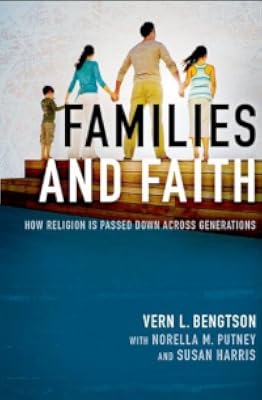
Few things are more likely to cause heartache for devout parents than seeing their child leave the faith. And it seems, from media portrayals, that this is happening more and more frequently. But is religious change between generations common? How does religion get passed down from one generation to the next? 'Families and Faith' seeks to answer these questions and many more.Tags
Recommendations





















Member Reviews
This isn't the easiest book to read - very academic, based on 35 years of surveys and study of a group of families in California. But it has some very comforting and helpful things to say in regards to the influence of families in transmitting religion to their children. Families are more influencial than they may think and it discusses traits of those who pass faith to next generations successfully. It also stresses the importance of grandparents and great-grandparents, who are growing in influence. The book was surprised by that. Churches need to focus on strengthening families - less on generation-specific programs and more on activities that will promote the growth of the family together. Very helpful book.
B&C, 3-4/14 review entitled Patience May Be Rewarded by R. Stephen Warner of Vern L. Bengston's Families and Faith--how religion is passed down across generations (KH: effective passing on of family heritage)
The majority of parents and their young adult children share the same religious identities. Despite the influence of peers, schools, and media, parents are still the strongest influence on their children's religious identities. Grandparents matter too, and because of increased longevity, the importance of grandparents as religious models and tutors for their grandchildren seems likely only to increase. These outcomes are not automatic—intergenerational continuity varies by religious tradition, religious transmission must be worked show more at, divorce and intermarriage make it much harder, and missteps are common even under propitious conditions—but the chances of success are better than the authors (and we, their readers, they say) have been led to expect.
The interviews flesh out the quantitative finding that quality of relationship between parents and children—especially the emotional warmth, or lack thereof, that children experience from their fathers—matters more than does the level of piety of parents. Emotional solidarity, consistent role modeling, and openness to adolescent and young adult experimentation are ingredients in successful intergenerational religious transmission.
The authors identify two particular patterns of unsuccessful transmission. Judgmental, authoritarian parenting is likely to produce what the authors call religious "rebels," many of whom reject religion altogether. Distant, inconsistent parenting may lead children to become religious "zealots," offspring who are more religious than their parents. With the benefit of their long-term hindsight, the authors identify a pattern whereby zealots, as they become parents, produce rebels by "shoving religion down my throat," as grown children recall. On the other hand, the long-term patience of supportive parents may be vindicated when once-rebellious offspring return as "prodigals." Bengtson, having returned to church life decades after he left, counts himself among their number.
But one surprise is the intergenerational continuity of a "no religion" identity. Perhaps because the sample was initially drawn in relatively irreligious California, already in 1970 11 percent of the LSOG interviewees claimed to have no religion, a figure that increased to 36 percent by 2005. Initially, these "nones" were likely to stem from Mainline Protestant families. But by 2005, nearly 60 percent of young adult nones had inherited their lack of religion. For some of them—memorably presented in family case studies—"no religion" is a distinct tradition.
That bias does not diminish the value of Families and Faith for the primary audience the authors address—parents and practitioners, the kind of people who read this magazine. They will be edified to know that, although there are no guarantees, they are not powerless to bring up their children in their faith. Mormons, evangelicals, and Jews, who are miles apart theologically, have similar rates of success. Affection, consistency (you have to walk the walk), and intentionality (you have to work at it) matter more than doctrine. Strictness often backfires. Patience may be rewarded.
R. Stephen Warner is professor emeritus of sociology at the University of Illinois at Chicago. show less
The majority of parents and their young adult children share the same religious identities. Despite the influence of peers, schools, and media, parents are still the strongest influence on their children's religious identities. Grandparents matter too, and because of increased longevity, the importance of grandparents as religious models and tutors for their grandchildren seems likely only to increase. These outcomes are not automatic—intergenerational continuity varies by religious tradition, religious transmission must be worked show more at, divorce and intermarriage make it much harder, and missteps are common even under propitious conditions—but the chances of success are better than the authors (and we, their readers, they say) have been led to expect.
The interviews flesh out the quantitative finding that quality of relationship between parents and children—especially the emotional warmth, or lack thereof, that children experience from their fathers—matters more than does the level of piety of parents. Emotional solidarity, consistent role modeling, and openness to adolescent and young adult experimentation are ingredients in successful intergenerational religious transmission.
The authors identify two particular patterns of unsuccessful transmission. Judgmental, authoritarian parenting is likely to produce what the authors call religious "rebels," many of whom reject religion altogether. Distant, inconsistent parenting may lead children to become religious "zealots," offspring who are more religious than their parents. With the benefit of their long-term hindsight, the authors identify a pattern whereby zealots, as they become parents, produce rebels by "shoving religion down my throat," as grown children recall. On the other hand, the long-term patience of supportive parents may be vindicated when once-rebellious offspring return as "prodigals." Bengtson, having returned to church life decades after he left, counts himself among their number.
But one surprise is the intergenerational continuity of a "no religion" identity. Perhaps because the sample was initially drawn in relatively irreligious California, already in 1970 11 percent of the LSOG interviewees claimed to have no religion, a figure that increased to 36 percent by 2005. Initially, these "nones" were likely to stem from Mainline Protestant families. But by 2005, nearly 60 percent of young adult nones had inherited their lack of religion. For some of them—memorably presented in family case studies—"no religion" is a distinct tradition.
That bias does not diminish the value of Families and Faith for the primary audience the authors address—parents and practitioners, the kind of people who read this magazine. They will be edified to know that, although there are no guarantees, they are not powerless to bring up their children in their faith. Mormons, evangelicals, and Jews, who are miles apart theologically, have similar rates of success. Affection, consistency (you have to walk the walk), and intentionality (you have to work at it) matter more than doctrine. Strictness often backfires. Patience may be rewarded.
R. Stephen Warner is professor emeritus of sociology at the University of Illinois at Chicago. show less
Ratings
Members
- Recently Added By
Lists

Youth: Spirituality
115 works; 1 member
Author Information
9 Works 130 Members
All Editions
Awards and Honors
Classifications
Statistics
- Members
- 56
- Popularity
- 548,268
- Reviews
- 2
- Rating
- (3.33)
- Languages
- English
- Media
- Paper, Ebook
- ISBNs
- 5
- ASINs
- 1