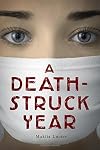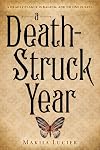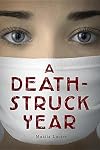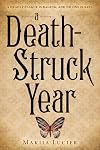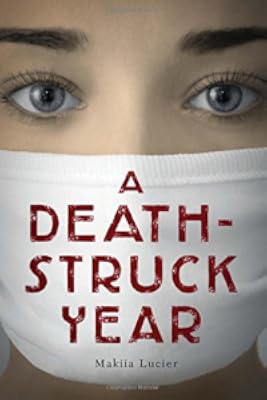
A Death-Struck Year
by Makiia Lucier
On This Page
Description
For Cleo Berry, the people dying of the Spanish Influenza in cities like New York and Philadelphia may as well be in another country—that's how far away they feel from the safety of Portland, Oregon. And then cases start being reported in the Pacific Northwest. Schools, churches, and theaters shut down. The entire city is thrust into survival mode—and into a panic. Headstrong and foolish, seventeen-year-old Cleo is determined to ride out the pandemic in the comfort of her own home, show more rather than in her quarantined boarding school dorms. But when the Red Cross pleads for volunteers, she can't ignore the call. As Cleo struggles to navigate the world around her, she is surprised by how much she finds herself caring about near-strangers. Strangers like Edmund, a handsome medical student and war vet. Strangers who could be gone tomorrow. And as the bodies begin to pile up, Cleo can't help but wonder: when will her own luck run out?Riveting and well-researched, A Death-Struck Year is based on the real-life pandemic considered the most devastating in recorded world history. Readers will be captured by the suspenseful storytelling and the lingering questions of: what would I do for a neighbor? At what risk to myself?
An afterword explains the Spanish flu phenomenon, placing it within the historical context of the early 20th century. Source notes are extensive and interesting.
A Spring 2014 Indies Introduce New Voices selection
. show less
Tags
Recommendations




Member Reviews
This book surprised me, actually. It started out a bit slow, enough that I considered initially dropping it. But once the story got rolling, it was like a boulder going down a mountainside. The stakes got higher and higher as time went on and the horrible world of a pandemic sweeping society kept me on the edge of my seat. I'm so glad I kept with it!
The real treat in this novel is the main character. We get to see some real growth in her as a maturing woman who can't stop doing what she sees as right. I can see why the slow part in the beginning, illustrating her time in school and establishing her as a teenager, was necessary. It just makes the stark changes in her world and character all the more vivid as Cleo joins the Red Cross and show more does her part for stricken Portland.
The historical details were something else. From snippets on Victorian society to the devastating effects the illness had on daily life as well as one's trust in family and neighbors in such circumstances, this scary world was amazingly vivid. I enjoyed how the author showed us the effects the disease had on society as a whole and the intimate details on whole families wiped out or the effect lone survivors had while everyone else was sick.
The only thing I wished the author might have devoted more time on was Edmund's and Cleo's relationship. For a book being touted as a "romance", this book had a very lack luster one. As more than one of my fellow reviewers have pointed out, it's more a strong friend connection with perks than a timeless and all encompassing love connection. I could have wished for more development in that arena.
But as a whole, this book was a wonderful read. Full of wonderful historical details and with a main character that I grew to love as she matured, I highly recommend it to anyone looking for a touching and horrifying portrayal of Spanish Flu-gripped America. show less
The real treat in this novel is the main character. We get to see some real growth in her as a maturing woman who can't stop doing what she sees as right. I can see why the slow part in the beginning, illustrating her time in school and establishing her as a teenager, was necessary. It just makes the stark changes in her world and character all the more vivid as Cleo joins the Red Cross and show more does her part for stricken Portland.
The historical details were something else. From snippets on Victorian society to the devastating effects the illness had on daily life as well as one's trust in family and neighbors in such circumstances, this scary world was amazingly vivid. I enjoyed how the author showed us the effects the disease had on society as a whole and the intimate details on whole families wiped out or the effect lone survivors had while everyone else was sick.
The only thing I wished the author might have devoted more time on was Edmund's and Cleo's relationship. For a book being touted as a "romance", this book had a very lack luster one. As more than one of my fellow reviewers have pointed out, it's more a strong friend connection with perks than a timeless and all encompassing love connection. I could have wished for more development in that arena.
But as a whole, this book was a wonderful read. Full of wonderful historical details and with a main character that I grew to love as she matured, I highly recommend it to anyone looking for a touching and horrifying portrayal of Spanish Flu-gripped America. show less
I read my electronic review copy of A Death-Struck Year this winter while I, like a great many other people, was suffering from this year's round of flu. I managed to avoid spiraling hypochondria, but reading about the 1918 flu epidemic while dealing with this year's version of the virus brought things home.
A Death-Struck Year is a coming-of-age novel, written for young adults, but with plenty of substance, so I'd recommend it for adult readers as well. Seventeen-year-old Cleo Berry lives in Portland, Oregon, and is being raised by her significantly older brother and his wife, since she was orphaned as a child. Her guardians take the train on a business/pleasure trip, and Cleo becomes a temporary border at the school she usually attends show more as a day pupil.
People on the west coast have been reading about the "Spanish" Flu (it probably originated in Kansas, despite the name), which is terrifying, but seems distant. That distance collapses as several soldiers with the illness arrive at an army base outside of Portland and the disease quickly spreads into the population at large. Public gatherings and unnecessary travel are cancelled; Cleo's guardians cannot return immediately, so she's quarantined at her school. Until, that is, she decides she'd rather face the terror of the flu in her own home, even if it means living alone during an epidemic, than remain at her school.
The rest of the action of the book results from this first decision. Cleo sees a call in the newspaper for female volunteers to nurse flu victims and, unaware of what she's about to get herself into, steps up. Her education—in life, mortality, courage, class, even reproductive rights—is swift and shaking.
This book contains a few tropes common to its genre: Cleo is well-off, knows how to drive a car, and has access to her brother's vehicle; there's the inevitable love interest; we also see scene after scene in which Cleo faces up to challenges of the moment that threaten to derail her. The thing of it is, these tropes work. Cleo's experiences feel genuine and vivid, even if they aren't novel for the genre. Her independence and wealth are counterbalanced by a strong awareness of what's expected of a girl of her station. The love interest (this isn't really a spoiler, but stop here if you want) doesn't end in a fairy-tale match transforming her life; Cleo remains a schoolgirl, but one whose horizons have broadened.
Makiia Lucien appears to have done her research well. She knows the pace at which the disease coursed through Portland, the emergency measures that were put into place during the epidemic, and the technology of the time (could you check the gas level on a tin Lizzie?). The etiology of the disease is rendered in appropriate detail. We see, again and again, a clear picture of how the epidemic would have been experienced by a young woman on her own for the first time.
When you're hungry for story, this is a great book to turn to. The narrative arc is clear and sure, the central character is engaging, and events are both riveting and plausible. show less
A Death-Struck Year is a coming-of-age novel, written for young adults, but with plenty of substance, so I'd recommend it for adult readers as well. Seventeen-year-old Cleo Berry lives in Portland, Oregon, and is being raised by her significantly older brother and his wife, since she was orphaned as a child. Her guardians take the train on a business/pleasure trip, and Cleo becomes a temporary border at the school she usually attends show more as a day pupil.
People on the west coast have been reading about the "Spanish" Flu (it probably originated in Kansas, despite the name), which is terrifying, but seems distant. That distance collapses as several soldiers with the illness arrive at an army base outside of Portland and the disease quickly spreads into the population at large. Public gatherings and unnecessary travel are cancelled; Cleo's guardians cannot return immediately, so she's quarantined at her school. Until, that is, she decides she'd rather face the terror of the flu in her own home, even if it means living alone during an epidemic, than remain at her school.
The rest of the action of the book results from this first decision. Cleo sees a call in the newspaper for female volunteers to nurse flu victims and, unaware of what she's about to get herself into, steps up. Her education—in life, mortality, courage, class, even reproductive rights—is swift and shaking.
This book contains a few tropes common to its genre: Cleo is well-off, knows how to drive a car, and has access to her brother's vehicle; there's the inevitable love interest; we also see scene after scene in which Cleo faces up to challenges of the moment that threaten to derail her. The thing of it is, these tropes work. Cleo's experiences feel genuine and vivid, even if they aren't novel for the genre. Her independence and wealth are counterbalanced by a strong awareness of what's expected of a girl of her station. The love interest (this isn't really a spoiler, but stop here if you want) doesn't end in a fairy-tale match transforming her life; Cleo remains a schoolgirl, but one whose horizons have broadened.
Makiia Lucien appears to have done her research well. She knows the pace at which the disease coursed through Portland, the emergency measures that were put into place during the epidemic, and the technology of the time (could you check the gas level on a tin Lizzie?). The etiology of the disease is rendered in appropriate detail. We see, again and again, a clear picture of how the epidemic would have been experienced by a young woman on her own for the first time.
When you're hungry for story, this is a great book to turn to. The narrative arc is clear and sure, the central character is engaging, and events are both riveting and plausible. show less
Review first published on fefferbooks.com. A free advanced reader copy of this book was provided by HMH Books in exchange for an honest review. The review below is in no way influenced by this consideration.
A Death-Struck Year is Makiia Lucier's debut novel and I hate to say it, but it shows. I didn't dislike this book--far from it. I thought the plot was interesting, the characters were mostly well-done, and the setting was great. I just wanted a little...more.
Firstly: the characters. Cleo, the heroine, is lovely. She's brave, thoughtful, and compassionate, and stronger than she's aware. Hannah and Kate are particular high points, and I also enjoyed Jack and Lucy. Edmund, the romantic lead, had some nice moments, but this is one place show more where I felt like there was something lacking--I wanted more opportunity to get to know Edmund. I felt like our chance to get to know him was rushed, and I never really knew that much about him.
Which brings me to my second point: there's some insta-love happening here. Cleo and Edmund seem to fall for each other really quickly, without really any explanation why, and having only bumped into one another about twice. Once the relationship starts, it does have some nice developing scenes, but then it kind of gets abandoned when Lucier decides to finish the book. The whole romantic subplot just needed a little more fleshing out.
The ending of the book, on the whole, was really kind of abrupt. Lucier spends a great deal of time on atmosphere; the book takes place in Portland, Oregon in 1918, and there's a war on, in addition to the Spanish flu epidemic. The story centers around Cleo's decision to volunteer with the Red Cross, helping people who fall ill in a city that's caught off-guard by sweeping illness. Lucier paints an elaborate, colorful picture of the city in that time, and the people who fill it, and it's the book's strength. It's hard not to be swept up, a bit, in the story, despite the niggling plot holes and distractions. When things suddenly, anticlimactically wrap up, then, it's all sort of odd and empty-feeling, and certainly devoid of all the depth and color Lucier spent so much time on in the previous 250 pages. It's kind of a let down.
Finally, and this is extremely nit-picky, but: I've gotten to be accepting of the choppy, incomplete-sentence writing style so many writers tend to use nowadays as long as the story's being told from first person point-of-view, and it's a contemporary novel. It's conversational, so I get it. In fact, I get it so well, that it's started creeping into my own blog writing here and there. However, when the book is written from the point-of-view of an educated older teen in the very early 20th century, it just doesn't work. For as well-researched as everything else in this novel was, Cleo's incomplete speech patterns were completely anachronistic. That said, these instances were only occasional.
Overall, I did enjoy the story, here. A Death-Struck Year was an entertaining read, despite my gripes, and I think Makiia Lucier is a writer with promise. Historical fiction can be difficult to write, particularly for the YA market, and I think she captured the voice nicely. I'll be interested to see what Lucier comes up with next.
Completely clean in every way. Interesting historical premise. 3 stars.
A Death-Struck Year was released Tuesday and is on shelves now. Thanks to HMH Books and Edelweiss for the advanced review copy. show less
A Death-Struck Year is Makiia Lucier's debut novel and I hate to say it, but it shows. I didn't dislike this book--far from it. I thought the plot was interesting, the characters were mostly well-done, and the setting was great. I just wanted a little...more.
Firstly: the characters. Cleo, the heroine, is lovely. She's brave, thoughtful, and compassionate, and stronger than she's aware. Hannah and Kate are particular high points, and I also enjoyed Jack and Lucy. Edmund, the romantic lead, had some nice moments, but this is one place show more where I felt like there was something lacking--I wanted more opportunity to get to know Edmund. I felt like our chance to get to know him was rushed, and I never really knew that much about him.
Which brings me to my second point: there's some insta-love happening here. Cleo and Edmund seem to fall for each other really quickly, without really any explanation why, and having only bumped into one another about twice. Once the relationship starts, it does have some nice developing scenes, but then it kind of gets abandoned when Lucier decides to finish the book. The whole romantic subplot just needed a little more fleshing out.
The ending of the book, on the whole, was really kind of abrupt. Lucier spends a great deal of time on atmosphere; the book takes place in Portland, Oregon in 1918, and there's a war on, in addition to the Spanish flu epidemic. The story centers around Cleo's decision to volunteer with the Red Cross, helping people who fall ill in a city that's caught off-guard by sweeping illness. Lucier paints an elaborate, colorful picture of the city in that time, and the people who fill it, and it's the book's strength. It's hard not to be swept up, a bit, in the story, despite the niggling plot holes and distractions. When things suddenly, anticlimactically wrap up, then, it's all sort of odd and empty-feeling, and certainly devoid of all the depth and color Lucier spent so much time on in the previous 250 pages. It's kind of a let down.
Finally, and this is extremely nit-picky, but: I've gotten to be accepting of the choppy, incomplete-sentence writing style so many writers tend to use nowadays as long as the story's being told from first person point-of-view, and it's a contemporary novel. It's conversational, so I get it. In fact, I get it so well, that it's started creeping into my own blog writing here and there. However, when the book is written from the point-of-view of an educated older teen in the very early 20th century, it just doesn't work. For as well-researched as everything else in this novel was, Cleo's incomplete speech patterns were completely anachronistic. That said, these instances were only occasional.
Overall, I did enjoy the story, here. A Death-Struck Year was an entertaining read, despite my gripes, and I think Makiia Lucier is a writer with promise. Historical fiction can be difficult to write, particularly for the YA market, and I think she captured the voice nicely. I'll be interested to see what Lucier comes up with next.
Completely clean in every way. Interesting historical premise. 3 stars.
A Death-Struck Year was released Tuesday and is on shelves now. Thanks to HMH Books and Edelweiss for the advanced review copy. show less
Note: I received an advanced reading copy of this book in exchange for an honest review.
One of the things that make this an excellent young adult novel is that it addresses not knowing what to do with the rest of your life, an anxiety-inducing uncertainty for many teens today. In the beginning, Cleo agonizes over her lack of ambition compared to her friends. She has no plans, no dreams, no calling. By the end, the book’s message seems to be that you just need to take life one step at a time, do meaningful things that will help you mature and grow, and not worry so much about having rock-hard plans.
Overall, this novel was a great read. Cleo is an engaging, sympathetic, imperfect narrator and the supporting characters are likable and show more well developed. The writing is succinct, vivid and tugs the reader forward at a brisk pace with a few heart-skipping moments. There’s a little romance in the second half, but it’s very much an underlying part of the story and won’t diminish it for anyone disinclined toward romance. The Spanish Influenza setting makes for a horrific yet inspiring look at what a disease outbreak can do to a town of people—it brings out the worse in some, and the best in others. It was interesting to see what life was like during this specific time period. I’d recommend this book for anyone who enjoys historical fiction and coming-of-age novels. show less
One of the things that make this an excellent young adult novel is that it addresses not knowing what to do with the rest of your life, an anxiety-inducing uncertainty for many teens today. In the beginning, Cleo agonizes over her lack of ambition compared to her friends. She has no plans, no dreams, no calling. By the end, the book’s message seems to be that you just need to take life one step at a time, do meaningful things that will help you mature and grow, and not worry so much about having rock-hard plans.
Overall, this novel was a great read. Cleo is an engaging, sympathetic, imperfect narrator and the supporting characters are likable and show more well developed. The writing is succinct, vivid and tugs the reader forward at a brisk pace with a few heart-skipping moments. There’s a little romance in the second half, but it’s very much an underlying part of the story and won’t diminish it for anyone disinclined toward romance. The Spanish Influenza setting makes for a horrific yet inspiring look at what a disease outbreak can do to a town of people—it brings out the worse in some, and the best in others. It was interesting to see what life was like during this specific time period. I’d recommend this book for anyone who enjoys historical fiction and coming-of-age novels. show less
I read this while we were in the midst of the COVID-19 epidemic, and this one hit close to home. Interesting to read about Cleo's experiences during the influenza outbreak in Portland. She leaves her boarding school after the city closes down and she ends up home alone. She answers the call from the Red Cross and is soon doing wellness checks, helping at make-shift hospital. There's a love story, questions about what she'll do when she grows up, and the tension of pretending she's not home alone to her brother (guardian) who has traveled out of town.
Let me begin by saying I don’t know if I’m ordering this novel or not. It’s one of the best novels I’ve read so far this year, however I’m trying to decide if it’s more suited for high school.
The novel begins on September 21, 1918 and ends January 17, 1919, although most of the novel takes place in September and October of 1918. Cleo is a student at a private school in Portland, Oregon. She commutes to school, living with her brother and his wife, Jack and Lucy. The Spanish Flu has been killing people in Europe and on the east coast. They feel safe living in the west. Cleo agrees to stay in the dorm at her school while Jack and Lucy take a trip to San Francisco.
After her brother departs, the flu hits Portland. The town show more basically shuts down in an attempt to stop the spread of the flu. Cleo sneaks out of her school to go home, not understanding the dangers of exposure. She volunteers at the Red Cross helping to find victims of the flu. The images and reality of how sudden and devastating the flu was hits the reader with ferocity. Life completely changes. Cleo goes from house to house looking for victims and drives them to the makeshift hospitals. She meets others who are willing to jeopardize their lives instead of living in fear. A soldier doctor becomes one of her closest friends, as they both fear losing each other, their co-workers, and their own families.
Ms. Lucier gives a haunting and heartbreaking look at a historical event that affected the entire world. It was one of the worst flu outbreaks in history where 30 – 50 million people are estimated to have died. The novel is a page-turner with interesting characters and suspense that keeps the reader up late at night reading. I highly recommend this novel; if I don’t order it, you should definitely go by the public library and check it out. show less
The novel begins on September 21, 1918 and ends January 17, 1919, although most of the novel takes place in September and October of 1918. Cleo is a student at a private school in Portland, Oregon. She commutes to school, living with her brother and his wife, Jack and Lucy. The Spanish Flu has been killing people in Europe and on the east coast. They feel safe living in the west. Cleo agrees to stay in the dorm at her school while Jack and Lucy take a trip to San Francisco.
After her brother departs, the flu hits Portland. The town show more basically shuts down in an attempt to stop the spread of the flu. Cleo sneaks out of her school to go home, not understanding the dangers of exposure. She volunteers at the Red Cross helping to find victims of the flu. The images and reality of how sudden and devastating the flu was hits the reader with ferocity. Life completely changes. Cleo goes from house to house looking for victims and drives them to the makeshift hospitals. She meets others who are willing to jeopardize their lives instead of living in fear. A soldier doctor becomes one of her closest friends, as they both fear losing each other, their co-workers, and their own families.
Ms. Lucier gives a haunting and heartbreaking look at a historical event that affected the entire world. It was one of the worst flu outbreaks in history where 30 – 50 million people are estimated to have died. The novel is a page-turner with interesting characters and suspense that keeps the reader up late at night reading. I highly recommend this novel; if I don’t order it, you should definitely go by the public library and check it out. show less
Trust me, it says something about a book when I can read it on a phone. This is the only book I have ever stuck out reading on my phone. So if minuscule text can keep my interest, surely that says something good.
Before starting A Death-Struck Year, I knew next to nothing about the Spanish Influenza. And I call myself a history nerd. So yeah, I learnt a LOT while reading this book and I enjoyed every minute of it.
This was one ride of a book. As you will see in the progress/status updates at the bottom of my Goodreads review. You will see that I thought that I nearly threw up my heart at one point. Lovely, eh? I was just stunned. It was horrible and shocking and I felt sick to the stomach for the characters.
Cleo was such a great main show more character because she was somehow likeable, even though she was stubborn and rather foolish. Somehow this only endeared her to me. She was brave and loyal, unafraid to stand up for what she believed was right. Even if she didn’t always choose the right path to achieve this.
The reason I’m docking off half a star is because at not one point in the book, was I a fan of the relationship between Edmund and Cleo. I just never really felt it. If you have read the book, hopefully you understand why I’m only leaving off half a star.
I was reading everywhere I could – and probably shouldn’t have.
I would recommend this to fans of historical fiction and to people with interest in the earlier nineteenth century. Or even if you just want a good book.
4.5/5 comets
KABOOM! That onnly leaves one little continent. One little flaw. show less
Before starting A Death-Struck Year, I knew next to nothing about the Spanish Influenza. And I call myself a history nerd. So yeah, I learnt a LOT while reading this book and I enjoyed every minute of it.
This was one ride of a book. As you will see in the progress/status updates at the bottom of my Goodreads review. You will see that I thought that I nearly threw up my heart at one point. Lovely, eh? I was just stunned. It was horrible and shocking and I felt sick to the stomach for the characters.
Cleo was such a great main show more character because she was somehow likeable, even though she was stubborn and rather foolish. Somehow this only endeared her to me. She was brave and loyal, unafraid to stand up for what she believed was right. Even if she didn’t always choose the right path to achieve this.
The reason I’m docking off half a star is because at not one point in the book, was I a fan of the relationship between Edmund and Cleo. I just never really felt it. If you have read the book, hopefully you understand why I’m only leaving off half a star.
I was reading everywhere I could – and probably shouldn’t have.
I would recommend this to fans of historical fiction and to people with interest in the earlier nineteenth century. Or even if you just want a good book.
4.5/5 comets
KABOOM! That onnly leaves one little continent. One little flaw. show less
Members
- Recently Added By
Lists

Set in the Pacific Northwest
136 works; 7 members

Viral Outbreaks and Pandemics
82 works; 8 members

Books Read in 2020
4,379 works; 124 members

Best Books About Plagues and Epidemics
99 works; 17 members

Books I have Recommended
208 works; 1 member
Author Information

5 Works 1,558 Members
Makiia Lucier received a B.A. in journalism from the University of Oregon and a Master's in Library and Information Science from the University of Wisconsin-Milwaukee. Her first novel, A Death-Struck Year, was published in 2014. (Bowker Author Biography)
Awards and Honors
Awards
Common Knowledge
- Original title
- A Death-Struck Year
- People/Characters
- Cleo Berry; Jack Berry; Lucy Berry; Edmund Parrish; Kate Bennett; Hannah Flynn (show all 8); Sgt. LaBouef; Waverly Bennett
- Important places
- Portland, Oregon, USA
- Original language
- English
Classifications
Statistics
- Members
- 266
- Popularity
- 121,915
- Reviews
- 22
- Rating
- (3.73)
- Languages
- English, German
- Media
- Paper, Ebook
- ISBNs
- 8
- ASINs
- 3