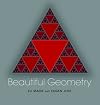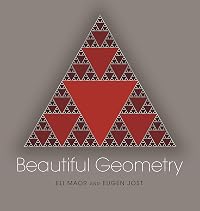
Beautiful Geometry
by Eli Maor, Eugen Jost (Author)
On This Page
Description
"If you've ever thought that mathematics and art don't mix, this stunning visual history of geometry will change your mind. As much a work of art as a book about mathematics, Beautiful Geometry presents more than sixty exquisite color plates illustrating a wide range of geometric patterns and theorems, accompanied by brief accounts of the fascinating history and people behind each. With artwork by Swiss artist Eugen Jost and text by acclaimed math historian Eli Maor, this unique celebration show more of geometry covers numerous subjects, from straightedge-and-compass constructions to intriguing configurations involving infinity. The result is a delightful and informative illustrated tour through the 2,500-year-old history of one of the most important and beautiful branches of mathematics"-- show lessTags
Recommendations









Member Reviews
If you want to love, or even like, geometry again, then this book might just do it. Beautiful Geometry pairs Maor’s elegant proofs with Jost’s vivid illustrations to help the layman understand geometry. They start with the basics—point, lines, and shapes—and work their way to Euclid, then prime geometry, infinite series, the golden ratio, experimentation with pi, parabolic geometry, and even fractals and epicycloids. There’s a fair amount of history on famous geometers and how they arrived at their discoveries. At the very least, if the proofs bore you, you can always marvel at the visuals. They’re worth the cost of admission. A quick and pretty book.
When I was a single digit prime number, I bought a ten cent comic book that was different from all the rest. It was called Donald Duck in Mathematics Land, and it was all about the absolute magic of numbers in geometry. It was a treasure and I still have it, carefully pressed flat and kept from the ravages of light.
Now just 50 years later, come a couple of number theory heavyweights, one in math and one in math-based art, one-upping Donald. Beautiful Geometry makes art of science and sense of math.
The science dates back to the golden age of Greece, that less-than-hundred year period where the Greeks ruled the intellectual world, spent their time racking up truckloads of discoveries, and elevating science to unheard of heights. show more Interestingly, there were no generalizations in the approach of the Greeks. Each time they discovered a variation or new instance, it became a new theorem, even though it might describe the same phenomenon as another theorem. Nothing was insignificant in the golden age. And though they did not have a real number system to work with (that had to wait till 1200 AD), and a lot of what they proposed was (ultimately) incorrect, they made remarkable contributions and remarkable progress.
There are 51 three page chapters, each illustrating magic of some sort in numbers and their geometric origin and/or display. The middle page of each chapter is a full page color work of art employing the topic of the chapter.
For those not mathematically inclined, it will be work to understand it all. But it is written as simply and basically as mathematics can be, and the overall effect is one of childlike fascination with the magic of it all. From equivalence to symmetry to infinity, it’s all here, updating and collecting facets of number theory that have occupied and obsessed the minds of mathematicians and philosophers for more than 2000 years. show less
Now just 50 years later, come a couple of number theory heavyweights, one in math and one in math-based art, one-upping Donald. Beautiful Geometry makes art of science and sense of math.
The science dates back to the golden age of Greece, that less-than-hundred year period where the Greeks ruled the intellectual world, spent their time racking up truckloads of discoveries, and elevating science to unheard of heights. show more Interestingly, there were no generalizations in the approach of the Greeks. Each time they discovered a variation or new instance, it became a new theorem, even though it might describe the same phenomenon as another theorem. Nothing was insignificant in the golden age. And though they did not have a real number system to work with (that had to wait till 1200 AD), and a lot of what they proposed was (ultimately) incorrect, they made remarkable contributions and remarkable progress.
There are 51 three page chapters, each illustrating magic of some sort in numbers and their geometric origin and/or display. The middle page of each chapter is a full page color work of art employing the topic of the chapter.
For those not mathematically inclined, it will be work to understand it all. But it is written as simply and basically as mathematics can be, and the overall effect is one of childlike fascination with the magic of it all. From equivalence to symmetry to infinity, it’s all here, updating and collecting facets of number theory that have occupied and obsessed the minds of mathematicians and philosophers for more than 2000 years. show less
Geometry books are the books where overleaf-placed figures are at their most reader-frustrating, and this volume is no exception. Otherwise, its high production quality and extensive color artwork do make it a thing of beauty. Besides (mostly Euclidean) geometry, it includes some number theory.
Pretty good book. Contains proofs of some theorems and shows wonderfully illustrated images that demonstrate these ideas.
Ratings
Members
- Recently Added By
Lists

University Presses
155 works; 1 member
Author Information

10 Works 2,271 Members
Eli Maor is a teacher of the history of mathematics who has successfully popularized his subject with the general public through a series of informative and entertaining books. In "E: The Story of a Number," Maor uses anecdotes, excursions and essays to illustrate that number's importance to mathematics. "Trigonometric Delights" brings show more trigonometry to life by blending history, biography, scientific curiosities and mathematics to achieve the goal of showing how trigonometry has contributed to both science and social development. "To Infinity and Beyond: A Cultural History of the Infinite" explores the idea of infinity in mathematics and art through the use of the illustrations of the Dutch artist M.C. Escher. Eli Maor's readable books have made the world of numbers accessible even to those with little or no background in mathematics. (Bowker Author Biography) show less
Awards and Honors
Classifications
Statistics
- Members
- 107
- Popularity
- 303,199
- Reviews
- 5
- Rating
- (4.00)
- Languages
- English, Italian
- Media
- Paper, Ebook
- ISBNs
- 4
- ASINs
- 1