King for a Day
by Rukhsana Khan
On This Page
Description
"Even though he is confined to a wheelchair, a Pakistani boy tries to capture the most kites during Basant, the annual spring kite festival, and become "king" for the day. Includes an afterword about the Basant festival"--Provided by publisher.Tags
Recommendations


Member Reviews
Basant (ba-SANT), as explained in the small glossary at the front of this book, is a spring kite festival celebrated all across South Asia. The origins of the festival are described in more depth at the end of the book.
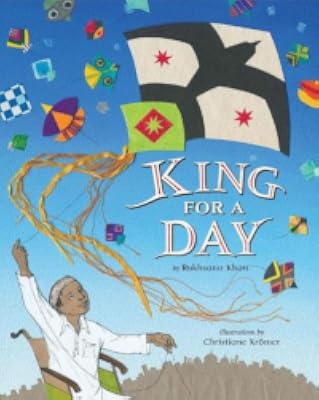
The story takes place in Lahore, in the Punjab Province in Pakistan. Malik is a young boy, wheelchair bound (this is only shown in illustrations but never mentioned), who aspires to be “King of Basant” by being the best kite fighter, and especially, by beating the bully next door.
The story follows the exploits of Malik as he catches all the other kites with his swift kite named Falcon, including the kite owned by the bully that Malik calls “Goliath.” Goliath may be big, but Malik built Falcon for speed, and of show more course Malik succeeds in becoming a “king” for a day.
At the end of the day, “One by one the stars come out till they shine down like a million jeweled kites.” Malik’s day as “King” is over, but tomorrow, he plans to start work on an even better kite for next year.
The collage illustrations by Christiane Krömer reveal the extent to which the artist researched the city of Lahore with its distinctive arches and skyline. She does an excellent job adding interest to the monochromatic city scenes by alternating textures, as well as including bright colorful kites on every page.
Discussion: Many readers will remember the story of The Kite Runner by Khaled Hosseini which is centered around kite competition in Afghanistan, banned by the Taliban in 1999, and which features a much worse bully than would be appropriate for a children’s book. But Pakistan has also had problems with kite flying. Only one sentence at the end of the book hints at any problems with the kite festival:
"In recent years, kite flying and the celebration of Basant in Lahore were banned for safety reasons and for security concerns due to orthodox religious opposition. But in 2013 the festival returned, hopefully for good.”
Given the intense symbolism the festival has acquired, it might have made sense to include more background on it in the book. (Also, the festival did not end up taking place in 2013.)
Basant was banned in Lahore from 2007 through 2012, ostensibly for safety reasons, which are in fact a problem. Some people tie glass and metal to their strings to help them cut the strings of competitors. This practice has resulted in horrible accidents and even some deaths. But according to the New York Times, the ban on the festival was probably due more to the local authority’s inability to provide security against Islamic extremist groups that challenge the celebration. In 2013, for example, the festival was expected to be restored:
"But then Jamaat ud Dawa — the charitable front of Lashkar-e-Taiba, the militant group accused of masterminding terrorist attacks in Mumbai in 2008 — warned against holding Basant celebrations, implicitly threatening attacks, on the grounds that the festival has “Hindu origins” and so is un-Islamic. The police said they could not guarantee public safety during the event, and [Lahore] was forced to abandon the project.”
Nevertheless, the festival remains in demand for a number of reasons, not least of which is the boost it provides the economy. Over the years, thousands of tourists have come to Lahore for the festival, filling the hotels and restaurants, and paying top prices to locals for spots on their rooftops.
The competition actually did take place in 2014, but despite prohibitions on the sale and use of metal twine, several people got injured from the wire as well as from stray bullets fired by jubilant kite flyers.
What would be appropriate for children in this regard? One issue for discussion could be the way in which games and other seemingly non-political activities often play an important role in expressing nationalist and/or religious identity. Children can learn about the revolutionary role of singing in Estonia and the chauvinistic soccer mania in Europe and now on the rise in the U.S. More relevant to this book, the conflict over whether or not to permit kite flying competitions can open the way to discuss the religious strife between Hindus and Muslims, the internecine battles within religions, and the repercussions for the rest of the world. Children could also talk about the issue of fairness in competition (such as the practice of using glass or metal strings versus regular twine).
Evaluation: I love the way the main character’s disability is just there, and not mentioned. Malik is written as just a kid like any other, with the same concerns and passions as other kids. (In Khan’s previous book, Big Red Lollipop, she used a similar tactic to feature a Pakistani family in a plot that was only about sibling rivalry and character development.) show less
The story takes place in Lahore, in the Punjab Province in Pakistan. Malik is a young boy, wheelchair bound (this is only shown in illustrations but never mentioned), who aspires to be “King of Basant” by being the best kite fighter, and especially, by beating the bully next door.
The story follows the exploits of Malik as he catches all the other kites with his swift kite named Falcon, including the kite owned by the bully that Malik calls “Goliath.” Goliath may be big, but Malik built Falcon for speed, and of show more course Malik succeeds in becoming a “king” for a day.
At the end of the day, “One by one the stars come out till they shine down like a million jeweled kites.” Malik’s day as “King” is over, but tomorrow, he plans to start work on an even better kite for next year.
The collage illustrations by Christiane Krömer reveal the extent to which the artist researched the city of Lahore with its distinctive arches and skyline. She does an excellent job adding interest to the monochromatic city scenes by alternating textures, as well as including bright colorful kites on every page.
Discussion: Many readers will remember the story of The Kite Runner by Khaled Hosseini which is centered around kite competition in Afghanistan, banned by the Taliban in 1999, and which features a much worse bully than would be appropriate for a children’s book. But Pakistan has also had problems with kite flying. Only one sentence at the end of the book hints at any problems with the kite festival:
"In recent years, kite flying and the celebration of Basant in Lahore were banned for safety reasons and for security concerns due to orthodox religious opposition. But in 2013 the festival returned, hopefully for good.”
Given the intense symbolism the festival has acquired, it might have made sense to include more background on it in the book. (Also, the festival did not end up taking place in 2013.)
Basant was banned in Lahore from 2007 through 2012, ostensibly for safety reasons, which are in fact a problem. Some people tie glass and metal to their strings to help them cut the strings of competitors. This practice has resulted in horrible accidents and even some deaths. But according to the New York Times, the ban on the festival was probably due more to the local authority’s inability to provide security against Islamic extremist groups that challenge the celebration. In 2013, for example, the festival was expected to be restored:
"But then Jamaat ud Dawa — the charitable front of Lashkar-e-Taiba, the militant group accused of masterminding terrorist attacks in Mumbai in 2008 — warned against holding Basant celebrations, implicitly threatening attacks, on the grounds that the festival has “Hindu origins” and so is un-Islamic. The police said they could not guarantee public safety during the event, and [Lahore] was forced to abandon the project.”
Nevertheless, the festival remains in demand for a number of reasons, not least of which is the boost it provides the economy. Over the years, thousands of tourists have come to Lahore for the festival, filling the hotels and restaurants, and paying top prices to locals for spots on their rooftops.
The competition actually did take place in 2014, but despite prohibitions on the sale and use of metal twine, several people got injured from the wire as well as from stray bullets fired by jubilant kite flyers.
What would be appropriate for children in this regard? One issue for discussion could be the way in which games and other seemingly non-political activities often play an important role in expressing nationalist and/or religious identity. Children can learn about the revolutionary role of singing in Estonia and the chauvinistic soccer mania in Europe and now on the rise in the U.S. More relevant to this book, the conflict over whether or not to permit kite flying competitions can open the way to discuss the religious strife between Hindus and Muslims, the internecine battles within religions, and the repercussions for the rest of the world. Children could also talk about the issue of fairness in competition (such as the practice of using glass or metal strings versus regular twine).
Evaluation: I love the way the main character’s disability is just there, and not mentioned. Malik is written as just a kid like any other, with the same concerns and passions as other kids. (In Khan’s previous book, Big Red Lollipop, she used a similar tactic to feature a Pakistani family in a plot that was only about sibling rivalry and character development.) show less
Overall, I thought King for a Day was a very good book. The illustrations immediately grabbed my attention by pulling my eyes toward the kites, the main theme around Basant, which the book is about. The colors also spread into the main characters, highlighting Malik’s sister’s outfit and Malik’s wheelchair. The text does a good job of describing the images in more detail, for example Malik says, “His kite is so big I nickname it Goliath,” really giving the reader an idea of how big he saw the kite to be. On many pages where there is a lot of action or color in big illustrations, the text is separated from the illustration, allowing the reader to really focus on each one. I found this helpful because it allowed me to see and show more then read what was going on in the book without being overwhelmed. It is also a good way to show that just because someone has a physical disability, they are not any less able to help others. Malik is is able to send a kite down to a young girl after her kite is taken by a bully even though he is not physically able to stop the bully. This is a good book that shows that anyone is possible of winning and helping others. show less
KING FOR A DAY is a tale of little boy in Pakistan who is excited to fly the kite he has built for the festival of Basant. Although he is confined to a wheelchair, it doesn't stop him or deter him from competing in the kite fighting. Later in the story, he even saves a little girl from a bully. The message of the story is that a wheelchair doesn't have to confine you. You can be free just like the kites in the festival, even though they are technically tethered by strings and carried by the wind they "will have tasted freedom." The full quote- "For a while the kites fly where the wind carries them. When they land, they'll belong to whoever finds them. But, at least they will have tasted freedom."
This book is about a boy in a wheelchair that wins the traditional kite battle in Lahore, Pakistan. People go on their roofs and try to keep their kites flying. The last one up wins. They have to try and take down the surrounding kites to be the last one in the sky. I like that this book shows diversity and it also tells of some Pakistan traditions. The book shows that children with disabilities can do things like or even better than anyone else. I also enjoyed the friendship between siblings.
I liked this book because it taught me about a tradition i never knew of before. the relationships between the children in the story were relatable even though the culture was so vastly different. t was a fictitious, but the traditions and culture represented was very real.
This book was good, but I don’t think I would highly recommend it to others. It definitely wasn’t one of my favorite books to read. However, the language in the book was very clear and detailed for it being an international book. The characters in the book weren’t exactly well-developed, but they were believable. The book mentions many characters through it, but very briefly. The illustrations in the book though really grabbed my attention! Each page was so colorful and bright, and the kites all had cool patterns to look at. The text also describes the images in more detail, for example Malik says, “This kite is so big, I nicked named it Goliath.” This is giving detail about how big the kite really must be. I think the plot is show more good too because it’s all about kindness and helping others. So overall, the book sends out a big message of how important it is to help out other people and shows that anyone is possible at winning! show less
Superbly illustrated but I find the story a bit contrived and heavy handed.
Members
- Recently Added By
Author Information

18+ Works 2,298 Members
Awards and Honors
Awards
Classifications
Statistics
- Members
- 166
- Popularity
- 197,151
- Reviews
- 14
- Rating
- (3.88)
- Languages
- English
- Media
- Paper, Ebook
- ISBNs
- 5
- ASINs
- 1