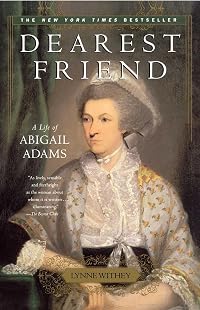
Dearest Friend: A Life of Abigail Adams
by Lynne Withey
On This Page
Description
The lively, authoritative, New York Times bestselling biography of Abigail Adams.This is the life of Abigail Adams, wife of patriot John Adams, who became the most influential woman in Revolutionary America. Rich with excerpts from her personal letters, Dearest Friend captures the public and private sides of this fascinating woman, who was both an advocate of slave emancipation and a burgeoning feminist, urging her husband to "Remember the Ladies" as he framed the laws of their new country.
show more
John and Abigail Adams married for love. While John traveled in America and abroad to help forge a new nation, Abigail remained at home, raising four children, managing their estate, and writing letters to her beloved husband. Chronicling their remarkable fifty-four-year marriage, her blossoming feminism, her battles with loneliness, and her friendships with Thomas Jefferson and James Madison, Dearest Friend paints a portrait of Abigail Adams as an intelligent, resourceful, and outspoken woman. show less
Tags
Recommendations








Member Recommendations
Member Reviews
This biography successfully stuck to the fine line of maintaining this reader’s interest in the subject as well as succinctly and lucidly analyzing the life of Abigail Adams and contemporaneous events. Dearest Friend reads really quickly, like a novel, with insights into personal thoughts, emotions, and motivations drawn from letters and diaries of Abigail and John Adams. It puts Revolutionary events into human perspective from Braintree and Boston, specifically, how Abigail and John viewed them. These events come across as open-ended, without forgone conclusions, importance, or names as later histories account them. Though summarized briefly, the events seem more like what one might read from newspapers or letters than the concise show more event neatly put into context by a historian. Abigail Adams, like her husband, remains a figure that is either admired or loathed – generally for the same reason – her sharp tongue and wit, yet this book generally manages to avoid either pitfall, relating her life as a person with merits and flaws.
The author treated Abigail as a mere mortal noting contradictions, changes in thinking/attitudes/relationships, for instance her stance on the Shays and Whiskey Rebellions as compared to her notions about the Revolution, as well as her eventual softening towards Republicanism later in life when the country didn’t fall apart under Jefferson. I think my favorite quote from the Adams' letters was “I desire you would Remember the Ladies, and be more generous and favourable to them than your ancestors. Do not put such unlimited power into the hands of the Husbands. Remember all men would be tyrants if they could If particular care and attention is not paid to the Ladies we are determined to foment a Rebelion, and will not hold ourselves bound by any Laws in which we have no voice, or Representation.” Which deftly makes the point that not only was Abigail Adams import as a feminist but that she did so by linking the cause of women to the American Revolution. Her keen powers of observation led to her comment on Hamilton’s 1791 plan: “I firmly believe if I live Ten years longer, I shall see a devision of the Southern and Northern States, unless more candour and less intrigue, of which I have no hopes, should prevail.”
Despite these qualities, this was not a perfect or comprehensive biography – little time was spent on her relationships with her children aside from Nabby, though there is such material available (especially between her and John Quincy). At times, the narration was so caught up in the events of the day it was hard to tell if it was a biography of Abigail or John Adams. Further, though a minor point, there were a number of typos in the text I read, outside of the retained contemporary spelling, which distract from the narrative flow, and hopefully these have been fixed in a newer edition. Nevertheless, a worthwhile read overall to get a good sense of Abigail’s life and times. show less
The author treated Abigail as a mere mortal noting contradictions, changes in thinking/attitudes/relationships, for instance her stance on the Shays and Whiskey Rebellions as compared to her notions about the Revolution, as well as her eventual softening towards Republicanism later in life when the country didn’t fall apart under Jefferson. I think my favorite quote from the Adams' letters was “I desire you would Remember the Ladies, and be more generous and favourable to them than your ancestors. Do not put such unlimited power into the hands of the Husbands. Remember all men would be tyrants if they could If particular care and attention is not paid to the Ladies we are determined to foment a Rebelion, and will not hold ourselves bound by any Laws in which we have no voice, or Representation.” Which deftly makes the point that not only was Abigail Adams import as a feminist but that she did so by linking the cause of women to the American Revolution. Her keen powers of observation led to her comment on Hamilton’s 1791 plan: “I firmly believe if I live Ten years longer, I shall see a devision of the Southern and Northern States, unless more candour and less intrigue, of which I have no hopes, should prevail.”
Despite these qualities, this was not a perfect or comprehensive biography – little time was spent on her relationships with her children aside from Nabby, though there is such material available (especially between her and John Quincy). At times, the narration was so caught up in the events of the day it was hard to tell if it was a biography of Abigail or John Adams. Further, though a minor point, there were a number of typos in the text I read, outside of the retained contemporary spelling, which distract from the narrative flow, and hopefully these have been fixed in a newer edition. Nevertheless, a worthwhile read overall to get a good sense of Abigail’s life and times. show less
Owning this book was sort of an accident. I had put a book called My Dearest Friend on my wishlist -- it was supposed to be largely just the collected letters between Abigail and John Adams. Andrew had made a list of the books on my wishlist and headed to a local bookstore and picked this up instead, thinking he'd gotten the book on my list. Oh, well. It was still very sweet!
This is more a straight-up biography, of course largely based on those letters, among other things, and sometimes containing excerpts from those letters. It seemed promising, with a lovely quote on the front from The Boston Globe of all places, saying it was "as lively, sensible, and forthright as the woman about whom it is written..." Personally, I would drop the show more word "lively" from the description. At times this book was so dry that the only thing that kept me reading was how excessively interested in Abigail Adams I have been from the beginning.
I acknowledge that I may have made the author's task more difficult by an over-familiarity with the subject. The basic details of her life I already know -- from 1776 and the John Adams mini-series, among other places. Every once in a while, Dearest Friend would sputter into life, and I would sit up, feeling like I was getting a truer glimpse into the details of Abigail's life -- a feeling for what it really must have been like to live that life. Then it would fade back into what seemed like a dry recitation of "and then this happened, and then this...."
I am probably being overly harsh on this poor book. Maybe the quote on the cover jaded me. Maybe I just wanted too deeply to be swept away with love for Abigail. Certainly I read the entire book with interest. But still, I want the book that was originally on my list. show less
This is more a straight-up biography, of course largely based on those letters, among other things, and sometimes containing excerpts from those letters. It seemed promising, with a lovely quote on the front from The Boston Globe of all places, saying it was "as lively, sensible, and forthright as the woman about whom it is written..." Personally, I would drop the show more word "lively" from the description. At times this book was so dry that the only thing that kept me reading was how excessively interested in Abigail Adams I have been from the beginning.
I acknowledge that I may have made the author's task more difficult by an over-familiarity with the subject. The basic details of her life I already know -- from 1776 and the John Adams mini-series, among other places. Every once in a while, Dearest Friend would sputter into life, and I would sit up, feeling like I was getting a truer glimpse into the details of Abigail's life -- a feeling for what it really must have been like to live that life. Then it would fade back into what seemed like a dry recitation of "and then this happened, and then this...."
I am probably being overly harsh on this poor book. Maybe the quote on the cover jaded me. Maybe I just wanted too deeply to be swept away with love for Abigail. Certainly I read the entire book with interest. But still, I want the book that was originally on my list. show less
LOVE this style of writing. Completely non-academic. Lynne Withey tells the story of Abigail Adams with great care and nuance. And what a wonderful subject. Abagail was an amazing woman for her time; perfectly suited for the brilliant but typically cantankerous John Adams.
Highly recommend.
Highly recommend.
When my grandmother passed a few years ago, I inherited some of her books (as the big reader in the family, almost by default). Among them was this one - a book that my mother had given her to read with the note you'll find at the bottom of this post.
I honestly don't know why I put up with having so many biographies in my possession. I dislike them immensely. They rarely illustrate a full life, especially when it's the life of someone who lived so long ago; we are subject to what was left behind almost incidentally as opposed to recorded, on top of which the writer - who means to interpret and illustrate that life for the reader - often leaves off the least-appetizing bits and inflates the subject's importance.
I don't deny Abigail Adams show more her influence. She was assuredly one of the most influential women in early American history, and she definitely suffered for it. But in Dearest Friend Lynn Withey really makes it feel as if Abigail was the only influential woman of the time, which is incorrect. And while Withey does not shy away from Abigail's personal faults, she does gloss them over by focusing so strongly on her loneliness, as if that were an excuse.
And from this book, you cannot tell that Abigail and John had any real feeling for one another. The author describes letters between the two of them and often fills space by saying that John did not write often, but still insists that the feelings were strong. In 1981, when this book was first published, this might have been acceptable. In 2016, it doesn't pass muster. I would rather have just read their letters. Instead, it was just a lot of Abigail Adams feeling sorry for herself and trying to control everyone else.
She decides to add rooms to her house, but we don't get an explanation of why. She agrees with her husband's politics (Federalist) until suddenly neither of them do, and then she starts agreeing with the Republicans - but so little is said about what was happening at the time and what could have influenced that change in her vision other than a mention of John Quincy explaining something that we never get the benefit of understanding; it reads more like an outline than a true-to-life story. It's an illustration that is neither complete nor appealing and, as a reader, it is a bit of an affront to my intelligence.
One note: in the epilogue, Withey mentions that although Abigail did not live to see it (spoiler alert?)
she was the "first and only woman ever to be both wife and mother of American Presidents." In 2001, 20 years after this book was published and 200 years since John Adams vacated the Presidency, Barbara Bush became the second. Though I very much doubt that Mrs. Bush ever had to make as many sacrifices, or was ever called on to advise, as much as Abigail was. I also very much doubt that Barbara would ever be caught hanging her laundry in the east room of the White House.
www.theliterarygothamite.com show less
I honestly don't know why I put up with having so many biographies in my possession. I dislike them immensely. They rarely illustrate a full life, especially when it's the life of someone who lived so long ago; we are subject to what was left behind almost incidentally as opposed to recorded, on top of which the writer - who means to interpret and illustrate that life for the reader - often leaves off the least-appetizing bits and inflates the subject's importance.
I don't deny Abigail Adams show more her influence. She was assuredly one of the most influential women in early American history, and she definitely suffered for it. But in Dearest Friend Lynn Withey really makes it feel as if Abigail was the only influential woman of the time, which is incorrect. And while Withey does not shy away from Abigail's personal faults, she does gloss them over by focusing so strongly on her loneliness, as if that were an excuse.
And from this book, you cannot tell that Abigail and John had any real feeling for one another. The author describes letters between the two of them and often fills space by saying that John did not write often, but still insists that the feelings were strong. In 1981, when this book was first published, this might have been acceptable. In 2016, it doesn't pass muster. I would rather have just read their letters. Instead, it was just a lot of Abigail Adams feeling sorry for herself and trying to control everyone else.
She decides to add rooms to her house, but we don't get an explanation of why. She agrees with her husband's politics (Federalist) until suddenly neither of them do, and then she starts agreeing with the Republicans - but so little is said about what was happening at the time and what could have influenced that change in her vision other than a mention of John Quincy explaining something that we never get the benefit of understanding; it reads more like an outline than a true-to-life story. It's an illustration that is neither complete nor appealing and, as a reader, it is a bit of an affront to my intelligence.
One note: in the epilogue, Withey mentions that although Abigail did not live to see it (spoiler alert?)
she was the "first and only woman ever to be both wife and mother of American Presidents." In 2001, 20 years after this book was published and 200 years since John Adams vacated the Presidency, Barbara Bush became the second. Though I very much doubt that Mrs. Bush ever had to make as many sacrifices, or was ever called on to advise, as much as Abigail was. I also very much doubt that Barbara would ever be caught hanging her laundry in the east room of the White House.
www.theliterarygothamite.com show less
A spectacular woman who spent most of her life alone, running the home for her absent husband. She was so smart and yet didn't have a vision of equality with men. Rather, she did her best to fulfill her role.
Book club selection enjoyed by all. Abigail Adams amazed us by her strength of character & ability to manage properties while her husband was away conducting business for the new government of America. Loved the letters exchanged between Abigail & John
A great way to learn history (through the eyes of women). Wonderful book about Abigail Adams and her family (past U.S. Presidents).
Members
- Recently Added By
Lists

Best U.S. History Books (1754-1828)
363 works; 18 members

Mustich's 1000 Books to Read Before You Die: A Life Changing List
1,001 works; 19 members
Author Information
Lynne Withey has taught history at the University of Iowa, Boston University, and the University of California at Berkeley, and is now the associate director of the University of California Press. She lives in San Francisco.
Awards and Honors
Common Knowledge
- Original publication date
- 1981
- People/Characters
- Reverend William Smith; Elizabeth Quincy Smith; Abigail Smith Adams; Mary Smith Cranch; Elizabeth Smith Shaw Peabody; William Smith, Jr. (show all 21); John Adams; Abigail Amelia Adams Smith; John Quincy Adams; Charles Adams; Thomas Boylston Adams; Josiah Quincy, Jr.; Mercy Otis Warren; Joseph Warren; Susanna Boylston; Abigail Louisa Smith; Sarah "Sally" Smith; Louisa Catherine Adams; Cotton Tufts; Benjamin Rush; Thomas Jefferson
- Important places
- Boston, Massachusetts, USA; Braintree, Massachusetts, USA; Quincy, Massachusetts, USA; Paris, Île-de-France, France; London, England, UK; New York, New York, USA (show all 10); Philadelphia, Pennsylvania, USA; Washington, D.C., USA; Weymouth, Massachusetts, USA; Amsterdam, North Holland, the Netherlands
- Important events
- Boston Massacre (1770-03-05); Boston Tea Party (1773-12-16); Battle of Lexington and Concord (1775-04-19); Battle of Bunker Hill (1775-06-17); Declaration of Independence (1776); Battle of Saratoga (1777) (show all 9); Battle of Yorktown (1781); Shay's Rebellion (1786 | 1787); XYZ Affair (1797 | 1798)
- Dedication
- For Michael
- First words
- Abigail Adams was a tiny woman, little more than five feet tall, with dark hair, piercing dark eyes, and a forceful personality that belied her size. Quiet and reserved as a child, she nonetheless displayed a brilliant mind... (show all) and fierce determination even then.
- Quotations
- God willing...I must be withing the Scent of the sea. - John Adams
The spirit of resistance to government is so valuable on certain occasions, that I wish it to be always kept alive...It will often be exercised when wrong, but better so than not to be exercised at all. I like a little rebell... (show all)ion now and then. It is like a storm in the Atmosphere. - Thomas Jefferson - Last words
- (Click to show. Warning: May contain spoilers.)Yet surely she would have approved of the reasons for her fame: the interest of a later age in the history of family and domestic life, as well as the history of politics, and, above all, its interest in the emancipation of women and in the discovery of women in the past who spoke out on behalf of their sex.
Classifications
- Genres
- Biography & Memoir, History, Nonfiction, General Nonfiction
- DDC/MDS
- 973.4 — History & geography History of North America United States Constitutional period (1789-1809)
- LCC
- E322.1 .A38 .W56 — History of the United States United States Revolution to the Civil War, 1775/1783-1861 By period 1789-1809. Constitutional period John Adams' administration, 1797-1801
- BISAC
Statistics
- Members
- 808
- Popularity
- 34,224
- Reviews
- 10
- Rating
- (3.69)
- Languages
- English
- Media
- Paper, Audiobook, Ebook
- ISBNs
- 8
- ASINs
- 7