Down the Great Unknown: John Wesley Powell's 1869 Journey of Discovery and Tragedy Through the Grand Canyon
by Edward Dolnick
On This Page
Description
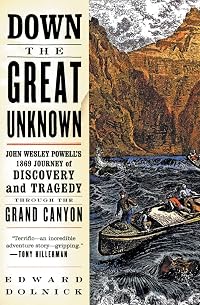
Drawing on rarely examined diaries and journals, Down the Great Unknown is the first book to tell the full, dramatic story of the Powell expedition.On May 24, 1869 a one-armed Civil War veteran, John Wesley Powell and a ragtag band of nine mountain men embarked on the last great quest in the American West. The Grand Canyon, not explored before, was as mysterious as Atlantis—and as perilous. The ten men set out from Green River Station, Wyoming Territory down the Colorado in four wooden show more rowboats. Ninety-nine days later, six half-starved wretches came ashore near Callville, Arizona.
Lewis and Clark opened the West in 1803, six decades later Powell and his scruffy band aimed to resolve the West's last mystery. A brilliant narrative, a thrilling journey, a cast of memorable heroes—all these mark Down the Great Unknown, the true story of the last epic adventure on American soil.
. show less
Tags
Recommendations






Member Reviews
Years later when asked how he and other members of his party managed to be the first to take boats down the Colorado River through the Grand Canyon in 1869, John Wesley Powell replied simply, "I was lucky."
More than luck was involved, of course, yet Powell and the others certainly were lucky, as Edward Dolnick explains in his adventurous 2001 book “Down the Great Unknown.”
Consider that Powell himself, leader of the expedition, had but one arm, having lost the other in the Battle of Shiloh. Consider that their large wooden boats were totally unsuitable for running river rapids and and no less suitable for carrying around the worst of the rapids. Consider that the rowers faced backwards. Consider that none of the men wore lifejackets show more or helmets. Consider that, because they were the first, they had no idea what might be beyond the next curve in the river. Many others, including some in recent years, have died trying to go down this river. That Powell and the others succeeded in their first attempt had something to do with luck.
Most of the 10 men who started the 99-day, 1,000-mile river trip that started in Wyoming Territory were Civil War veterans. Having survived the war, they figured they could survive anything. They were all eager for adventure, although Powell himself was also in pursuit of science. He wanted to map the river and study geology along the way. Names he gave to rapids, canyons and other features along the way are still in use today.
Only six of the 10 completed the trip, the others bailing out along the way because of the hardships they endured. Powell was cautious, choosing to avoid the worst rapids whenever possible, but to his crew carrying those heavy boats long distances over rocks often seemed worse than taking their chances with the rapids.
Dolnick makes a nail-biting adventure story out of this river trip, describing what happened each day along the way. At the same time he tells us much about river rapids in general, about the Grand Canyon's history and geology and about others who have ventured down it. His book makes exciting and informative reading. show less
More than luck was involved, of course, yet Powell and the others certainly were lucky, as Edward Dolnick explains in his adventurous 2001 book “Down the Great Unknown.”
Consider that Powell himself, leader of the expedition, had but one arm, having lost the other in the Battle of Shiloh. Consider that their large wooden boats were totally unsuitable for running river rapids and and no less suitable for carrying around the worst of the rapids. Consider that the rowers faced backwards. Consider that none of the men wore lifejackets show more or helmets. Consider that, because they were the first, they had no idea what might be beyond the next curve in the river. Many others, including some in recent years, have died trying to go down this river. That Powell and the others succeeded in their first attempt had something to do with luck.
Most of the 10 men who started the 99-day, 1,000-mile river trip that started in Wyoming Territory were Civil War veterans. Having survived the war, they figured they could survive anything. They were all eager for adventure, although Powell himself was also in pursuit of science. He wanted to map the river and study geology along the way. Names he gave to rapids, canyons and other features along the way are still in use today.
Only six of the 10 completed the trip, the others bailing out along the way because of the hardships they endured. Powell was cautious, choosing to avoid the worst rapids whenever possible, but to his crew carrying those heavy boats long distances over rocks often seemed worse than taking their chances with the rapids.
Dolnick makes a nail-biting adventure story out of this river trip, describing what happened each day along the way. At the same time he tells us much about river rapids in general, about the Grand Canyon's history and geology and about others who have ventured down it. His book makes exciting and informative reading. show less
(27) This is a non-fiction account of John Wesley Powell and his expedition's navigation of the uncharted Colorado rapids through the Grand Canyon just after the Civil War. This was the second book in a row I just happened to read about this time period in America. It is interesting to read about the rank and file veterans of the Civil War and how they went on - separate from the story of the politics and the country itself. Exploring the Grand Canyon at this time in history in the context of Darwin's contemporaneous theory of evolution vis a vis a Biblical interpretation of time was interesting to think about. The author did a good job of putting us in the mind of an educated man of the times. The book itself was based on many of the show more men's journals or their recorded eye witness accounts after the journey. How woefully unprepared they were, the grueling work, the sand, rain, blazing sun, and heart stopping terror of the rapids. I learned a lot about whitewater and found the dramatic tension to be engaging. Powell was remarkable - how did he do it all with one arm?
On the negative side, it was a bit repetitive, They essentially did the same thing over and over again with each rapid being "the worst one yet." I began to flag a bit towards the end despite a brief 300 pages, the book began to feel long. My interest picked up when the party broke up, but unfortunately, there was only so much the author could tell us of the Howland brothers who choose to abandon the expedition at the end.
We bought this book ~ 2 years ago in the gift shop before our mule journey down to Phantom Ranch so the book has some sentimental value. The canyon is awe-inspiring for sure, though I don't find geology as exciting as the author and Powell. I am glad I read it, but honestly - also glad I chose not to do the multi-day river rafting trip on the Colorado back then. show less
On the negative side, it was a bit repetitive, They essentially did the same thing over and over again with each rapid being "the worst one yet." I began to flag a bit towards the end despite a brief 300 pages, the book began to feel long. My interest picked up when the party broke up, but unfortunately, there was only so much the author could tell us of the Howland brothers who choose to abandon the expedition at the end.
We bought this book ~ 2 years ago in the gift shop before our mule journey down to Phantom Ranch so the book has some sentimental value. The canyon is awe-inspiring for sure, though I don't find geology as exciting as the author and Powell. I am glad I read it, but honestly - also glad I chose not to do the multi-day river rafting trip on the Colorado back then. show less
An extremely detailed and readable account of Powell's 1869 trek, drawing on the contemporary and later writings of the participants. While the text tends to get a bit monotonous after a while (bacon for breakfast, then rapids again?), the human drama of the group pulls the story together well. The only thing that really bugged me about this book was Dolnick's use of really weird and unnecessary metaphors throughout; some judicious editor ought to have excised those and improved the book greatly.
Pretty good overview of the Powell expedition down the Colorado. It is pretty wild to think a group of men set off with little knowledge about the river below the Green and whether there were falls or other impassable sections. I was really hooked in the second half of the book. The author used information from modern day river runners that at times distracted from the subject but also provided context to how hard running the river is.
Overall the book was good, but I found it a bit uneven at times. There were a lot of side stories that gave background, but didn't advance the narrative. Some of these tangents were better than others. The most compelling part of the book for me was when the author waxed poetic on geology. He got me excited about rocks!
Down the Great Unknown is the story of one of the great adventures of US history, the 1869 expedition to explore the Green and Colorado Rivers, led by John Wesley Powell. Ten men entered the Green River in Wyoming with four boat and supplies to last ten months. 99 days later 6 men, with two boats and food for perhaps 3 days, emerged on the far side of the Grand Canyon. They were the first people to venture into the river and come out alive at the other end.
Like the expedition led by Lewis and Clark 60 years earlier, the Powel Expedition had been given up for dead, presumed to be victims of an unknown fate while attempting to penetrate an unknown landscape. The true story, as told by Edward Dolnick, was one that was made up of nearly show more every kind of human emotion as the group beat the odds time and again. Reaching their goal at the southern end of the river was not such victory as it was survival, and it is a story that Dolnick tells well.
Dolnick relies on the journals kept by Powell and two other members of the group as his primary sources and works into the story accounts from other river explorers, as well as the perspective of more modern river travelers. Powell set out on what he intended to be a scientific exploration of an unknown region of the country. He planned to map the river and its significant landmarks, as well as to engage in study of the geology of the southwest. He had little idea of what the river itself would be like and consequently was ill-prepared as the exploration unfolded.
Not only was this expedition entering unknown territory in terms of geography, they were also in unknown territory in terms of how to navigate white water. Taking rowboats designed for fast movement across flat water they learned that their boats were poorly suited to the conditions of these rivers. They frequently portaged around rapids, carrying the supplies forward and then moving the boats through by the method of 'lining.' It was time-consuming and strenuous work. Rarely did they run rapids, although in the last week of the journey they did so frequently, out of a sense of desperation, as their food supplies ran critically low.
Dolnick tells the story well, easily on par with the account of Lewis and Clark in Stephen Ambrose's Undaunted Courage. He doesn't gloss over the hardships, nor fill-in gaps with information that can't be connected from his sources. And his primary sources are three men whose variety in perspective creates a three dimensional portrait of an incredible, and true, journey into was truly an unknown territory. show less
Like the expedition led by Lewis and Clark 60 years earlier, the Powel Expedition had been given up for dead, presumed to be victims of an unknown fate while attempting to penetrate an unknown landscape. The true story, as told by Edward Dolnick, was one that was made up of nearly show more every kind of human emotion as the group beat the odds time and again. Reaching their goal at the southern end of the river was not such victory as it was survival, and it is a story that Dolnick tells well.
Dolnick relies on the journals kept by Powell and two other members of the group as his primary sources and works into the story accounts from other river explorers, as well as the perspective of more modern river travelers. Powell set out on what he intended to be a scientific exploration of an unknown region of the country. He planned to map the river and its significant landmarks, as well as to engage in study of the geology of the southwest. He had little idea of what the river itself would be like and consequently was ill-prepared as the exploration unfolded.
Not only was this expedition entering unknown territory in terms of geography, they were also in unknown territory in terms of how to navigate white water. Taking rowboats designed for fast movement across flat water they learned that their boats were poorly suited to the conditions of these rivers. They frequently portaged around rapids, carrying the supplies forward and then moving the boats through by the method of 'lining.' It was time-consuming and strenuous work. Rarely did they run rapids, although in the last week of the journey they did so frequently, out of a sense of desperation, as their food supplies ran critically low.
Dolnick tells the story well, easily on par with the account of Lewis and Clark in Stephen Ambrose's Undaunted Courage. He doesn't gloss over the hardships, nor fill-in gaps with information that can't be connected from his sources. And his primary sources are three men whose variety in perspective creates a three dimensional portrait of an incredible, and true, journey into was truly an unknown territory. show less
In 1869 John Wesley Powell decided to set off down the Green River and follow it to the Colorado and then down the Colorado through the Grand Canyon. All of this was territory that had been unexplored by Europeans. Edward Dolnick recounts the passage in Down the Great Unknown. It's a fascinating story told masterfully of a courageous -- or foolish -- adventure.
His companions had no experience running rapids and their equipment was sturdy but not designed for shooting rapids. Fortunately, by starting high on the Green, they were able to learn some of the basics without killing themselves. Water, because it cannot be compressed and is fluid, does some strange things when running through narrow canyons and over rocks. Speed is not the show more greatest hazard: "Waves ricochet off rocks and cliffs and collide with one another; water rushes over rocks and dives down into holes and moves upstream to fill in 'empty' spaces behind obstacles." Water is moving in so many directions at once and at so many different speeds that obstacles such as rocks, dangerous in and of themselves, become even more hazardous.
Many of the canyons were very deep making portages around bad rapids impossible. Their first hint of difficulty came after Brown's Park, a lush hidden valley favored by cattle rustlers, called Lodore Canyon. The entrance was described as a "dark portal to a region of gloom." The walls of the canyon extended upwards some 2,000 feet. "The Gates of Lodore hinge inward, cruelly joined, hard rock, ominous, and when the mists skulk low between the cliffs, they become an engraving by Gustave Dore for one of Dante's lower levels of hell." This a description by a modern writer who extols the river.
And this was before they got to the tough parts. show less
His companions had no experience running rapids and their equipment was sturdy but not designed for shooting rapids. Fortunately, by starting high on the Green, they were able to learn some of the basics without killing themselves. Water, because it cannot be compressed and is fluid, does some strange things when running through narrow canyons and over rocks. Speed is not the show more greatest hazard: "Waves ricochet off rocks and cliffs and collide with one another; water rushes over rocks and dives down into holes and moves upstream to fill in 'empty' spaces behind obstacles." Water is moving in so many directions at once and at so many different speeds that obstacles such as rocks, dangerous in and of themselves, become even more hazardous.
Many of the canyons were very deep making portages around bad rapids impossible. Their first hint of difficulty came after Brown's Park, a lush hidden valley favored by cattle rustlers, called Lodore Canyon. The entrance was described as a "dark portal to a region of gloom." The walls of the canyon extended upwards some 2,000 feet. "The Gates of Lodore hinge inward, cruelly joined, hard rock, ominous, and when the mists skulk low between the cliffs, they become an engraving by Gustave Dore for one of Dante's lower levels of hell." This a description by a modern writer who extols the river.
And this was before they got to the tough parts. show less
Members
- Recently Added By
Lists

Geology
24 works; 2 members
Author Information

12+ Works 3,458 Members
Edward Dolnick is the author of Down the Great Unknown, The Forger's Spell, and the Edgar Award-winning The Rescue Artist. A former chief science writer at the Boston Globe, he lives with his wife near Washington, D.C.
Common Knowledge
- Alternate titles
- Down the Great Unknown
- Original publication date
- 2001
- People/Characters
- John Wesley Powell
- Important places
- Grand Canyon National Park, Arizona, USA
- Epigraph
- We are now ready to start on our way down the Great Unknown. . . . We are three quarters of a mile in the depths of the earth. . . . We have an unknown distance yet to run; an unknown river yet to explore. What falls there ar... (show all)e, we know not; what rocks beset the channel, we know not; what walls rise over the river, we know not. Ah, well! We may conjecture many things. The men talk as cheerfully as ever; jests are bandied about freely this morning; but to me the cheer is somber and the jests are ghastly.
- John Wesley Powell, August 13, 1869 - Dedication
- To Ruth and Lynn, The girls in my life.
- First words
- The few inhabitants of Green River Station, Wyoming Territory, gather at the riverfront to cheer off a rowdy bunch of adventurers.
- Last words
- (Click to show. Warning: May contain spoilers.)"He wanted to know and he was willing to risk his life that he might know."
- Original language
- English US
Classifications
- Genres
- Nonfiction, Travel, General Nonfiction, History, Biography & Memoir, Science & Nature
- DDC/MDS
- 917.913044 — History & geography Geography & travel Geography of and travel in North America West Coast U.S. Arizona
- LCC
- F788 .D65 — Local History of the United States, Canada and Latin America United States local history New Southwest. Colorado River, Canyon, and Valley
- BISAC
Statistics
- Members
- 540
- Popularity
- 55,160
- Reviews
- 13
- Rating
- (3.96)
- Languages
- English
- Media
- Paper, Audiobook, Ebook
- ISBNs
- 15
- ASINs
- 6