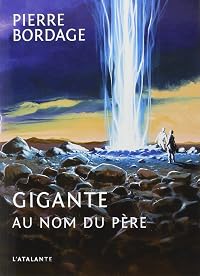
Gigante : Au nom du père
by Pierre Bordage
On This Page
Description
Le jeune ethnolinguiste Zaslo Merticant de’barque sur Gigante depuis la lointaine Azade’e, en qu©®te des mythiques ge’ants dont une expe’dition aurait exhume’ les squelettes des sie`cles plus to^t. Dans le but, e’galement, de tuer son pe`re, qui l'a abandonne’ avant m©®me sa naissance... Mais comment exercer une vengeance sur une plane`te dix-huit mille fois plus volumineuse que la Terre, ou` tout voyage est a` sens unique ? Comment m©®me voyager sur un monde parcouru de show more sphe`res incandescentes et d'orages e’lectriques d'une rare violence ? C'est l'histoire d'un apprentissage, celui d'un monde aux cole`res destructrices. Il passe par le cheminement de Zaslo vers l'apaisement inte’rieur jusqu'a` la de’couverte de son r©þle fondamental pour l'avenir des peuples humains disse’mine’s sur Gigante. Un planet opera... gigantesque. Ses capacite’s de conteur, son inventivite’ sans limites, permettent a` Pierre Bordage de s'affranchir de toutes les contraintes. Une fois encore, tel un Midas moderne, il transforme les sujets qu'il aborde en joyaux litte’raires. Lelitte’raire.com Conteur inve’te’re’ avant d'©®tre un architecte d'univers, Pierre Bordage s'ave`re un touche-a`-tout virtuose. Libe’ration show lessTags
Member Reviews
'Gigante' was a two-novels series, written respectively by Alain Grousset and Pierre Bordage. The first author would focus on the character of the father, while the latter would write the story from the POV of the son, hence the respective titles 'Au nom du fils' and 'Au nom du père'. While the books are connected (and more aimed at younger readers), I think both can be read independently.
What's Bordage's story about? A son who seeks revenge for the fact that his father abandoned him and his mother for the sake of pursuing new endeavours as and entholinguist. Zaslo never knew his father, so his upbringing wasn't ideal, especially since his mother couldn't cope with her husband having left them. Hence transmitting a sort of anger onto show more her son, who took it to heart and vowed to take his father out when they would meet on one giant planet called Gigante (French for gigantic). Oh yes, Zaslo was, like his father, an ethnolinguist.
Zaslo travelled to Gigante and would arrive sooner than his father, because technology for space travel had greatly progressed. However, the poor boy didn't have enough money to pay for his travels and stay. Fortunately, he met some people who would help him with that. Zaslo wouldn't even have to repay them, because these people were rich enough.
At some point, and as Gigante has its own laws of nature, like fireballs raining down the sky, electricity storms serving as means of (lighting-fast) transportation, ... Zaslo would realise that, in his quest for the Giants (the ancient, huge people being at the origin of colonisation or life on Gigante), he had no choice but to use those electrical storms. However, not everyone would be able to use them. All depended on one's inner self, one's "jid", one's spiritual soul. The use of said storms greatly changed a person, almost scorching them and modifying the colour of their eyes. And yet, the more attuned one became, the easier the travel would be.
About the Giants: a myth that is massively denied by the current people on Gigante, for whatever reason. Zaslo would, however, find a partner-in-crime, a woman formerly active as assistant, mercenary, and more. And as you can imagine (or is a bit custom with Bordage), there would be love. Not that it's crucial in the flow of things, because one can mutually understand one another without the need to express it physically. Especially on a not-so-habitable planet, of which most of its surface had yet to be discovered, like Gigante.
But anyway, Zaslo's original purpose would evaporate in favour of seeking the origins of the Giants, though it would cost him and his partner a lot. They would meet various wise people, helping them on their way, yet also warning them. One thought that continued to cross Zaslo's mind was that if you don't take the plunge/make a decision/step out of your comfort zone/..., you'll (probably) regret it for the rest of your life. Because the unknown might hide something better, could help you evolve, understand life in a different way, etc. But again, at a cost.
Throughout the story, Zaslo would have greatly changed, from scared teenager to someone with a higher self-confidence, a more altruistic/humanistic behaviour, and seeing the bigger picture. Especially when various people, living in remote areas, were in danger of perishing because of Gigante's moods. His quest for the origins of Gigante, or at least the first people (Giants), would not have been in vain. But again, at a cost.
----------
Pierre Bordage can tell a good story and he proved (partially, unfortunately) it with 'Gigante', too. There were several peaks that made it hard to put the book down. The short chapters (10-12 pages, on average) also contributed to this feeling. Good ideas here - typical of Bordage - and there and more than enough to return to Gigante to further explore the planet, its peoples, its fauna and flore, its linguistic side (since Zaslo was an ethnolinguist, like his father), the customs and habits of its peoples, ...
However, and that's probably due to certain constraints and like I saw in another review, there's a lot left untold, not shown. Also because Pierre Bordage mainly focuses on characters, less on world-building and exploration.
For instance, Gigante is indeed so massive that to travel fast, one must use the electric storms, which only come when circumstances are right. The planet has been colonised and terraformed here and there, as the food and businesses are quite like on Earth. I think there are big cities, but also smaller colonies, but not much is known about their respective governments.
The language is not that different from what humans speak on Earth, though the vocabulary varies a wee bit. Since our main character is an ethnolinguist, there should have been more exploration and explanation of the language(s) used on Gigante. It's a huge place, time works differently than on Earth and cities are hundred of thousands, if not millions, of kilometers apart. Why wasn't there more of linguistic exploration in the story? Zaslo could have been a plumber, a teacher, a mailman, ... because his education and forming wasn't ever put to use, I found.
Finally, the writing wasn't always superb, even if it was written in quite an accessible style. Sometimes very wordy for little progress.
----------
----------
Previously read, in chronological order: (not counting his stories published in various anthologies since his last collection)
* Chroniques des ombres (my review)
* Hier je vous donnerai de mes nouvelles (my review)
* Le Jour où la guerre s'arrêta (my review)
* Entretiens avec Pierre Bordage (my review)
* Contes des sages d'autres mondes et d'autres temps (my review)
* Contes des sages pas sages (my review)
* Dernières nouvelles de la Terre... (my review)
* Les Dames blanches (my review)
* Nouvelle Vie™ (my review)
* Les Derniers Hommes (my review)
* La Désolation (Arkane, #1) (my review) + La Résurrection (Arkane, #2) (my review)
Still on my TBR-pile:
* La Trilogie des Guerriers du silence (trilogy)
* Les Portes d'Occident + Les Aigles d'Orient (Wang duology)
* Le Livre des prophéties (omnibus)
* La Fraternité du Panca (omnibus)
* Les Fables de l'Humpur
* Abzalon + Orchéron
* Qui vient du bruit + Le Dragon aux plumes de sang (Griots Celestes duology)
* L'Enjomineur (trilogy) show less
What's Bordage's story about? A son who seeks revenge for the fact that his father abandoned him and his mother for the sake of pursuing new endeavours as and entholinguist. Zaslo never knew his father, so his upbringing wasn't ideal, especially since his mother couldn't cope with her husband having left them. Hence transmitting a sort of anger onto show more her son, who took it to heart and vowed to take his father out when they would meet on one giant planet called Gigante (French for gigantic). Oh yes, Zaslo was, like his father, an ethnolinguist.
Zaslo travelled to Gigante and would arrive sooner than his father, because technology for space travel had greatly progressed. However, the poor boy didn't have enough money to pay for his travels and stay. Fortunately, he met some people who would help him with that. Zaslo wouldn't even have to repay them, because these people were rich enough.
At some point, and as Gigante has its own laws of nature, like fireballs raining down the sky, electricity storms serving as means of (lighting-fast) transportation, ... Zaslo would realise that, in his quest for the Giants (the ancient, huge people being at the origin of colonisation or life on Gigante), he had no choice but to use those electrical storms. However, not everyone would be able to use them. All depended on one's inner self, one's "jid", one's spiritual soul. The use of said storms greatly changed a person, almost scorching them and modifying the colour of their eyes. And yet, the more attuned one became, the easier the travel would be.
About the Giants: a myth that is massively denied by the current people on Gigante, for whatever reason. Zaslo would, however, find a partner-in-crime, a woman formerly active as assistant, mercenary, and more. And as you can imagine (or is a bit custom with Bordage), there would be love. Not that it's crucial in the flow of things, because one can mutually understand one another without the need to express it physically. Especially on a not-so-habitable planet, of which most of its surface had yet to be discovered, like Gigante.
But anyway, Zaslo's original purpose would evaporate in favour of seeking the origins of the Giants, though it would cost him and his partner a lot. They would meet various wise people, helping them on their way, yet also warning them. One thought that continued to cross Zaslo's mind was that if you don't take the plunge/make a decision/step out of your comfort zone/..., you'll (probably) regret it for the rest of your life. Because the unknown might hide something better, could help you evolve, understand life in a different way, etc. But again, at a cost.
Throughout the story, Zaslo would have greatly changed, from scared teenager to someone with a higher self-confidence, a more altruistic/humanistic behaviour, and seeing the bigger picture. Especially when various people, living in remote areas, were in danger of perishing because of Gigante's moods. His quest for the origins of Gigante, or at least the first people (Giants), would not have been in vain. But again, at a cost.
----------
Pierre Bordage can tell a good story and he proved (partially, unfortunately) it with 'Gigante', too. There were several peaks that made it hard to put the book down. The short chapters (10-12 pages, on average) also contributed to this feeling. Good ideas here - typical of Bordage - and there and more than enough to return to Gigante to further explore the planet, its peoples, its fauna and flore, its linguistic side (since Zaslo was an ethnolinguist, like his father), the customs and habits of its peoples, ...
However, and that's probably due to certain constraints and like I saw in another review, there's a lot left untold, not shown. Also because Pierre Bordage mainly focuses on characters, less on world-building and exploration.
For instance, Gigante is indeed so massive that to travel fast, one must use the electric storms, which only come when circumstances are right. The planet has been colonised and terraformed here and there, as the food and businesses are quite like on Earth. I think there are big cities, but also smaller colonies, but not much is known about their respective governments.
The language is not that different from what humans speak on Earth, though the vocabulary varies a wee bit. Since our main character is an ethnolinguist, there should have been more exploration and explanation of the language(s) used on Gigante. It's a huge place, time works differently than on Earth and cities are hundred of thousands, if not millions, of kilometers apart. Why wasn't there more of linguistic exploration in the story? Zaslo could have been a plumber, a teacher, a mailman, ... because his education and forming wasn't ever put to use, I found.
Finally, the writing wasn't always superb, even if it was written in quite an accessible style. Sometimes very wordy for little progress.
----------
----------
Previously read, in chronological order: (not counting his stories published in various anthologies since his last collection)
* Chroniques des ombres (my review)
* Hier je vous donnerai de mes nouvelles (my review)
* Le Jour où la guerre s'arrêta (my review)
* Entretiens avec Pierre Bordage (my review)
* Contes des sages d'autres mondes et d'autres temps (my review)
* Contes des sages pas sages (my review)
* Dernières nouvelles de la Terre... (my review)
* Les Dames blanches (my review)
* Nouvelle Vie™ (my review)
* Les Derniers Hommes (my review)
* La Désolation (Arkane, #1) (my review) + La Résurrection (Arkane, #2) (my review)
Still on my TBR-pile:
* La Trilogie des Guerriers du silence (trilogy)
* Les Portes d'Occident + Les Aigles d'Orient (Wang duology)
* Le Livre des prophéties (omnibus)
* La Fraternité du Panca (omnibus)
* Les Fables de l'Humpur
* Abzalon + Orchéron
* Qui vient du bruit + Le Dragon aux plumes de sang (Griots Celestes duology)
* L'Enjomineur (trilogy) show less
Nov 4, 2024Dutch
Ratings
Members
- Recently Added By
Lists

French SF / SF française
52 works; 1 member
Author Information

96+ Works 2,006 Members
Series
Belongs to Publisher Series
Statistics
- Members
- 5
- Popularity
- 3,437,344
- Reviews
- 1
- Rating
- (2.50)
- Languages
- English, French
- Media
- Paper, Ebook
- ISBNs
- 3
- ASINs
- 1