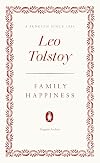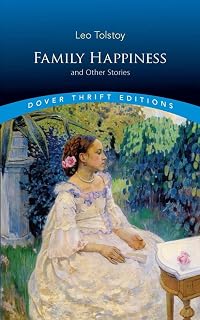
Family Happiness
by Leo Tolstoy
On This Page
Description
The story follows unconventional love and marriage of a young girl, Masha aged 17, and the much older Sergey Mikhaylych, an old family friend. The story is narrated by Masha. After a courtship that has the trappings of a mere family friendship, Masha's love grows and expands until she can no longer contain it. She reveals it to Sergey Mikhaylych and discovers that he also is deeply in love.Tags
Recommendations



































Member Reviews
I read three short works by Tolstoy published in one book: Family Happiness, Master and Man, and Alyosha the Pot. I never thought Tolstoy could be so accessible. The writing is beautifully elegant, seemingly simple yet highly nuanced. Tolstoy is one of the best writers of all time because he has his finger on the human spirit and great insight into the fabric of the human being. The stories are masterful.
In Family Happiness, seventeen-year-old Masha falls in love with a thirty-six-year-old man, and they eventually marry. The romance in their lives and their relationship change as the story progresses. There are many ways to interpret the dynamics of their actions and growth. It is truly a timeless tale.
Master and Man may be a parable. show more Brekhunov, the master, is a provincial innkeeper, church elder, and merchant preoccupied with his business ventures and money. He insists upon a journey that defies common sense, and Nikita, his guide, must abide by his wishes. A third character, a horse named Mukhorty, is the most intuitive creature in the tale. Tolstoy depicts class differences between the men and shows that human beings are driven by similar features, even if their societal standings differ.
Alyosha the Pot is the shortest of the stories yet striking because Tolstoy shows peasants' relative value in Russian society. Alyosha is an extremely hard worker whose human value is not readily apparent to the family for whom he works. Nevertheless, he is eager to please, and the reader sympathizes with him as he meets his fate.
See my reviews: https://quipsandquotes.net/ show less
In Family Happiness, seventeen-year-old Masha falls in love with a thirty-six-year-old man, and they eventually marry. The romance in their lives and their relationship change as the story progresses. There are many ways to interpret the dynamics of their actions and growth. It is truly a timeless tale.
Master and Man may be a parable. show more Brekhunov, the master, is a provincial innkeeper, church elder, and merchant preoccupied with his business ventures and money. He insists upon a journey that defies common sense, and Nikita, his guide, must abide by his wishes. A third character, a horse named Mukhorty, is the most intuitive creature in the tale. Tolstoy depicts class differences between the men and shows that human beings are driven by similar features, even if their societal standings differ.
Alyosha the Pot is the shortest of the stories yet striking because Tolstoy shows peasants' relative value in Russian society. Alyosha is an extremely hard worker whose human value is not readily apparent to the family for whom he works. Nevertheless, he is eager to please, and the reader sympathizes with him as he meets his fate.
See my reviews: https://quipsandquotes.net/ show less
I wanted to shake all the characters repeatedly, but well-written, interesting exploration of family dynamics.
Me encanta la literatura rusa, más si son clásicos, pero Tolstoi es uno de esos enormes placeres que me gusta dame, ¡cómo lo disfruto!, su hermosa prosa, fácil, sencilla pero tan profunda.
Con una inteligencia y con una facilidad impresionante Tolstoi nos pone en la mesa la realidad de lo que significa vivir en matrimonio.
Para Masha, quien es la que nos relata su vida en primera persona, conocer el amor, lo que significa amar tan profundamente a alguien, sentir el amor de esa otra persona, depender tanto de su marido en el buen sentido de la palabra, para luego encontrarse con cosas que ella no comprende.
Me ha parecido a mi que esa lucha de Masha por madurar, por ver su amor madurar es una manera tan clara y realista de presentar lo show more que les sucede en la realidad a los matrimonios, pero es que al final cuando Serguéi le hace ver a Masha la realidad de la situación, como ella tiene que madurar entender que también su amor ha cambiado y madurado, que no es desamor si no la plenitud del mismo, que la pasión que ella cree que falta y la convierte en desamor es en realidad la mutación de un amor más grande, es que, me ha parecido hermoso.
Es un libro precioso y uno puede ir pasando las páginas y es inevitable juzgar a Masha con sus actitudes, su modo equivocado de comportarse, su egoísmo, su vanidad y su orgullo o juzgar a Serguéi por su orgullo, su alejamiento, su frialdad o tal vez su indiferencia, para al final recibir una enorme lección de parte del autor, nadie podemos juzgar lo que sucede dentro de un matrimonio hasta conocer realmente las motivaciones o vivir dentro del corazón y la cabeza de ese matrimonio.
Un libro precioso, maravilloso y por supuesto super recomendable show less
Con una inteligencia y con una facilidad impresionante Tolstoi nos pone en la mesa la realidad de lo que significa vivir en matrimonio.
Para Masha, quien es la que nos relata su vida en primera persona, conocer el amor, lo que significa amar tan profundamente a alguien, sentir el amor de esa otra persona, depender tanto de su marido en el buen sentido de la palabra, para luego encontrarse con cosas que ella no comprende.
Me ha parecido a mi que esa lucha de Masha por madurar, por ver su amor madurar es una manera tan clara y realista de presentar lo show more que les sucede en la realidad a los matrimonios, pero es que al final cuando Serguéi le hace ver a Masha la realidad de la situación, como ella tiene que madurar entender que también su amor ha cambiado y madurado, que no es desamor si no la plenitud del mismo, que la pasión que ella cree que falta y la convierte en desamor es en realidad la mutación de un amor más grande, es que, me ha parecido hermoso.
Es un libro precioso y uno puede ir pasando las páginas y es inevitable juzgar a Masha con sus actitudes, su modo equivocado de comportarse, su egoísmo, su vanidad y su orgullo o juzgar a Serguéi por su orgullo, su alejamiento, su frialdad o tal vez su indiferencia, para al final recibir una enorme lección de parte del autor, nadie podemos juzgar lo que sucede dentro de un matrimonio hasta conocer realmente las motivaciones o vivir dentro del corazón y la cabeza de ese matrimonio.
Un libro precioso, maravilloso y por supuesto super recomendable show less
This is a story that begins as a fairy tale romance and ends in maternal happiness or sadness depending on your point of view.
Narrated by Masha, a teenage girl, the story tells of a courtship that has the trappings of a mere family friendship. Masha's falls in love with an older family friend, Sergey Mikhaylych whos is in his mid-thirties. Eros grips Masha and her love develops until she must reveal it to Sergey Mikhaylych and discovers that he also is deeply in love. If he has resisted her it was because of his fear that the age difference between them would lead the very young Masha to tire of him. He likes to be still and quiet, he tells her, while she will want to explore and discover more and more about life. Is Masha naive? show more Perhaps, but she may merely be willful. Her view of their "love" is idealized and she is unsure about her own consciousness of the world she has entered at such a young age. Nonetheless the couple are apparently passionately happy, so they engage to be married and move to Mikhaylych's home.
Masha soon feels impatient with the quiet order of life on the estate, notwithstanding the powerful understanding and love that remains between the two. She thinks to herself, "I began to feel lonely, that life was repeating itself, that there was nothing new either in him or myself, and that we were merely going back to what had been before."(p 62) To assuage her anxiety, they decide to spend a few weeks in St. Petersburg. Sergey Mikhaylych agrees to take Masha to an aristocratic ball. He hates "society" but she is enchanted with it and She becomes a regular, the darling of the countesses and princes, with her rural charm and her beauty. Sergey Mikhaylych, at first very pleased with Petersburg society's enthusiasm for his wife, frowns on her passion for "society"; but he does not try to influence Masha. She is not unaware of his feelings but tells herself that "If the relation between us has become a little different, everything will be the same again in summer, when we shall be alone in our house at Nikolskoe with Tatyana Semenovna."(p 74)
Out of respect for her, Sergey Mikhaylych allows his young wife to discover the truth about the emptiness and ugliness of "society" on her own. But his trust in her is damaged as he watches how dazzled she is by this world. Finally they confront each other about their differences. They argue but do not treat their conflict as something that can be resolved through negotiation. Both are shocked and mortified that their intense love has suddenly been called into question. She notices, "His face seemed to me to have grown suddenly old and disagreeable".(p 80) Her idealism has faded and with it the romance of her relationship. Because of pride, they both refuse to talk about it. The trust and the closeness are gone. Only courteous friendship remains. Masha yearns to return to the passionate closeness they had known before Petersburg. They go back to the country. Though she gives birth to children and the couple has a good life, she despairs. They can barely be together by themselves. Finally she asks him to explain why he did not try to guide and direct her away from the balls and the parties in Petersburg. The novella ends with a suggestion that she has accepted maternal happiness. Will this carry them forward together? And at what price--the loss of Romance?
Tolstoy deftly depicts nature throughout the story and uses music as a motif as well. Masha loves to play Beethoven's "Moonlight Sonata", especially the darkly romantic first movement. But there is a chilling scene near the end of the story when she plays the sonata:
"At the end of the first movement I looked round instinctively to the corner where he used once to sit and listen to my playing. He was not there: his chair, long unmoved, was still in its place: through the window I could see a lilac-bush against the light of the setting sun: the freshness of evening streamed through the open windows . . . I recalled with pain the irrevocable past, and timidly imagined the future. But for me there seemed to be no future, no desires at all and no hopes."(p 97)
While this seems bleak, there is hope by the end of the story with the suggestion that maternal love could be the foundation for a different kind of "Family Happiness". show less
Narrated by Masha, a teenage girl, the story tells of a courtship that has the trappings of a mere family friendship. Masha's falls in love with an older family friend, Sergey Mikhaylych whos is in his mid-thirties. Eros grips Masha and her love develops until she must reveal it to Sergey Mikhaylych and discovers that he also is deeply in love. If he has resisted her it was because of his fear that the age difference between them would lead the very young Masha to tire of him. He likes to be still and quiet, he tells her, while she will want to explore and discover more and more about life. Is Masha naive? show more Perhaps, but she may merely be willful. Her view of their "love" is idealized and she is unsure about her own consciousness of the world she has entered at such a young age. Nonetheless the couple are apparently passionately happy, so they engage to be married and move to Mikhaylych's home.
Masha soon feels impatient with the quiet order of life on the estate, notwithstanding the powerful understanding and love that remains between the two. She thinks to herself, "I began to feel lonely, that life was repeating itself, that there was nothing new either in him or myself, and that we were merely going back to what had been before."(p 62) To assuage her anxiety, they decide to spend a few weeks in St. Petersburg. Sergey Mikhaylych agrees to take Masha to an aristocratic ball. He hates "society" but she is enchanted with it and She becomes a regular, the darling of the countesses and princes, with her rural charm and her beauty. Sergey Mikhaylych, at first very pleased with Petersburg society's enthusiasm for his wife, frowns on her passion for "society"; but he does not try to influence Masha. She is not unaware of his feelings but tells herself that "If the relation between us has become a little different, everything will be the same again in summer, when we shall be alone in our house at Nikolskoe with Tatyana Semenovna."(p 74)
Out of respect for her, Sergey Mikhaylych allows his young wife to discover the truth about the emptiness and ugliness of "society" on her own. But his trust in her is damaged as he watches how dazzled she is by this world. Finally they confront each other about their differences. They argue but do not treat their conflict as something that can be resolved through negotiation. Both are shocked and mortified that their intense love has suddenly been called into question. She notices, "His face seemed to me to have grown suddenly old and disagreeable".(p 80) Her idealism has faded and with it the romance of her relationship. Because of pride, they both refuse to talk about it. The trust and the closeness are gone. Only courteous friendship remains. Masha yearns to return to the passionate closeness they had known before Petersburg. They go back to the country. Though she gives birth to children and the couple has a good life, she despairs. They can barely be together by themselves. Finally she asks him to explain why he did not try to guide and direct her away from the balls and the parties in Petersburg. The novella ends with a suggestion that she has accepted maternal happiness. Will this carry them forward together? And at what price--the loss of Romance?
Tolstoy deftly depicts nature throughout the story and uses music as a motif as well. Masha loves to play Beethoven's "Moonlight Sonata", especially the darkly romantic first movement. But there is a chilling scene near the end of the story when she plays the sonata:
"At the end of the first movement I looked round instinctively to the corner where he used once to sit and listen to my playing. He was not there: his chair, long unmoved, was still in its place: through the window I could see a lilac-bush against the light of the setting sun: the freshness of evening streamed through the open windows . . . I recalled with pain the irrevocable past, and timidly imagined the future. But for me there seemed to be no future, no desires at all and no hopes."(p 97)
While this seems bleak, there is hope by the end of the story with the suggestion that maternal love could be the foundation for a different kind of "Family Happiness". show less
My first impression was one of respect for Tolstoy's ability to write from the female perspective. Masha was the main character. As the story progressed, Masha seemed to have some extreme highs & lows. I wonder if that is how men view women when they cannot grasp the female psyche. Was Tolstoy the first man to understand women or is love that difficult?
I wanted to shake all the characters repeatedly, but well-written, interesting exploration of family dynamics.
I wanted to shake all the characters repeatedly, but well-written, interesting exploration of family dynamics.
Members
- Recently Added By
Lists

Books Read in 2023
5,638 works; 147 members

Reading List of Christopher McCandless
12 works; 1 member

Recommended Literary Books
111 works; 1 member

Book wishlist
78 works; 1 member

Las mejores obras literarias releídas en 2023 (R. D.)
11 works; 1 member
Author Information

2,530+ Works 130,077 Members
Count Lev Nikolayevich Tolstoy was born on September 9, 1828 in Russia. He is usually referred to as Leo Tolstoy. He was a Russian author who is regarded as one of the greatest authors of all time. Leo Tolstoy is best known for his novels War and Peace (1869) and Anna Karenina (1877). Tolstoy's fiction includes dozens of short stories and several show more novellas such as The Death of Ivan Ilyich, Family Happiness, and Hadji Murad. He also wrote plays and numerous philosophical essays. Tolstoy had a profound moral crisis and spiritual awakening in the 1870's which he outlined in his work, A Confession. His literal interpretation of the ethical teachings of Jesus, centering on the Sermon on the Mount, caused him to become a fervent Christian anarchist and pacifist. His ideas of nonviolent resistance which he shared in his works The Kingdom of God is Within You, had a profund impact on figures such as Mohandas Gandhi and Martin Luther King, Jr. On September 23, 1862 Tolstoy married Sophia Andreevna Behrs. She was the daughter of a court physician. They had 13 children, eight of whom survived childhood. Their early married life allowed Tolstoy much freedom to compose War and Peace and Anna Karenina with his wife acting as his secretary and proofreader. The Tolstoy family left Russia in the aftermath of the Russian Revolution and the subsequent establishment of the Soviet Union. Leo Tolstoy's relatives and descendants moved to Sweden, Germany, the United Kingdom, France and the United States. Tolstoy died of pneumonia at Astapovo train station, after a day's rail journey south on November 20, 1910 at the age of 82. (Bowker Author Biography) Count Leo Tolstoy was born in 1828 on the family estate of Yasnaya Polyana in the Tula province. He married in 1862 & was the father of 13 children. Tolstoy managed the estate of Yasnaya Polyana & ran its peasant schools, while writing his great novels, "War & Peace" (1869) & "Anna Karenina" (1877). He died in 1910. (Publisher Provided) show less
Some Editions
Awards and Honors
Distinctions
Series
Belongs to Publisher Series
Work Relationships
Is contained in
Common Knowledge
- Canonical title
- Family Happiness
- Original title
- Семейное счастье = Semejnoe sčastʹe
- Original publication date
- 1859
- People/Characters*
- Mashechka; Sergey Mikhaylych
- Quotations
- I have lived through much, and now I think I have found what is needed for happiness. A quiet secluded life in the country, with the possibility of being useful to people to whom it is easy to do good, and who are not accusto... (show all)med to have it done to them; then work which one hopes may be of some use; then rest, nature, books, music, love for one’s neighbor — such is my idea of happiness.
- Original language
- Russian
*Some information comes from Common Knowledge in other languages. Click "Edit" for more information.
Classifications
- Genres
- Fiction and Literature, General Fiction
- DDC/MDS
- 891.733 — Literature & rhetoric Literatures of other languages East Indo-European and Celtic literatures Russian and East Slavic languages Russian fiction 1800–1917
- LCC
- PG3366 .A13 — Language and Literature Slavic languages and literatures. Baltic languages. Albanian language Slavic. Baltic. Albanian Russian literature Individual authors and works 1800-1870 Tolstoi
- BISAC
Statistics
- Members
- 586
- Popularity
- 50,263
- Reviews
- 18
- Rating
- (3.84)
- Languages
- 14 — Catalan, Dutch, English, Finnish, French, German, Italian, Farsi/Persian, Polish, Portuguese, Russian, Spanish, Swedish, Turkish
- Media
- Paper, Ebook
- ISBNs
- 66
- ASINs
- 22