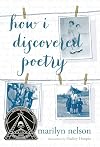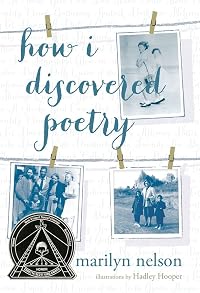
How I Discovered Poetry
by Marilyn Nelson
On This Page
Description
The author reflects on her childhood in the 1950s and her development as an artist and young woman through fifty poems that consider such influences as the Civil Rights Movement, the "Red Scare" era, and the feminist movement.Tags
Recommendations













Member Reviews
How I Discovered Poetry by Marilyn Nelson is a delightful book of poetry that offers a glimpse into 1950s America through the life of Nelson and her family. Nelson's poetry tells a story that engaged me, made me think, and touched my heart so much I often found myself looking forward to my nightly poetry reading, thinking about the poems throughout the day, and reading more than my allotted number of poems per day. Nelson pulls words together into poetry that weaves world events, American society, interracial relations, and family together with finesse and honesty. How I Discovered Poetry is as much about discovering life as it is about discovering poetry.
This is a memoir in poems, encompassing 10 years of Nelson's life from 1950-1960. There are a few poems for each year, but what is significant and touching is that it encompasses not only her personal life (ages 4 to 14), but also national events. She was the daughter of "one of the first African-American career officers in the Air Force" and within the 10 year span lived at least 5 different places. There is a lot of material here for reflection. Often her family was the "first Negro" in a variety of settings -- sometimes the first in the town or school as shown in the poem "Making History." This was both a burden and an opportunity, especially in this particular era. Nelson captures these themes with grace and brevity and depth, show more staying true to the viewpoint and understanding of her age at the time. In the poem "Telling Time" (age 5) she simplifies: "Past is before now; future is after. Now is a five-minute eternity." Other reflections of the era include "Bomb Drill" "Sputnik" and more personally "The Queen of 6th Grade" because really our history starts with us and the wider world gradually intrudes. show less
HOW I DISCOVERED POETRY by Marilyn Nelson is a series of unrhymed sonnets based on her life and what was going on around her during the 1950s. It spans a decade, beginning with the innocent voice of a 4-year-old and ending as a 13-year-old who is still a child, but beginning to understand the world and her place in it as her father and family relocate numerous times to Air Force bases around the country. I was born on an AFB in Rome, NY, and my brothers were born on one in Fort Worth, TX. Maybe that's part of the reason I loved this book. My father got out of the military when I was young, but we continued to move around (he was always a grass-is-greener-on-the-other-side-of-the-fence person), so I understand what it's like to forever show more be the new kid (eight schools total and five of those before age ten). As one of Nelson's poems states, "When you die, you go to a different school." I can relate. Early on, she loses herself in books, the way I always did (and do). Marilyn's story, though, has the added layer of being the new African American family in town. At eight, she learns that "TV is black-and-white, but people aren't / There's a bad name mean people might call you…"
Marilyn records her story with grace, not sinking into sentimentality or a poor-me attitude. The voice of a child is true ("That's why I'm here petting this stupid cow") as is the teenager who discovers poetry and the power of words. This is definitely a book to give a poetry lover or a child who feels different or alone. Some of my favorite lines from "Just Pick a Name":
What if I left a note in a mailbox
out in the boonies, far from any town,
that said, I know it's hard. You're doing fine.
I wonder: Would that make things different? show less
Marilyn records her story with grace, not sinking into sentimentality or a poor-me attitude. The voice of a child is true ("That's why I'm here petting this stupid cow") as is the teenager who discovers poetry and the power of words. This is definitely a book to give a poetry lover or a child who feels different or alone. Some of my favorite lines from "Just Pick a Name":
What if I left a note in a mailbox
out in the boonies, far from any town,
that said, I know it's hard. You're doing fine.
I wonder: Would that make things different? show less
How I Discovered Poetry is a semi-autobiographical collection of 50 poems that cover the speaker's life through the 1950's, from ages 4 to 14. The speaker (how Nelson prefers we refer to the narrator) moves around quite a bit due to her father's career in the Air Force. While the poems tell a more complete story when taken together, there are too many narrative gaps to consider this to be a verse novel. These poems cover many topics, including racial issues and 1950's historical events, but are primarily about how the speaker falls in love with words. I was pretty fascinated by the speakers life story, and this book made me interested to read more about Nelson's life, as well as her father's. The simple illustrations by Hadley Hooper show more add visual interest and highlight important themes or ideas. show less
Wouldn't it be awesome if African American memoirs-in-verse just started flooding the children's market? (Or the entire book market, for that matter.) I really liked the sonnet structure and the perspective of being the daughter of one of the first career Air Force African Americans. I didn't feel like I got to know the speaker and her friends and family quite as well as everyone in Jacqueline Woodson's Brown Girl Dreaming (the obvious 2014 comparison) and thus didn't experience quite the same stirrings, but all the same, this book offers a unique perspective couched in a turbulent decade.
Marilyn Nelson uses poetry to remember her early years moving from military base to base. It is sophisticated as she attempts to capture her understanding and gaps of knowledge of the world around her in these short poems that span from age 4 - 14 during the 1950s. Her African-America family lives all around the United States in these years and has different experiences during this time around the country.
A quick read that requires readers to bring some knowledge of history to the text and reflect on the poems in order to help construct an understanding of the narrative.
A quick read that requires readers to bring some knowledge of history to the text and reflect on the poems in order to help construct an understanding of the narrative.
This book is a memoir collection of poems that cover Ms. Nelson’s formative years in the 1950s. They reflect her awareness of language and her development as an artist from the time she was 4 in 1950, until she was 14 in 1960. Each page offers a poem and the opposing page either a photograph from Ms. Nelson’s past or an illustration by Hadley Hooper. Great book for narration, poetry, cultural references.
Members
- Recently Added By
Lists

Red Dot 2014-2015 - Older Readers - Longlist
37 works; 4 members
Author Information

31+ Works 2,628 Members
Marilyn Nelson is the author of numerous books, including The Cachoeira Tales and Other Poems, The Fields of Praise, and Magnificat. Her honors include three National Book Award Finalist medals, the Frost Medal, the Poets' Prize, and the Boston Globe/Hornbook Award. Nelson is an emeritus professor at the University of Connecticut, the former poet show more laureate of Connecticut, and founder and director of Soul Mountain Retreat. show less
All Editions
Awards and Honors
Awards
Distinctions
Notable Lists
Classifications
Statistics
- Members
- 177
- Popularity
- 185,093
- Reviews
- 12
- Rating
- (3.92)
- Languages
- English
- Media
- Paper, Ebook
- ISBNs
- 4
- ASINs
- 2