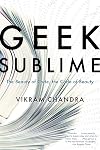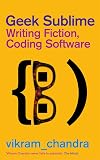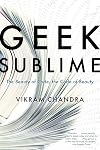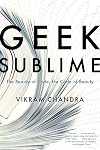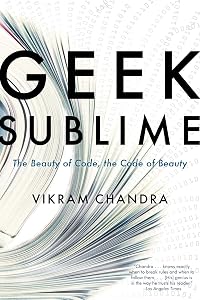
Geek Sublime: The Beauty of Code, the Code of Beauty
by Vikram Chandra
On This Page
Description
Biography & Autobiography. Nonfiction. Vikram Chandra has been a computer programmer for almost as long as he has been a novelist. In this extraordinary new book, his first work of nonfiction, he searches for the connections between the worlds of art and technology. Coders are obsessed with elegance and style, just as writers are, but do the words mean the same thing to both? Can we ascribe beauty to the craft of writing code? Exploring such varied topics as logic gates and literary show more modernism, the machismo of tech geeks, the omnipresence of an "Indian Mafia" in Silicon Valley, and the writings of the eleventh-century Kashmiri thinker Abhinavagupta, Geek Sublime is both an idiosyncratic history of coding and a fascinating meditation on the writer's art. Part literary essay, part technology story, and part memoir, it is an engrossing, original, and heady book of sweeping ideas. show lessTags
Recommendations





Member Reviews
I am a computer programmer... I have designed and built computer circuit - LS7400 and wire-wrap! - written simple operating systems, I/O device drivers, and lots of application code. Half of Chandra's book is about hardware and software technology. It was well written and pulls in tasty morsels - e.g. a nice story of programming on a machine with drum storage, and using placement of instructions on the drum to introduce desired delay - so I was never bored or felt like skipping anything.
I am also a student of Indian philosophy. Chandra here dives into the rasa aesthetic theory of Abhinavagupta. I have heard a bit about that before but never in any depth at all. Chandra sketches out the basics very nicely. I felt like I really learned show more something.
I'm not exactly sure how these two parts of the book were intended to fit together. Certainly it was a delight to learn about Panini's grammar and how that has given Sanskrit a formal structure and a kind of timeless quality. But then the rasa theory shows how meaning is not really so timeless, since it depends on resonance with memories of the reader.
I think the idea is to contrast this time-dependent quality of literature with the mechanical timelessness of software. But really most software is hardly self-contained at all It's shot through with interfaces to other packages and services. That's a lot of why software needs to be maintained, because the other systems it's connected to are always changing. The meaning of software is also quite time-dependent! Or maybe that was Chandra's point and I just missed it? Or maybe, rasa-style, he just suggested it so it feels like I figured it out for myself? Not impossible!
The book felt like a short little wade on the edge of a vast ocean, maybe like in South Africa, where the Indian and Atlantic Oceans meet. show less
I am also a student of Indian philosophy. Chandra here dives into the rasa aesthetic theory of Abhinavagupta. I have heard a bit about that before but never in any depth at all. Chandra sketches out the basics very nicely. I felt like I really learned show more something.
I'm not exactly sure how these two parts of the book were intended to fit together. Certainly it was a delight to learn about Panini's grammar and how that has given Sanskrit a formal structure and a kind of timeless quality. But then the rasa theory shows how meaning is not really so timeless, since it depends on resonance with memories of the reader.
I think the idea is to contrast this time-dependent quality of literature with the mechanical timelessness of software. But really most software is hardly self-contained at all It's shot through with interfaces to other packages and services. That's a lot of why software needs to be maintained, because the other systems it's connected to are always changing. The meaning of software is also quite time-dependent! Or maybe that was Chandra's point and I just missed it? Or maybe, rasa-style, he just suggested it so it feels like I figured it out for myself? Not impossible!
The book felt like a short little wade on the edge of a vast ocean, maybe like in South Africa, where the Indian and Atlantic Oceans meet. show less
Is computer programming an art? Through his dual experience as a successful computer programmer and author of fiction, Chandra is perfectly situated to tackle this complex issue. In this fascinating memoir, he draws a parallel between programming languages and the intricate grammatical rules of Sanskrit, which arguably played an instrumental role in the establishment of the algorithmic principles that eventually evolved into computer instructions. Although the first chapters on the principles and history of coding are brilliantly eloquent - as is the very convincing critic of the inherent machismo of the IT community - the rest of the book quickly evolves into a rather dense discussion of literature aesthetics. And eventually leads to a show more bittersweet conclusion: code is code, it ultimately exists for a purpose. The intrinsic elegance of a computer program will only be perceptible by a very select group of human beings, as in, arguably, literature. But that is all right, for the true beauty both of a computer program and a good book lies more in how if affects the life of the user/reader than in arcane language rules. Who can object to that after a hundred pages of Sanskrit theory? show less
I'm having trouble figuring out how to summarize this book, and I think that tells you something about the problems with it.
There is a lot of really fascinating information in here, but it doesn't really hold together. Chandra is trying to write about the relationship between programming and literature, specifically Sanskrit literature. In the first chapters, he talks about the world of computer programming, especially the machismo and racism that are built into today's programming culture. He sets up a straw man: some programmers talk about code as art.
The middle chapters of the book focus on Sanskrit literature. At first, the connection to programming seems clear: early Sanskrit grammarians wrote a set of rules that sound very much show more like coding algorithms, and some of the early coding languages took these ancient Sanskrit grammars into account when inventing their artificial languages. But then Chandra veers off into a discussion of Indian aesthetics. This is fascinating information, but it's really hard to tell where he's going with it.
Actually, here is where I think he was going with it: he needed to get this off his chest. He needed to explore it for his own development as an Indian-American writer. He needed to understand his Sanskrit roots, and how they manifest in his post-colonial literature. He wrote these chapters for himself, so that he could come to terms with his Indian past and how it fits into his American present.
But then, at the very end, he remembers that he has set out to write a book about programming, so he has a very brief chapter in which he argues that the theory of aesthetics does not apply to code, so code isn't art and that's the end of that.
I am glad I read this book. There is a lot of fascinating information in it. I myself am a programmer who took it up after years as an artist (musician and writer), and I have studied a lot of postcolonial literature, so the information in this book is right up my alley. Unfortunately, Chandra's argument really didn't have much coherence, and I feel like this was mostly a personal exploration for Chandra's own benefit. show less
There is a lot of really fascinating information in here, but it doesn't really hold together. Chandra is trying to write about the relationship between programming and literature, specifically Sanskrit literature. In the first chapters, he talks about the world of computer programming, especially the machismo and racism that are built into today's programming culture. He sets up a straw man: some programmers talk about code as art.
The middle chapters of the book focus on Sanskrit literature. At first, the connection to programming seems clear: early Sanskrit grammarians wrote a set of rules that sound very much show more like coding algorithms, and some of the early coding languages took these ancient Sanskrit grammars into account when inventing their artificial languages. But then Chandra veers off into a discussion of Indian aesthetics. This is fascinating information, but it's really hard to tell where he's going with it.
Actually, here is where I think he was going with it: he needed to get this off his chest. He needed to explore it for his own development as an Indian-American writer. He needed to understand his Sanskrit roots, and how they manifest in his post-colonial literature. He wrote these chapters for himself, so that he could come to terms with his Indian past and how it fits into his American present.
But then, at the very end, he remembers that he has set out to write a book about programming, so he has a very brief chapter in which he argues that the theory of aesthetics does not apply to code, so code isn't art and that's the end of that.
I am glad I read this book. There is a lot of fascinating information in it. I myself am a programmer who took it up after years as an artist (musician and writer), and I have studied a lot of postcolonial literature, so the information in this book is right up my alley. Unfortunately, Chandra's argument really didn't have much coherence, and I feel like this was mostly a personal exploration for Chandra's own benefit. show less
This guy broke my brain and I loved it. Code, Indian literature, computers, memoir all deliciously stirred together. In some ways, it may seem that he jumps all over the place but honestly this book just flows so nicely and you’re learning at the same time and it all meshes.
A definite recommend
A definite recommend
A little too encyclopedic on the Indian poetry/Sanskrit, but a good description of what creativity looks like when writing code.
There are a lot of great insights, quotes and stories in this book regarding programming and writing, art and asthetics. I also really appreciated his perspective as a man from India who came to U.S. and supported his passion for writing fiction by writing code. But the parts on Indian aesthetic theories felt like they could have been handled better. These chapters caused me to alternate between "YES YES YES!" and "Wait, what?!" I'll need to re-read those sections because I found the ideas fascinating, but he was using too many Sanskrit terms that were defined once before leaving the reader to remember them on later reference. (Define your variables in scope, please!)
Also, for such a good critique of macho/bro tech culture and lack of show more women in tech in the U.S., I was surprised how few women were cited and used as examples outside of Ada Lovelace, Grace Hopper and the original ENIAC programmers. Even for hypothetical archetypes like "Ted" (I know the Einsteins and Morts were not of his invention, so I can't fault him there).
Overall, I definitely recommend this for lovers of code, literature, poetry, art and aesthetics. show less
Also, for such a good critique of macho/bro tech culture and lack of show more women in tech in the U.S., I was surprised how few women were cited and used as examples outside of Ada Lovelace, Grace Hopper and the original ENIAC programmers. Even for hypothetical archetypes like "Ted" (I know the Einsteins and Morts were not of his invention, so I can't fault him there).
Overall, I definitely recommend this for lovers of code, literature, poetry, art and aesthetics. show less
This book is initially about the experience of computer program coding, but morphs into excursions into Panini linguistics and Sanskrit poetry. It's really an interesting book even if it isn't tightly woven. Indian philosophy is very broad ranging and the Sanskrit language is the mother lode of the Indo-European language grammar. As a person who likes comparative linguistics I sometimes have a different perspective on morphology and its effects. Chandra discusses the phrase gangayam ghoshah (a village on the Ganga) and I can see that the first word is accusative, but Chandra, under the influence of Anandavardhana is taken with this expression's figurative or metaphorical implications, whereas I would start with morphology and then show more proceed.
Although I learned Fortran in the late 1960s, I did not become a coder but only wrote programs very infrequently. show less
Although I learned Fortran in the late 1960s, I did not become a coder but only wrote programs very infrequently. show less
Members
- Recently Added By
Published Reviews
ThingScore 88
(...) a compendium of delight in which Chandra delves with relish into the bowels of technology and the intricate mechanisms of linguistic suggestion, drawing on his own experiences to create an extraordinary thesis that is part autobiography, part crash course in coding and unfailingly an ode to language.
(...) an eloquent tribute to text and its ability to shape our emotions, and rewrite the show more very world we live in. show less
(...) an eloquent tribute to text and its ability to shape our emotions, and rewrite the show more very world we live in. show less
added by timtom
Chandra is brilliant at technical exegesis – explaining logic gates, or evoking the appeal of "object-oriented programming" – but he also casts a sceptical eye on modern coding culture, especially its generalised misogyny.
added by timtom
(...) a thought-provoking set of linked essays that are part memoir, part analysis of geeks, part aesthetic treatise.
(...) a delight to read and never prescriptive.
(...) a delight to read and never prescriptive.
added by timtom
Lists

Top Five Books of 2015
811 works; 241 members
Author Information

12+ Works 4,056 Members
Author Vikram Chandra was born in New Delhi, India in 1961. He attended college in the United States receiving a BA in English with a concentration in creative writing from Pomona College and attended the film school at Columbia University before dropping out to work on his first novel. His first novel, Red Earth and Pouring Rain, was inspired by show more an autobiography of a nineteenth century soldier named Colonel James "Sikander" Skinner. It won the Commonwealth Writers Prize for Best First Book and the David Higham Prize for Fiction. His next novel, Love and Longing in Bombay, won the Commonwealth Writers Prize for Best Book (Eurasia region) and was short-listed for the Guardian Fiction Prize. In 2000, he and Suketu Mehta co-wrote the Bollywood movie Mission Kashmir. He teaches creative writing at the University of California and currently divides his time between Berkeley, California and Mumbai. (Bowker Author Biography) show less
Awards and Honors
Awards
Distinctions
Common Knowledge
- Alternate titles
- Geek Sublime: Writing Fiction; Coding Software
- Original publication date
- 2013
- People/Characters
- Anandavardahana; Abhinavagupta
- First words
- class Program
{
public static void Main ()
{
System.Console.WriteLine( "Hello, world!" );
... (show all); }
}
Even if you're the type of person who tells new acquaintances at dinner parties that you hate e-mail and e-books, you probably recognize the words above as being some sort of computer code. - Quotations
- The second postcard from Alan Turing to Robin Gandy contains:
III. The Universe is the interior of the Light Cone of the Creation.
IV. Science is a Differential Equation. Relig... (show all)ion is a Boundary Condition.
Third postcard:
V. Hyperboloids of wondrous Light
Rolling for aye through Space and Time
Harbour there Waves which somehow Might
Play out God's holy pantomime. - Last words
- (Click to show. Warning: May contain spoilers.)If so, an obsession with contradiction, paradox, ambiguity, and mirroring has been my repetition, one that I'm happy with. Repetition need not only be a grim karmic necessity or an endless rehearsal of trauma. In the practice of fiction, what is tasted--first and then again--is consciousness itself.
- Blurbers
- Poole, Steven; Pears, Iain
Classifications
- Genres
- Technology, Literature Studies and Criticism, Biography & Memoir
- DDC/MDS
- 809.93356 — Literature & rhetoric Literature, rhetoric & criticism History, description, critical appraisal of more than two literatures Literature displaying specific features, miscellaneous writings Literature displaying other aspects Literature dealing with specific themes and subjects Humanity Scientific and technical
- LCC
- PN56 .T37 .C426 — Language and Literature Literature (General) Literature (General) Theory. Philosophy. Esthetics
- BISAC
Statistics
- Members
- 310
- Popularity
- 103,368
- Reviews
- 12
- Rating
- (3.38)
- Languages
- English, French, Italian
- Media
- Paper, Audiobook, Ebook
- ISBNs
- 8
- UPCs
- 1
- ASINs
- 3