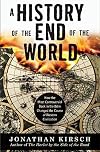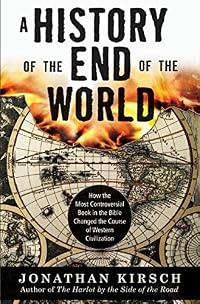
A History of the End of the World
by Jonathan Kirsch
On This Page
Description
"A learned, lively, … literary tour of the life and the improbable afterlife of the greatest apocalypse of them all." - Jack Miles, Pulitzer Prize-winning author of God: A Biography and Christ: A Crisis in the Life of God "[A]n important book that is essential reading in our torn, conflicted world: it is articulate, learned and balanced." - Karen Armstrong, New York Times bestselling author of A History of God and The Spiral Staircase "This book does what history is supposed to do…A show more truly fine book." - John M. Barry, New York Times bestselling author of The Great Influenza "[A] delightful, 2,000 year journey…. a fine book that merits wide readership." - Publishers Weekly "Fascinating - and sure to provoke heated discussion." - Booklist "Kirsch's splendid examination of this dark corner of religious resentment holds out a new perspective and, mercifully, some solace." - Los Angeles Times "A thorough account of the intellectual and spiritual mischief that Revelation has spawned." - Washington Post "Kirsch traces Revelation's 2,000-year history --- a "romantic tale, full of intrigue and suspense" --- in lucid, captivating prose." - Atlanta Journal-Constitution. show lessTags
Recommendations











Member Reviews
Is A History of the End of the World an expedient critique or a sarcastic attempt to highlight the Christian delusions in the Book of Revelation? While Jonathan Kirsch’s treaty is well structured and placed in the context of the Book of Daniel, it provides nothing new or illuminating.
It is an easy and non-offensive read in a sermon style, so much so that that I perceive it as ignorant and arrogant. It is strikingly brilliant how the author lists truly offensive passages and analysis as if they would not have had a catastrophic impact on human development through millennia. For example:
“If John is seeking to scare his readers and hearers into shunning their pagan friends, neighbors, and kinfolk, the demonization of Roman show more coinage─and the condemnation of the ‘cargo’ that it could buy─was a clever psychological tool. After all, Christian true believers could congratulate themselves on their own poverty, whether self-imposed or not, by reminding themselves that participating in pagan commerce was equivalent to bargaining with the Devil. They are encouraged by the book of Revelation to console themselves with dreams of the day when God will punish the collaborators who took the Devil’s coin. And revenge, as we shall see, is among the core values of Revelation.”
As an author that focuses on social economics of poverty, I am alarmed at what level Kirsch seems to be desensitized or contempt to a wording that has, according to the writer, clearly Jewish origins. There is no compassion for and no relation to billions that live in (Jewish) religion induced poverty today and through the ages. A mere statement of the intolerable makes it seem as the author welcomes the consequences of the Jewish follies (or at least not condemns it). Glorification of poverty by Christians (and Muslims, both guided by Judaic scriptures) seems to me offensive in itself. It merited the mentioning of a strong connection between ongoing humanitarian disasters and teachings that should have been rooted out on inception as crimes against humanity. Instead, Kirsch seems to like the teachings of the New Testament where quite obviously (the Roman) civilization is rejected.
The author repeatedly refers to the possibility that numerous writers thought the Book of Revelation should not have been included in the New Testament, Luther among them. The point is: the discussion about its potential elimination is in vain. Christians cannot pick and choose from the “prophetic” stock of Judaic writings. They believe or they don’t. They half believe in what the New Testament says? A History of the End is selective reading at its best, and that is also the main shortcoming of the book. In other words, while the author rejects the Book of Revelation, he obviously embraces the rest and seeks out an expedient version of history and context.
Like other authors with similar interests and background, there seems to be no critical thought as to a possible placement in time of the Revelation, despite illuminating every possible angle of its authorship. The first century is a done deal. However, “prophesies” arose from necessity in a slow moving context of either sectarian conflicts or clashes with the authorities. More importantly, they were written AFTER a disaster. Given that the Temple in Jerusalem was destroyed in the first century and six thousand Jews were crucified (not Christians), one could be content with this marking the end of the world (for the Jews). However, this is the twentyfirst century and our critical capabilities should have evolved a little further than that. In my book The Great Leap-Fraud, which is certainly not beyond error, it is demonstrated when and how prophesies were written and embedded into pre-existing material. If carbon dating on the earliest known copies would be conducted, we had a starting point +/- 50 years or so, provided that it had not been written on the back of an older text or on top of a washed off subscript. So far, the Oxyrhynchus Papyri are dated with Palaeography to the early fourth century. Palaeography is not good enough, though. The forgers knew quite well what they were doing. My hypothesis is that the book might have been fathered much later, possibly based on Augustine’s core ideas, which have also been edited. Augustine displays precise doctrinal ideas that were fought over only after his death. Distractions into the relationship between church and state as well as Chalcedonian definitions should be strong hints at dating later edits. A simple analysis of word use in The City of God reveals an over utilization of terms in books XVII, XVIII, and XX. The word Revelation (as in the book) only appears in book XX and notably not thereafter. Any attentive reader of Augustine should immediately recognize that the Revelation is a prerequisite for the study of book XX. Rather than dealing with the big picture, it explores expertly details in an abstract fashion that is far removed from those that have not pondered the deeper meanings of the New Testament including the Revelation. But why the need to forge the Revelation into fifth century Augustine? Is the Revelation possibly altogether a post-Chacedonian invention? Given the convoluted consensus, the Book of Revelation just does not seem to fit into an early context. Hence, instead of thinking and exploring, the author resorts to the consensus.
The scriptures of Judaism, Christianity, and Islam are a house of cards that rests on serial frauds. It is time to apply reason rather than blind faith in assessing “A History of the End of the World” as presented by the author. For starters, the consensus accepts the unreliability of Eusebius’s testimonies, which the author includes in his evidence. However, by erasing this single author, the history of the Book of Revelation before Constantine the Great simply vanishes, except for a few dubious passages that may or may not refer to the text. However, since Constantine is (fraudulently) claimed a Christian, the Revelation would make absolutely no sense─it was Christian heaven under the guiding hand of that Roman Emperor, so it is claimed. There lies the paradox to be solved. As the author points out, the source could not have been the Eastern Syrian Church or Christian Orthodoxy. For the West it can be excluded also. The Great Leap-Fraud shows that Pope Gregory the Great had no knowledge of the Revelation in the sixth century. Hence, where then is it coming from? I think that the author treats the most exciting questions of his topic with contempt.
Given this riddle, it seems noteworthy that the author does not make an effort to include the pre-Islamic or Persian worlds in the events around the millennium, the supposed end of the world. As laid out in The Great Leap-Fraud, the Muslim world─for some inexplicable reason (for the consensus that is)─was shaken by the Doomsday, so much so that they resorted to destroying churches all over the caliphate(s) and displayed a lifestyle of the walking dead. The author comments about a post-millennium monk of Fleury in France, who seemed perplexed about the content of a sermon, as if he had heard the Revelation for the first time. Why not start wondering? Is it possible that Revelation was absent from the West? If so, who were its carriers? When did it arrive and where? Is it an eastern text? The same issue remains with the fifteenth century Savonarola. Why did he go against Rome with the help of Revelation? Papal excess and cultural decay (as the culprit, according to the consensus) were not new in his generation. There must have been a deep sectarian reason smothering below the surface that has been wiped out and cleaned up by the winning Catholic Church. But with whom?
The language in the book is polished and with no frills, repetitive at the beginning. It keeps the reader focused on the general ideas until after World War II. However, after that, the lecture becomes painful. Irrelevant sects and personalities are highlighted beyond their importance in the context of Revelation. Also, it is noteworthy that the author makes no forward looking statements about 2012.
For readers that are content to reaffirm what they already know, A History of the End of the World is a pleasurable read─without the risk of being intellectually challenged─for the sake of reading. It is the expediency of criticizing the Christian belief for the pleasure of mockery without actually bringing forth anything new, but to enforce the selective wishful thinking that fails to recognize that Christianity, Judaism and Islam are based on hatred against mankind (e.g. the exclusion of the Roman way of life at the expense of millions of lives and for one single purpose: the redemption of Israel). Five stars! The sad core is that the book of Revelation is not the end of the world but the judgment over humanity. It promises a renewal of the world for 144,000 Jewish males and the same number of Jewish virgins (for the sake of ethnic cleanliness), composed from the twelve tribes of the Chosen People. The rest of us is doomed regardless of their faith or disbelief. If that does not challenge the intellectual happiness of the Christians, what will?
Those that ask for more have better things to do. No star!
A.J. Deus, author of The Great Leap-Fraud - Social Economics of Religious Terrorism
ajdeus.org show less
It is an easy and non-offensive read in a sermon style, so much so that that I perceive it as ignorant and arrogant. It is strikingly brilliant how the author lists truly offensive passages and analysis as if they would not have had a catastrophic impact on human development through millennia. For example:
“If John is seeking to scare his readers and hearers into shunning their pagan friends, neighbors, and kinfolk, the demonization of Roman show more coinage─and the condemnation of the ‘cargo’ that it could buy─was a clever psychological tool. After all, Christian true believers could congratulate themselves on their own poverty, whether self-imposed or not, by reminding themselves that participating in pagan commerce was equivalent to bargaining with the Devil. They are encouraged by the book of Revelation to console themselves with dreams of the day when God will punish the collaborators who took the Devil’s coin. And revenge, as we shall see, is among the core values of Revelation.”
As an author that focuses on social economics of poverty, I am alarmed at what level Kirsch seems to be desensitized or contempt to a wording that has, according to the writer, clearly Jewish origins. There is no compassion for and no relation to billions that live in (Jewish) religion induced poverty today and through the ages. A mere statement of the intolerable makes it seem as the author welcomes the consequences of the Jewish follies (or at least not condemns it). Glorification of poverty by Christians (and Muslims, both guided by Judaic scriptures) seems to me offensive in itself. It merited the mentioning of a strong connection between ongoing humanitarian disasters and teachings that should have been rooted out on inception as crimes against humanity. Instead, Kirsch seems to like the teachings of the New Testament where quite obviously (the Roman) civilization is rejected.
The author repeatedly refers to the possibility that numerous writers thought the Book of Revelation should not have been included in the New Testament, Luther among them. The point is: the discussion about its potential elimination is in vain. Christians cannot pick and choose from the “prophetic” stock of Judaic writings. They believe or they don’t. They half believe in what the New Testament says? A History of the End is selective reading at its best, and that is also the main shortcoming of the book. In other words, while the author rejects the Book of Revelation, he obviously embraces the rest and seeks out an expedient version of history and context.
Like other authors with similar interests and background, there seems to be no critical thought as to a possible placement in time of the Revelation, despite illuminating every possible angle of its authorship. The first century is a done deal. However, “prophesies” arose from necessity in a slow moving context of either sectarian conflicts or clashes with the authorities. More importantly, they were written AFTER a disaster. Given that the Temple in Jerusalem was destroyed in the first century and six thousand Jews were crucified (not Christians), one could be content with this marking the end of the world (for the Jews). However, this is the twentyfirst century and our critical capabilities should have evolved a little further than that. In my book The Great Leap-Fraud, which is certainly not beyond error, it is demonstrated when and how prophesies were written and embedded into pre-existing material. If carbon dating on the earliest known copies would be conducted, we had a starting point +/- 50 years or so, provided that it had not been written on the back of an older text or on top of a washed off subscript. So far, the Oxyrhynchus Papyri are dated with Palaeography to the early fourth century. Palaeography is not good enough, though. The forgers knew quite well what they were doing. My hypothesis is that the book might have been fathered much later, possibly based on Augustine’s core ideas, which have also been edited. Augustine displays precise doctrinal ideas that were fought over only after his death. Distractions into the relationship between church and state as well as Chalcedonian definitions should be strong hints at dating later edits. A simple analysis of word use in The City of God reveals an over utilization of terms in books XVII, XVIII, and XX. The word Revelation (as in the book) only appears in book XX and notably not thereafter. Any attentive reader of Augustine should immediately recognize that the Revelation is a prerequisite for the study of book XX. Rather than dealing with the big picture, it explores expertly details in an abstract fashion that is far removed from those that have not pondered the deeper meanings of the New Testament including the Revelation. But why the need to forge the Revelation into fifth century Augustine? Is the Revelation possibly altogether a post-Chacedonian invention? Given the convoluted consensus, the Book of Revelation just does not seem to fit into an early context. Hence, instead of thinking and exploring, the author resorts to the consensus.
The scriptures of Judaism, Christianity, and Islam are a house of cards that rests on serial frauds. It is time to apply reason rather than blind faith in assessing “A History of the End of the World” as presented by the author. For starters, the consensus accepts the unreliability of Eusebius’s testimonies, which the author includes in his evidence. However, by erasing this single author, the history of the Book of Revelation before Constantine the Great simply vanishes, except for a few dubious passages that may or may not refer to the text. However, since Constantine is (fraudulently) claimed a Christian, the Revelation would make absolutely no sense─it was Christian heaven under the guiding hand of that Roman Emperor, so it is claimed. There lies the paradox to be solved. As the author points out, the source could not have been the Eastern Syrian Church or Christian Orthodoxy. For the West it can be excluded also. The Great Leap-Fraud shows that Pope Gregory the Great had no knowledge of the Revelation in the sixth century. Hence, where then is it coming from? I think that the author treats the most exciting questions of his topic with contempt.
Given this riddle, it seems noteworthy that the author does not make an effort to include the pre-Islamic or Persian worlds in the events around the millennium, the supposed end of the world. As laid out in The Great Leap-Fraud, the Muslim world─for some inexplicable reason (for the consensus that is)─was shaken by the Doomsday, so much so that they resorted to destroying churches all over the caliphate(s) and displayed a lifestyle of the walking dead. The author comments about a post-millennium monk of Fleury in France, who seemed perplexed about the content of a sermon, as if he had heard the Revelation for the first time. Why not start wondering? Is it possible that Revelation was absent from the West? If so, who were its carriers? When did it arrive and where? Is it an eastern text? The same issue remains with the fifteenth century Savonarola. Why did he go against Rome with the help of Revelation? Papal excess and cultural decay (as the culprit, according to the consensus) were not new in his generation. There must have been a deep sectarian reason smothering below the surface that has been wiped out and cleaned up by the winning Catholic Church. But with whom?
The language in the book is polished and with no frills, repetitive at the beginning. It keeps the reader focused on the general ideas until after World War II. However, after that, the lecture becomes painful. Irrelevant sects and personalities are highlighted beyond their importance in the context of Revelation. Also, it is noteworthy that the author makes no forward looking statements about 2012.
For readers that are content to reaffirm what they already know, A History of the End of the World is a pleasurable read─without the risk of being intellectually challenged─for the sake of reading. It is the expediency of criticizing the Christian belief for the pleasure of mockery without actually bringing forth anything new, but to enforce the selective wishful thinking that fails to recognize that Christianity, Judaism and Islam are based on hatred against mankind (e.g. the exclusion of the Roman way of life at the expense of millions of lives and for one single purpose: the redemption of Israel). Five stars! The sad core is that the book of Revelation is not the end of the world but the judgment over humanity. It promises a renewal of the world for 144,000 Jewish males and the same number of Jewish virgins (for the sake of ethnic cleanliness), composed from the twelve tribes of the Chosen People. The rest of us is doomed regardless of their faith or disbelief. If that does not challenge the intellectual happiness of the Christians, what will?
Those that ask for more have better things to do. No star!
A.J. Deus, author of The Great Leap-Fraud - Social Economics of Religious Terrorism
ajdeus.org show less
After vexillology (the study of flags and their designs) and ichthyology (the study of fishes), my third favorite “ology” is eschatology: the study of the end of times. It is simultaneously incredibly easy and infinitely impossible to posit what the future will hold, and even more so when talking about the end of the future. How will humanity live out its final days? Will we relocate to a new planet? Will we succumb to our own destructive forces? Or will a grand creator revisit their creation and judge those left on the last day? Jonathan Kirsch’s A History of the End of the World looks at the Biblical writing concerning the end of days and finds that a lot of the prophecies influenced culture, history, and even civilization show more itself.
The Book of Revelation is the last book in the Bible, purportedly the product of the visions of John (either John the Apostle or John of Patmos) and written sometime between 60 and 95 CE. These visions are jam-packed with images, symbols, numbers, and scenes that are to occur as both a warning and a part of the end times. Kirsch’s history looks at how people at different times have interpreted these writings to structure their lives. People saw signs from the Book of Revelation in the Fall of Rome, the Black Death, the Inquisition, and every 20th century war. Like the visions of Nostradamus, the human imagination is capable of gleaning symbolism from almost any pattern of events. And much like those odd visions, the end times of Revelation fail to come to fruition (at least so far). Kirsch’s tone is equal parts scholarly, arrogant, and slightly condescending, and makes for a more interesting reading of both the Bible and Western history. All in all, a very intriguing book. show less
The Book of Revelation is the last book in the Bible, purportedly the product of the visions of John (either John the Apostle or John of Patmos) and written sometime between 60 and 95 CE. These visions are jam-packed with images, symbols, numbers, and scenes that are to occur as both a warning and a part of the end times. Kirsch’s history looks at how people at different times have interpreted these writings to structure their lives. People saw signs from the Book of Revelation in the Fall of Rome, the Black Death, the Inquisition, and every 20th century war. Like the visions of Nostradamus, the human imagination is capable of gleaning symbolism from almost any pattern of events. And much like those odd visions, the end times of Revelation fail to come to fruition (at least so far). Kirsch’s tone is equal parts scholarly, arrogant, and slightly condescending, and makes for a more interesting reading of both the Bible and Western history. All in all, a very intriguing book. show less
This book surveys how the Book of Revelation has influenced culture throughout time. It provides a basic idea of how apocalyptic rhetoric has been used and developed with time. However, I didn’t learn much history from this book. In fact, Kirsh mostly assumes that the reader is either familiar with the history or willing to look up the interesting bits elsewhere. It is also very dense, since much of the text is direct quotes or paraphrases from other writers. Kirsch has a strong bias against apocalyptic rhetoric, and his book implies a direct influence of Revelation on pretty much everything bad that has ever happened. Personally, I think the case is over-stated. Apocalyptic rhetoric certainly impacts everyone’s lives in the same show more way as Shakespearian rhetoric does, but Kirsh implies a more active influence. I had the uneasy feeling that Kirsh was quoting people out of context; and I noticed one time he left important facts out of a historical example, thus misleading the reader. Kirsh also has a distinctly un-Christian leaning (I’m GUESSING he’s a secular Jew), and his views might offend conservative or fundamentalist Christians. Overall, I’m happy I read the book because it provided a broad survey. But I’d like to read others to get a more in-depth look at specifics. show less
Intriguing concept, but not quite interestingly enough written to hold one's attention. I started it, but had to stop to read better books. Hope to come back to it... A few months later, I did come back to it and finished the book. It got more interesting as it went along. I think, personally, that it made some valid points, but tried too much to blame every bad thing that's ever happened since on the Book of Revelation. The writer apparently is Jewish and seems to either be a Bible scholar who doesn't read the Bible, or a Bible reader who doesn't study the Bible. I guess the main point is that Revelation can be and has been dangerously misinterpreted...which is hard to argue. Guess one could make an argument for churches teaching show more Revelation as something other and better than a doomsday manual; otherwise, I don't what he's calling for, other than ripping the book out of the Bible. show less
Truly an interesting addition to the portfolio of the author. He looks at the book of Revelation, tracing it through history from its initial meaning to all the meanings that have been put on it since its inception. This book has been responsible for a great many of our ideas about heaven and hell, as it is the book that spells out these ideas the most explicitly. Kirsch has a clear and lucid style of writing, and is able to bring a great deal of knowledge and wit to bear on the subject at hand.
The questions raised in the Book of Revelation go straight to the heart of the human fear of death and obsession with the afterlife. Will we, individually or collectively, ride off to glory, or will we drown in hellfire for all eternity?
This book is so good. I highly recommend it for unbelievers and believers alike. A historical and political account that helps us understand how one’s interpretation of revelation can impact one’s values and therefore our choices in positions of power and daily life.
Members
- Recently Added By
Author Information

16 Works 3,178 Members
Awards and Honors
Distinctions
Common Knowledge
- Canonical title
- A History of the End of the World
- Original publication date
- 2007
- Epigraph
- Itself a cabalistic book, the night was crowded with sacred names and symbols - mystery upon mystery. The stars looked like letters of the alphabet, vowel points, notes of music. The world was a parchment scrawled with words ... (show all)and songs. He was surrounded by powers, some good, some evil, some cruel, some merciful, but each with its own nature and its own task to performance. -Isaac Beshevis Singer, The Slave
- First words
- "I know the ending," says the slogan on a license-plate frame that can be spotted here and there on the streets and highways of America. "God Wins." -Chapter 1, Something Rich and Strange
- Blurbers
- Armstrong, Karen; Miles, Jack; Barry, John M.
- Original language
- English
- Canonical DDC/MDS
- 228.06
- Canonical LCC
- BS2825.52
Classifications
Statistics
- Members
- 448
- Popularity
- 67,981
- Reviews
- 11
- Rating
- (3.55)
- Languages
- English
- Media
- Paper, Ebook
- ISBNs
- 6
- ASINs
- 5