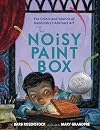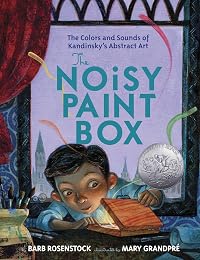
The Noisy Paint Box: The Colors and Sounds of Kandinsky's Abstract Art
by Barb Rosenstock
On This Page
Description
Describes how Vasya Kandinsky's creative life was profoundly shaped by a neurological condition called synesthesia which caused him to experience colors as sounds and sounds as colors.Tags
Recommendations










Member Reviews
Vasya Kandinsky was a proper little boy: he studied math and history, he practiced the piano, he sat up straight and was perfectly polite. And when his family sent him to art classes, they expected him to paint pretty houses and flowers—like a proper artist.
But as Vasya opened his paint box and began mixing the reds, the yellows, the blues, he heard a strange sound—the swirling colors trilled like an orchestra tuning up for a symphony! And as he grew older, he continued to hear brilliant colors singing and see vibrant sounds dancing. But was Vasya brave enough to put aside his proper still lifes and portraits and paint . . . music?
In this exuberant celebration of creativity, Barb Rosenstock and Mary GrandPré tell the fascinating show more story of Vasily Kandinsky, one of the very first painters of abstract art. Throughout his life, Kandinsky experienced colors as sounds, and sounds as colors—and bold, groundbreaking works burst forth from his noisy paint box. show less
But as Vasya opened his paint box and began mixing the reds, the yellows, the blues, he heard a strange sound—the swirling colors trilled like an orchestra tuning up for a symphony! And as he grew older, he continued to hear brilliant colors singing and see vibrant sounds dancing. But was Vasya brave enough to put aside his proper still lifes and portraits and paint . . . music?
In this exuberant celebration of creativity, Barb Rosenstock and Mary GrandPré tell the fascinating show more story of Vasily Kandinsky, one of the very first painters of abstract art. Throughout his life, Kandinsky experienced colors as sounds, and sounds as colors—and bold, groundbreaking works burst forth from his noisy paint box. show less
A music and art book for all! For anyone unfamiliar with Kandinsky's art or his impact upon the abstract art world, there is so much to enjoy. There's a little boy who wants so much to do well, a family expecting much from him, and a unique ability to hear music when he sees colors. It's a special ability, but like so many others before and after him, Kandinsky struggles with making those around him happy. The message isn't heavy-handed, but the reader experiences the pleasure that can be found in a crescendo of thinking about what makes you happy.
Although the story is real, the dialogue is imagined, bringing humor to the struggles a young boy might feel. The text font moves and changes, hitting notes with the reader and adding to show more Kandinsky's experience with the paint box. I very enjoyable read with gorgeous illustrations. There is depth, texture, mystery, and movement along with a very pleasing color palate. It's a unique challenge to put yourself out there through your art, and Kandinsky managed to find a way to convey a depth of feeling that many artists were striving for at the time. It's exciting to read such a beautiful biography of him. show less
Although the story is real, the dialogue is imagined, bringing humor to the struggles a young boy might feel. The text font moves and changes, hitting notes with the reader and adding to show more Kandinsky's experience with the paint box. I very enjoyable read with gorgeous illustrations. There is depth, texture, mystery, and movement along with a very pleasing color palate. It's a unique challenge to put yourself out there through your art, and Kandinsky managed to find a way to convey a depth of feeling that many artists were striving for at the time. It's exciting to read such a beautiful biography of him. show less
Vasya Kandinsky was a proper little boy: he studied math and history, he practiced the piano, he sat up straight and was perfectly polite. And when his family sent him to art classes, they expected him to paint pretty houses and flowers—like a proper artist. But as Vasya opened his paint box and began mixing the reds, the yellows, the blues, he heard a strange sound—the swirling colors trilled like an orchestra tuning up for a symphony! And as he grew older, he continued to hear brilliant colors singing and see vibrant sounds dancing. But was Vasya brave enough to put aside his proper still lifes and portraits and paint . . . music? In this exuberant celebration of creativity, Barb Rosenstock and Mary GrandPré tell the fascinating show more story of Vasily Kandinsky, one of the very first painters of abstract art. Throughout his life, Kandinsky experienced colors as sounds, and sounds as colors—and bold, groundbreaking works burst forth from his noisy paint box. show less
Vasily Kandinsky is a young boy growing up in a proper household in Russia and is being educated in the dull and mundane subjects of math, science and history. Through the illustrations we can see that the world is drab and void of color or any type of excitement. However, his world is invigorated when his aunt introduces him to the paintbox so that he may 'appreciate art'. To Vasily, the colors are vibrant and brilliantly sonorific. Author Barb Rosenstock uses geometric shapes, eloquent chroma and onomatopoeia to bring Vasily's colors to life. Because Vasily's family doesn't see his art as art, he does not pursue it and grows into a conventional adult with a job as a lawyer. Nevertheless, he cannot deny his passion for the melodic show more symphony reverberating from the colors he comes into contact with and thus becomes a pioneer for abstract art. Throughout, illustrator Mary GrandPre presents us with exquisite patterns. She uses bold illustrations to exude the tediousness of life without fervor in contrast to the essence of his true dynamic spirit. show less
This book is about Vasya, a young boy who was expected to follow the traditions of a proper Russian boy. He got a paint box from his aunt and learned that he could hear the colors make sounds. He didn't follow the proper Russian boy or the traditional art form, he made his own abstract art.
I think doing an art lesson with students about what music sounds like to them would be a cool activity! Then you could have group discussions about why they painted the way the did.
I think doing an art lesson with students about what music sounds like to them would be a cool activity! Then you could have group discussions about why they painted the way the did.
I enjoyed this book for sharing the story about how abstract art came to life. However, I think some of the vocabulary used would be hard for readers to understand if they are younger. Additionally, I feel that those readers who love art would enjoy this book. However, those who are not into art may feel it is hard to connect to abstract art because the paintings may not make them feel the way the author suggests that the paintings should make you feel. This book uses illustrations to enhance the text by showing the reader what abstract art looks like and how the emotions of the artists vary when creating this type of art. Additionally, this book pushes readers to understand how art can be portrayed in different ways and viewers can show more have different opinions about a piece of art. The plot is well paced and offers the readers to understand how Vasya Kandinsky felt as he grew up creating various types of art, but showed how his true passion was creating abstract art. The book uses very descriptive writing to ensure the readers understand each emotion the author is trying to convey. For example, he did not enjoy painting houses and flowers even though that is what his family and teachers expected him to do. The main message of this story is that art can be seen in many different viewpoints and other individuals may have a different opinion than you, but that does not mean you are wrong. show less
Summary:
This Caldecott award winner is about a Russian boy that was expected to be proper. Although he did everything that his family expected, he was never truly happy until he was given a paint box set one day from his aunt. Every time he mixed the colors to paint, he heard music. He couldn't help but paint what he heard. This didn't make sense to many, so he eventually steered away from it. Later when he became an adult and moved to Moscow, he again started hearing the colors singing again. He decided to give it another shot. Others tried to discourage him again, but he refused to let that happen. Being determined to follow his heart, he ended up creating a new type of art.
Personal Reaction:
I thought this was a great story. In the show more beginning I was bothered how his family discouraged him as a child with his art creations. But later was happy to see that he followed his dreams and what he believed in, no matter what others thought. I think it's important to be yourself and to follow your heart and this story demonstrates that. I also like how vibrant the colors are in the illustrations which help you feel the inspirational tone of the story.
Classroom Extension Ideas:
1. I could turn on some symphony music, creating a peaceful tone. Then I could have each student paint exactly what comes to thought.
2. I could show the students a piece of abstract art and have them write a story about what they see. show less
This Caldecott award winner is about a Russian boy that was expected to be proper. Although he did everything that his family expected, he was never truly happy until he was given a paint box set one day from his aunt. Every time he mixed the colors to paint, he heard music. He couldn't help but paint what he heard. This didn't make sense to many, so he eventually steered away from it. Later when he became an adult and moved to Moscow, he again started hearing the colors singing again. He decided to give it another shot. Others tried to discourage him again, but he refused to let that happen. Being determined to follow his heart, he ended up creating a new type of art.
Personal Reaction:
I thought this was a great story. In the show more beginning I was bothered how his family discouraged him as a child with his art creations. But later was happy to see that he followed his dreams and what he believed in, no matter what others thought. I think it's important to be yourself and to follow your heart and this story demonstrates that. I also like how vibrant the colors are in the illustrations which help you feel the inspirational tone of the story.
Classroom Extension Ideas:
1. I could turn on some symphony music, creating a peaceful tone. Then I could have each student paint exactly what comes to thought.
2. I could show the students a piece of abstract art and have them write a story about what they see. show less
Members
- Recently Added By
Lists

Caldecott Honor Books
296 works; 23 members

Books Read in 2023
5,638 works; 147 members
Author Information

All Editions
Awards and Honors
Awards
Distinctions
Notable Lists
Common Knowledge
- Original publication date
- 2014
- People/Characters
- Wassily Kandinsky
- Dedication
- For Mr. Paul Fornek, the best teacher ever. Thank you wherever you are. --B. R.
For all young artists who look and listen with brave hearts --M. G. - First words
- Vasya Kandinsky spent his days learning to be a proper Russian boy.
- Last words
- (Click to show. Warning: May contain spoilers.)"How does it make you feel?"
Classifications
Statistics
- Members
- 724
- Popularity
- 39,231
- Reviews
- 82
- Rating
- (4.40)
- Languages
- English, Turkish
- Media
- Paper, Ebook
- ISBNs
- 8
- ASINs
- 2