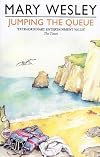
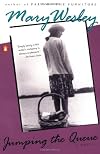
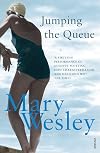
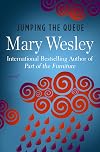
Jumping the Queue
by Mary Wesley
On This Page
Description
A "quirky, sad, and very funny" novel about suicide, matricide, and an unlikely love, from one of England's best-loved authors (The Guardian). Determined to end it all after the death of her husband, Matilda Poliport's carefully laid plans to kill herself are derailed when she comes to the rescue of another potential bridge jumper--a notorious young man on the run for having murdered his mother. Faced with the choice of either turning him in to the police or continuing on with her show more suicide attempt, Matilda makes the obvious decision and takes Hugh Warner home to stay with her while they both sort out what to do next. As Hugh and Matilda find surprising comfort in each other, secrets about Matilda's deceased husband are revealed, leaving Matilda to face some very uncomfortable facts about her life. And as the pair plot to help Hugh escape the law, they will both need to face the truth about themselves and how far they are willing to go for each other. This "virtuoso performance of guileful plotting, deft characterizations, and malicious wit" showcases the talents of Mary Wesley at her caustic and comical best (The Times, London). show lessTags
Recommendations



















Member Reviews
Mary Wesley writes odd little novels, firmly grounded in her very British-ness, but often with twists and ambiguities that set them apart. Her characters can be unlikeable but never unsympathetic, which is something of a feat in my opinion. This one is about an older woman whose plan to kill herself is thrown into disarray when she meets a younger man hiding from the police after killing his mother. It's about aging and family and how much we really know those closest to us. In these two characters, Wesley explores the misunderstandings and misperceptions of life, as well as its disappointments and quiet joys. This was my fourth novel by this underappreciated author, and I am glad I have several more sitting on my shelves.
Mary Wesley has become one of my favourite British female authors since I discovered her last year. This is not a happy story by any means, as it starts with our protagonist Matilda Poliport who's been widowed for a few years and having lost her cherished husband, with four grown children who refuse to visit her, has decided the best life has to offer is behind her. When the novel begins, she is just putting the last touches to a major housecleaning as she is carefully putting into execution her meticulously planned suicide. Her beloved pet gander Gus is sold to a farmer, where he'll ostensibly be happy with a harem of six geese, and she's off to her favourite secluded beach to have a picnic of brie and Beaujolais before taking sleeping show more pills and swimming into the tide. But of course her plans are foiled when she meets Hugh Warner, an attractive 30-something man on the run from the police and known all over the media as "The Matricide". She saves him before committing his own suicide attempt and brings him back to her cottage to hide away, where of course, a most unusual relationship will develop. Relationships are Wesley's strength, as is writing from a mature person's perspective on life, but mature not so much in the sense of having acquired bundles of wisdom as having lived life fully and being past caring what others think and feeling free to impose one's personality on others. Which of course makes for fascinating characters. I don't know if Matilda is necessarily a likeable character, since we learn she has mostly lived her life denying all the uncommonly unpleasant things that have been thrown her way, but thanks to Wesley's subtle skills it is impossible not to form an attachment to her AND the matricide. Of course, we're not to expect a happy ever after given the ingredients this story is made up of, but that hardly matters, as Wesley succeeds in creating another thing of messy and unruly beauty. show less
I read The Camomile Lawn as a student and, being young and naive, was impressed by its suave, sophisticated, witty characters. With this in mind, I happily snaffled Mary Wesley’s Jumping the Queue when I found it on a bookshop expedition to Winchester with H. Now I wonder whether, if I were to reread The Camomile Lawn, I would find there the negatives that I noticed here alongside the wit and sophistication: detached indifference; clever people behaving horribly to one another; a rather nihilistic view of the world. What, really, is the point? That’s the question we find the recently widowed Matilda Poliport contemplating as the book starts. Carrying a basket of wine, cheese and fresh bread, she’s heading down to the beach for a show more picnic before she ends it all. When her plans are frustrated, she heads back to a life that she thought she had all neatly tied up; but this time she has an unexpected companion: a soul almost as lost as she is. Be warned. This is not a cosy piece of classic fiction. This is fiction with claws. And teeth...
For the full review, please see my blog:
https://theidlewoman.net/2019/07/31/jumping-the-queue-mary-wesley/ show less
For the full review, please see my blog:
https://theidlewoman.net/2019/07/31/jumping-the-queue-mary-wesley/ show less
This book tells the story of Matilda who is interrupted in her suicide attempt when she comes across Hugh who is on the run from the police. Rather than hand him in she takes him home and there the adventures begin.
I loved this book which you would think would be depressing given the subject matter but instead is actually very life-affirming in places and full of pathos. I loved the fact that it didn't feel the need to make the character nice but gave them weaknesses and foibles which seemed more realistic.
My favourite character was Gus who always made his prescence known.
A brilliant first book by this author at the age of 70.
I loved this book which you would think would be depressing given the subject matter but instead is actually very life-affirming in places and full of pathos. I loved the fact that it didn't feel the need to make the character nice but gave them weaknesses and foibles which seemed more realistic.
My favourite character was Gus who always made his prescence known.
A brilliant first book by this author at the age of 70.
Never thought that matricide could be a fascinating topic,With honesty, irony and insightful wit, this little gem carves a realistic path through a whole raft of family issues.
Matilda and, even more, the reader slowly discover surprising details about the people in her life. Nonetheless, the book ends with lots of unanswered questions---perhaps because that's the way the world works. I was hoping for a happier ending.
This book was well-written, but that's all I can say in its favour. Matilda, the heroine, isn't a likeable character. She's full of strange ideas, disloyalties, and unmaternal feelings. It was apparently supposed to be funny but I found it dissatisfying and rather depressing. Not at all recommended.
Members
- Recently Added By
Lists

Top Five Books of 2018
802 works; 265 members
Author Information

25+ Works 4,580 Members
Mary Aline Mynors Farmar was born in Berkshire in 1912. She was the youngest of three children and her father was an army officer, so the family frequently moved. In 1936, she married Lord Swinfen, had two children, and divorced in the early 1940's. During World War II, she fell in love with journalist Eric Siepmann and lived with him for several show more years before they were married, which caused Mary's parents to cut her out of their will in disapproval. When her husband died, she was broke with a teenage son. During the late 1960's, she wrote two books, "Speaking Terms" and "The Sixth Seal," but it wasn't until she was in her seventies that her first major novel was published, "Jumping the Queue." Afterwards, she published "Cammomile Lawn" (1984), which is about love and sex in the British upper middle class and was adapted for television, "Harnessing Peacocks" (1986), which is about a young unwed mother who turns to prostitution to pay for her son's education, and "The Vacillations of Peppy Carew" (1986). Wesley's other titles include "A Sensible Life" (1990), "A Dubious Legacy" (1993), "An Imaginative Experience" (1994) and "Part of the Furniture" (1997). She died of natural causes following a long battle with gout on December 30, 2002. (Bowker Author Biography) show less
Some Editions
Series
Belongs to Publisher Series
dtv (11893)
Work Relationships
Is contained in
Common Knowledge
- Canonical title*
- Matildas letzter Sommer
- Original title
- Jumping the queue
- Original publication date
- 1983
- People/Characters
- Matilda Poliport; Hugh Warner; Gus; Huw Jones
- Important places
- Cornwall, England, UK; London, England, UK
- First words
- All week Gus had been fussed by Matilda's unusual activity.
- Last words
- (Click to show. Warning: May contain spoilers.)'Buggered up a day's fishing, this.'
- Original language*
- Englisch
*Some information comes from Common Knowledge in other languages. Click "Edit" for more information.
Classifications
Statistics
- Members
- 385
- Popularity
- 81,447
- Reviews
- 14
- Rating
- (3.63)
- Languages
- 5 — English, French, German, Lithuanian, Swedish
- Media
- Paper, Audiobook, Ebook
- ISBNs
- 25
- ASINs
- 5