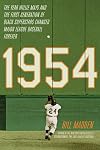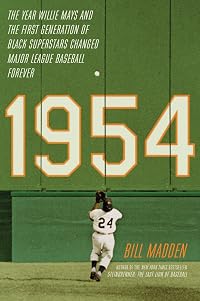
1954: The Year Willie Mays and the First Generation of Black Superstars Changed Major League Baseball Forever
by Bill Madden
On This Page
Description
"Jackie Robinson heroically broke the color barrier in 1947. But how--and, in practice, when--did the integration of the sport actually occur? Bill Madden shows that baseball's famous "black experiment" did not truly succeed until the coming of age of Willie Mays and the emergence of some star players--Larry Doby, Hank Aaron, and Ernie Banks--in 1954. And as a relevant backdrop off the field, it was in May of that year that the US Supreme Court unanimously ruled, in the case of Brown v. show more Board of Education, that segregation be outlawed in America's public schools. Featuring original interviews with key players and weaving together the narrative of one of baseball's greatest seasons with the racially charged events of that year, 1954 demonstrates how our national pastime--with the notable exception of the Yankees, who represented white supremacy in the game--was actually ahead of the curve in terms of the acceptance of black Americans, while the nation at large continued to struggle with tolerance"-- show lessTags
Recommendations









Member Reviews
Despite Jackie Robinson breaking the color barrier in 1947, only half of the sixteen major league teams had a black player on their roster when spring training commenced in 1954. However the growing tide of talent signed from the waning Negro Leagues and being nurtured in the minor league system would eventually cause sweeping changes in the composition of major league rosters. With preternaturally gifted stars such as Mays and Aaron already making their presence felt, even teams with serious reservations about integrating their rosters accepted the inevitable.
The Indians won the American League pennant in 1954 breaking the Yankees string of dominance. Center fielder Larry Doby was a major contributor to the Indians' success and the show more Yankees would finally squelch the racist impulses of management and add future star Elston Howard to their roster in 1955. The Red Sox would be the last team to integrate, waiting until 1959.
The then NY Giants would go on to upset the Indians by sweeping them in the 54' Series, a series which helped immortalize Mays with " The Catch." As he and other black superstars asserted their influence on the game, the likes of Clemente, Gibson ... waited in the wings. 1954 was a pivotal year in race relations, for baseball and for society, it was the same year as the Brown vs. Board decision was rendered, with far-reaching consequences.
This is a must-read narrative of an exciting season and a watershed year as America gradually came to grips with its moral blemish of institutional racism. show less
The Indians won the American League pennant in 1954 breaking the Yankees string of dominance. Center fielder Larry Doby was a major contributor to the Indians' success and the show more Yankees would finally squelch the racist impulses of management and add future star Elston Howard to their roster in 1955. The Red Sox would be the last team to integrate, waiting until 1959.
The then NY Giants would go on to upset the Indians by sweeping them in the 54' Series, a series which helped immortalize Mays with " The Catch." As he and other black superstars asserted their influence on the game, the likes of Clemente, Gibson ... waited in the wings. 1954 was a pivotal year in race relations, for baseball and for society, it was the same year as the Brown vs. Board decision was rendered, with far-reaching consequences.
This is a must-read narrative of an exciting season and a watershed year as America gradually came to grips with its moral blemish of institutional racism. show less
Ratings
Members
- Recently Added By
Lists

What A Year: Books titled with a particular year
147 works; 2 members
Author Information

10+ Works 432 Members
Bill Madden, the 2010 recipient of the Baseball Hall of Fame's J.G. Taylor Spink Award, is the author of the New York Times bestseller Steinbrenner For more than thirty years, he has covered baseball for the New York Daily News. He lives in New Jersey.
Awards and Honors
Awards
Common Knowledge
- People/Characters
- Willie Mays
- Original language
- English
Classifications
- Genres
- Sports and Leisure, Nonfiction, General Nonfiction, History, Politics and Government, Biography & Memoir
- DDC/MDS
- 796.357 — Arts & recreation Recreation, sports, and performing arts Athletic and outdoor sports and games Ball sports Ball and stick sports Baseball
- LCC
- GV863 .A1 .M28 — Geography, Anthropology and Recreation Recreation. Leisure Recreation. Leisure Sports Ball games: Baseball, football, golf, etc.
- BISAC
Statistics
- Members
- 69
- Popularity
- 454,056
- Reviews
- 1
- Rating
- (3.44)
- Languages
- English
- Media
- Paper, Ebook
- ISBNs
- 3
- ASINs
- 2