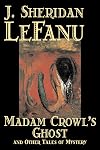
Madam Crowl's Ghost and Other Stories
by Sheridan Le Fanu
On This Page
Description
Includes tales which mostly appeared in The Dublin University Magazine and other periodicals.Tags
Recommendations


















Member Reviews
Madam Crowl's Ghost and Other Stories contains twelve supernatural tales that might be best be read late at night when the house is quiet. Even Henry James agrees: there's a statement by James on the back cover that reads
"There was the customary novel by Mr. Le Fanu for the bedside; the ideal reading in a country house for the hours after midnight."
Perhaps these aren't the best ghost stories I've ever read, but Le Fanu is a master of atmosphere, which helps to produce the sense of dread or doom I look for when I read these sorts of tales. For the ghost-story aficionado, this collection is definitely one not to miss. While these stories aren't a complete set of terrifying tales by Le Fanu, they've certainly been enough to whet my show more appetite for more. Most of these tales have to do with vengeance of wrongs brought forth to the present because of actions of someone in the past, while some are folkloric in nature. And, for the haunted-house story reader, there are a number of those here -- for example, my favorite of this type found in this book, "An Account of Some Strange Disturbances In Aungiers Street." I also eally liked the stories set in among the hills of Ireland, largely because Le Fanu steeps these tales in atmosphere from the outset.
While I have all of Le Fanu's novels, I've never before ventured into his shorter tales, but I must say that they are very satisfying for someone like me who loves a good ghostly yarn. show less
"There was the customary novel by Mr. Le Fanu for the bedside; the ideal reading in a country house for the hours after midnight."
Perhaps these aren't the best ghost stories I've ever read, but Le Fanu is a master of atmosphere, which helps to produce the sense of dread or doom I look for when I read these sorts of tales. For the ghost-story aficionado, this collection is definitely one not to miss. While these stories aren't a complete set of terrifying tales by Le Fanu, they've certainly been enough to whet my show more appetite for more. Most of these tales have to do with vengeance of wrongs brought forth to the present because of actions of someone in the past, while some are folkloric in nature. And, for the haunted-house story reader, there are a number of those here -- for example, my favorite of this type found in this book, "An Account of Some Strange Disturbances In Aungiers Street." I also eally liked the stories set in among the hills of Ireland, largely because Le Fanu steeps these tales in atmosphere from the outset.
While I have all of Le Fanu's novels, I've never before ventured into his shorter tales, but I must say that they are very satisfying for someone like me who loves a good ghostly yarn. show less
Madam Crowl’s Ghost & Other Stories contains twelve of Sheridan Le Fanu’s ghost stories that had originally been published anonymously or under pseudonyms. The stories offer some insight into the culture, folklore, and landscape of mid-eighteenth century Ireland, and Le Fanu sets the scenes of his tales quite well with a keen sense of foreboding.
The stories were collected and edited by M.R. James in 1923, fifty years after Le Fanu’s death. In his introduction, James notes that he has “placed the most striking and sensational of the stories at the beginning,” and assuredly, the opener “Madam Crowl’s Ghost” is the best of this lot, wherein an old woman recounts her strange experience at the age of thirteen when she was show more sent to Applewale House to care for the elderly and addled Dame Arabella Crowl. And upon Madam Crowl’s death, her darkest secret comes to light. That the unfolding events are seen through the eyes of a child add an additional layer of creepiness, though Le Fanu’s continuous use of a regional dialect throughout the story forces the reader to hit the brakes occasionally thereby slowing the narrative’s natural flow.
Most of the subsequent stories are fairly bland and routine, but these are the ones of some note:
Squire Toby’s Will - When the old Squire Toby Marston dies, his estate is left to his two sons, Scroope and Charlie. The elder Scroope is convinced that Charlie, by suppressing a key document, has cheated him out of ownership of the house at Gylingden - and promises revenge. An excellent atmospheric ghost story.
The White Cat of Drumgunniol - The story of that white cat and its dark omen that has hereditarily attached itself to the Donovan family. And here, the use of regional dialect in the dialogue somehow enhances the effectiveness of the story.
Ghost Stories of Chapelizod - Le Fanu spent his early childhood in Chapelizod, a village within Dublin, and it is reasonable to imagine that these tales in this mini anthology were inspired by events, rumors, or legends that came his way in those formative years. The stories are decidedly mundane, but the thought of their possible origin adds just a bit of spice. show less
The stories were collected and edited by M.R. James in 1923, fifty years after Le Fanu’s death. In his introduction, James notes that he has “placed the most striking and sensational of the stories at the beginning,” and assuredly, the opener “Madam Crowl’s Ghost” is the best of this lot, wherein an old woman recounts her strange experience at the age of thirteen when she was show more sent to Applewale House to care for the elderly and addled Dame Arabella Crowl. And upon Madam Crowl’s death, her darkest secret comes to light. That the unfolding events are seen through the eyes of a child add an additional layer of creepiness, though Le Fanu’s continuous use of a regional dialect throughout the story forces the reader to hit the brakes occasionally thereby slowing the narrative’s natural flow.
Most of the subsequent stories are fairly bland and routine, but these are the ones of some note:
Squire Toby’s Will - When the old Squire Toby Marston dies, his estate is left to his two sons, Scroope and Charlie. The elder Scroope is convinced that Charlie, by suppressing a key document, has cheated him out of ownership of the house at Gylingden - and promises revenge. An excellent atmospheric ghost story.
The White Cat of Drumgunniol - The story of that white cat and its dark omen that has hereditarily attached itself to the Donovan family. And here, the use of regional dialect in the dialogue somehow enhances the effectiveness of the story.
Ghost Stories of Chapelizod - Le Fanu spent his early childhood in Chapelizod, a village within Dublin, and it is reasonable to imagine that these tales in this mini anthology were inspired by events, rumors, or legends that came his way in those formative years. The stories are decidedly mundane, but the thought of their possible origin adds just a bit of spice. show less
A collection (made by M.R. James) of a few J. Sheridan Le Fanu ghost stories, most of these originally published anonymously in the Dublin University Magazine. I liked these, but not as much as I liked Le Fanu's Uncle Silas or James' own ghost stories (in part probably because James' stories so often are of an antiquarian or bibliophilic bent). Still, these make for very enjoyable reading, and some of them are deliciously disturbing.
Le Fanu's stories take as their subject some of what have come to be seen as "traditional" elements of ghost stories: apparitions of long-dead murder victims, mysterious supernatural happenings (often as portents of death), and the actions of fairy people. The author certainly deserves his place, as James show more puts it in his introduction "absolutely in the first rank as a writer of ghost stories." show less
Le Fanu's stories take as their subject some of what have come to be seen as "traditional" elements of ghost stories: apparitions of long-dead murder victims, mysterious supernatural happenings (often as portents of death), and the actions of fairy people. The author certainly deserves his place, as James show more puts it in his introduction "absolutely in the first rank as a writer of ghost stories." show less
A posthumous collection of lesser and early work by arguably the first great ghost story writer. Still, half the contents are worth the price of admission with the eponymous story, Squire Toby's Will, Dickon the Devil, The Child that went with the Fairies, The White Cat of Drumgunniol, Aungier Street, Sir Dominick's Bargain being all worth the time before the fireplace with the lights down.
Review from Badelynge
In judging the quality of this collection of ghost stories by Sheridan Le Fanu I think it's worth mentioning that this particular collection was compiled by M.R. James to bring together all of Le Fanu's anonymously published supernatural short stories. It's not a collection of his best work, far from it. Le Fanu's writings throw up all sorts of obstacles for the more ordered reader wishing to read all of his back catalogue. Many of these stories appeared uncredited in Le Fanu's own Dublin University Magazine or Dickens' famous periodical All the Year Round. James' included notes are invaluable to anybody embarking on a Le Fanu reading list. Though Le Fanu's penchant for publishing his stories, ideas and characters show more many times, often revised in small ways, completely rewritten, or subsumed into other works, tests even James' extensive study of his works. These stories are often set in the author's native Ireland or in the North of England, some very close to where I live in Lancashire. The English setting, mostly in his later works was an attempt to appeal to the larger English market. Exploiting the English market was probably one of the factors resulting in some of the revised publications.
Le Fanu is rightly acknowledged as one of history's finest writers in the genre of the ghost story. Though none of his very best are included here. His stories are often characterised by a slow build up of atmosphere through the use of highly evocative language, with the supernatural elements often included sketchily or by implication. It's a formula that he made himself master of, though this collection does highlight some of his shortcomings. His syntax sometimes becomes meandering. His habit of transcribing regional dialects directly into the dialogue does add local flavour but more often renders the text almost indecipherable. Sometimes his story structure is undermined by the inclusion of little extras tagged onto the endings. There is still much to be admired. My favourite story from this collection is 'An Account Of Some Strange Disturbances In Aungier Street'. Very creepy. though even this does sport some of those extras I mentioned or as Le Fanu would have it some 'valuable collateral particulars'. show less
In judging the quality of this collection of ghost stories by Sheridan Le Fanu I think it's worth mentioning that this particular collection was compiled by M.R. James to bring together all of Le Fanu's anonymously published supernatural short stories. It's not a collection of his best work, far from it. Le Fanu's writings throw up all sorts of obstacles for the more ordered reader wishing to read all of his back catalogue. Many of these stories appeared uncredited in Le Fanu's own Dublin University Magazine or Dickens' famous periodical All the Year Round. James' included notes are invaluable to anybody embarking on a Le Fanu reading list. Though Le Fanu's penchant for publishing his stories, ideas and characters show more many times, often revised in small ways, completely rewritten, or subsumed into other works, tests even James' extensive study of his works. These stories are often set in the author's native Ireland or in the North of England, some very close to where I live in Lancashire. The English setting, mostly in his later works was an attempt to appeal to the larger English market. Exploiting the English market was probably one of the factors resulting in some of the revised publications.
Le Fanu is rightly acknowledged as one of history's finest writers in the genre of the ghost story. Though none of his very best are included here. His stories are often characterised by a slow build up of atmosphere through the use of highly evocative language, with the supernatural elements often included sketchily or by implication. It's a formula that he made himself master of, though this collection does highlight some of his shortcomings. His syntax sometimes becomes meandering. His habit of transcribing regional dialects directly into the dialogue does add local flavour but more often renders the text almost indecipherable. Sometimes his story structure is undermined by the inclusion of little extras tagged onto the endings. There is still much to be admired. My favourite story from this collection is 'An Account Of Some Strange Disturbances In Aungier Street'. Very creepy. though even this does sport some of those extras I mentioned or as Le Fanu would have it some 'valuable collateral particulars'. show less
A strong blend of the fear of growing old or outliving others meeting other traits similar to that. I'm not sure it's a story for me but I thoroughly enjoyed it.
I don't have much to say on it besides it's a solid hour read.
I don't have much to say on it besides it's a solid hour read.
Probably the progenitor of English ghost stories, J.S> LeFanu produced some superb ghost stories. MR James, who was probably the best English ghost writer ever, considered LeFanu "absolutely in the first rank as a writer of ghost stories."
Members
- Recently Added By
Lists

Lovecraft's 'Supernatural Horror in Literature' Reading List
216 works; 8 members

Ghosts
278 works; 18 members
Jones & Newman: Best Horror Books Further Recommended Reading
577 works; 4 members
Author Information

266+ Works 12,388 Members
The greatest author of supernatural fiction during the nineteenth century was undoubtedly J. Sheridan Le Fanu. Le Fanu was born in Dublin and, as with so many other English popular fiction authors of his time, entered the genre of fiction by way of journalism, working on such publications as the Evening Mail and the Dublin University Magazine. Le show more Fanu came from a middle-class background; his family was of Huguenot descent. He graduated from Trinity College and married in 1844. After his wife died in 1858, until his own death, Le Fanu was known as a recluse, creating his ghost fiction late at night in bed. Probably he began writing ghost fiction in 1838; his earliest supernatural story is often cited as being either "The Ghost and the Bone-Setter" or the "Fortunes of Sir Robert Ardagh," both of which were later collected in the anthology entitled The Purcell Papers (1880). Writing most effectively in the short story form, Le Fanu's tales such as "Carmilla" (a vampire story that is thought possibly to have influenced Bram Stoker's Dracula) and the problematic "Green Tea" are considered by many literary scholars to be classics of the supernatural genre. His lengthy Gothic novels, such as Uncle Silas (1864), though less highly regarded than his shorter fiction, are nonetheless wonderfully atmospheric. Le Fanu's particular brand of literary horror tends toward the refined, subtle fright rather than the graphic sensationalism of Matthew Gregory Lewis. His work influenced other prominent horror fiction authors, including M. R. James. (Bowker Author Biography) show less
All Editions
Some Editions
Series
Belongs to Publisher Series
Work Relationships
Contains
Common Knowledge
- Canonical title
- Madam Crowl's Ghost and Other Stories
- Original publication date
- 1923
Classifications
Statistics
- Members
- 368
- Popularity
- 85,669
- Reviews
- 9
- Rating
- (3.61)
- Languages
- English, Polish, Spanish
- Media
- Paper, Ebook
- ISBNs
- 11
- ASINs
- 7