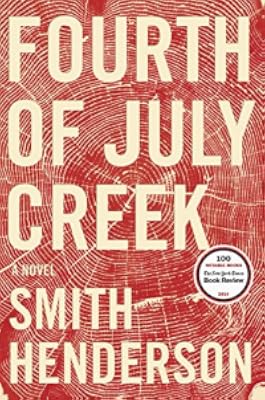
Fourth of July Creek
by Smith Henderson
On This Page
Description
In this shattering and iconic American novel, PEN prize-winning writer, Smith Henderson explores the complexities of freedom, community, grace, suspicion and anarchy, brilliantly depicting our nation's disquieting and violent contradictions.After trying to help Benjamin Pearl, an undernourished, nearly feral eleven-year-old boy living in the Montana wilderness, social worker Pete Snow comes face to face with the boy's profoundly disturbed father, Jeremiah. With courage and caution, Pete show more slowly earns a measure of trust from this paranoid survivalist itching for a final conflict that will signal the coming End Times.
But as Pete's own family spins out of control, Pearl's activities spark the full-blown interest of the F.B.I., putting Pete at the center of a massive manhunt from which no one will emerge unscathed.
. show less
Tags
Recommendations










Member Recommendations
Member Reviews
FOURTH OF JULY CREEK, by Smith Henderson.
Who is this guy, Smith Henderson, and where did he come from? Because this book is just so damn good! He's like Athena, who was born fully grown and armed, springing from the forehead of Zeus. Only this guy, this AUTHOR, has sprung fully armed with all the best tools of the writing trade from, from ... Hell, I don't know where from, but did I say how GOOD this book is?
I probably don't really need to summarize the plot, because the book's already been reviewed a few hundred times by now. But Pete Snow is a protagonist who will not be easily forgotten. A caseworker for the Department of Family Services in western Montana in the early Reagan years, Snow is overworked but fiercely dedicated, trying show more with everything he has to make a difference in the lives of some of the poorest and most screwed up people you have ever met. As a character, Snow is completely, fully realized. Henderson is inside the guy's head to an extent that, once you've started reading, it's almost impossible to get Snow out of YOUR head. While Pete tries to save the least of our brethren, his own family has disintegrated. His wife and thirteen year-old daughter (and oh, the daughter, another sad story, and another character Henderson OWNS, he is so inside her head too) have left. Pete is living in a cabin in the mountains, off the grid. Hey, I don't want to summarize this complex, moving, at times frighteningly horrific story. That's already been done. Then there is Jeremiah Pearl and his eleven year-old son, Benjamin. Pearl is a survivalist, a religious crazy, a guy who hates the government and civilization in general. When they enter Pete's purview in tiny Tenmile, Montana, the story takes off, and you can't help but hang on for your life in a tale that takes you from Montana to Texas to Indiana to Washington and Oregon and a lot of strange places in between. Henderson knows these places. He knows the Yaak wilderness - the forests and mountains and valley - as well as the red light district of Seattle and the main drag at UT-Austin. And he makes you feel that you know these places too.
What makes this book such a ride? Think Waco, think Ruby Ridge, think the Unabomber, and maybe even a little bit of Jonestown with its sacramental Kool-Aid. Put all this kind of stuff deep in the trackless "rain forest" and "jungle" of the Yaak. Send in cops and the ATF and FBI on a concentrated all-out manhunt. And put Pete Snow, this imperfect, battered but dedicated "priest" of the secular religion of Social Work, right smack in the middle of it, trying to save a young boy. (In fact there are other cases he's covering that are equally interesting and morbidly horrific, i.e. Cecil and Katie, and their abusive druggie mom.) And then there's the parallel plot of Pete's daughter Rachel (aka 'Rose'), who takes you deep into the terrifying, dark and ineffably sad world of teenage runaways.
Sorry, I can't get all this stuff into a review. There's just too much going on, but it all comes together masterfully, and there is a kind of redemption to be found, finally, if you manage to ride it out to the end.
Influences? Comparisons? I first thought of a recent novel by another Montanan, Kim Zupan's THE PLOUGHMEN - another beautiful book about an equally grim subject. And the descriptions of the bars and clubs of Missoula made me think of the late James Crumley, whose PI noirs nailed those places so well. And the Yaak Valley, with its dope farmers and other weirdoes brought to mind the West Virginia stories of Pinckney Benedict. And poor, crazy, raging teenage Cecil and his doper mother brought back Earl Thompson's classic novel of Depression-era Kansas, A GARDEN OF SAND. In the end, however, Smith Henderson has created his own unique world here, and it couldn't be any more real - or terrifying - than it is. Final word: FOURTH OF JULY CREEK is, hands down, simply one of the best books I have read in the past ten years. My highest recommendation. show less
Who is this guy, Smith Henderson, and where did he come from? Because this book is just so damn good! He's like Athena, who was born fully grown and armed, springing from the forehead of Zeus. Only this guy, this AUTHOR, has sprung fully armed with all the best tools of the writing trade from, from ... Hell, I don't know where from, but did I say how GOOD this book is?
I probably don't really need to summarize the plot, because the book's already been reviewed a few hundred times by now. But Pete Snow is a protagonist who will not be easily forgotten. A caseworker for the Department of Family Services in western Montana in the early Reagan years, Snow is overworked but fiercely dedicated, trying show more with everything he has to make a difference in the lives of some of the poorest and most screwed up people you have ever met. As a character, Snow is completely, fully realized. Henderson is inside the guy's head to an extent that, once you've started reading, it's almost impossible to get Snow out of YOUR head. While Pete tries to save the least of our brethren, his own family has disintegrated. His wife and thirteen year-old daughter (and oh, the daughter, another sad story, and another character Henderson OWNS, he is so inside her head too) have left. Pete is living in a cabin in the mountains, off the grid. Hey, I don't want to summarize this complex, moving, at times frighteningly horrific story. That's already been done. Then there is Jeremiah Pearl and his eleven year-old son, Benjamin. Pearl is a survivalist, a religious crazy, a guy who hates the government and civilization in general. When they enter Pete's purview in tiny Tenmile, Montana, the story takes off, and you can't help but hang on for your life in a tale that takes you from Montana to Texas to Indiana to Washington and Oregon and a lot of strange places in between. Henderson knows these places. He knows the Yaak wilderness - the forests and mountains and valley - as well as the red light district of Seattle and the main drag at UT-Austin. And he makes you feel that you know these places too.
What makes this book such a ride? Think Waco, think Ruby Ridge, think the Unabomber, and maybe even a little bit of Jonestown with its sacramental Kool-Aid. Put all this kind of stuff deep in the trackless "rain forest" and "jungle" of the Yaak. Send in cops and the ATF and FBI on a concentrated all-out manhunt. And put Pete Snow, this imperfect, battered but dedicated "priest" of the secular religion of Social Work, right smack in the middle of it, trying to save a young boy. (In fact there are other cases he's covering that are equally interesting and morbidly horrific, i.e. Cecil and Katie, and their abusive druggie mom.) And then there's the parallel plot of Pete's daughter Rachel (aka 'Rose'), who takes you deep into the terrifying, dark and ineffably sad world of teenage runaways.
Sorry, I can't get all this stuff into a review. There's just too much going on, but it all comes together masterfully, and there is a kind of redemption to be found, finally, if you manage to ride it out to the end.
Influences? Comparisons? I first thought of a recent novel by another Montanan, Kim Zupan's THE PLOUGHMEN - another beautiful book about an equally grim subject. And the descriptions of the bars and clubs of Missoula made me think of the late James Crumley, whose PI noirs nailed those places so well. And the Yaak Valley, with its dope farmers and other weirdoes brought to mind the West Virginia stories of Pinckney Benedict. And poor, crazy, raging teenage Cecil and his doper mother brought back Earl Thompson's classic novel of Depression-era Kansas, A GARDEN OF SAND. In the end, however, Smith Henderson has created his own unique world here, and it couldn't be any more real - or terrifying - than it is. Final word: FOURTH OF JULY CREEK is, hands down, simply one of the best books I have read in the past ten years. My highest recommendation. show less
In the opening chapter we are introduced to Pete Snow, social worker, as he intervenes with a very dysfunctional family in Pete's jurisdiction of rural Montana. And we think, "Ah, a do-gooder! Let's root for Pete." But come the second chapter, we find that Pete's pretty dysfunctional too. His wife is leaving him, and his daughter has no sympathy for him either for the things he's done, so our sympathies shift to them. But, no, we then find up they're pretty screwed up, too.
Indeed, there's not a single character in this book--and there are quite a few--who isn't screwed up in one way or another.
And by the end, a major character whom we perceived as being screwed-up from his introduction becomes one who gains some of our sympathy.
Human show more beings are a complicated lot, we are. No one can righteously carry the mantle of angel, and there are few true devils. The book ends, "You gotta believe. You can't just go through live acting like there are answers to every--"
The book is very well written. Ironically, with so much ugliness happening in the narrative, it is countered in the narrative by so much beautiful prose. I question a bit whether some of the wonderful allusion and metaphor the author uses should have been allowed to slop over into the things actually voiced by some of the uneducated characters, but I suppose that's literary license.
This is Smith Henderson's first novel, and I would look forward to his next. show less
Indeed, there's not a single character in this book--and there are quite a few--who isn't screwed up in one way or another.
And by the end, a major character whom we perceived as being screwed-up from his introduction becomes one who gains some of our sympathy.
Human show more beings are a complicated lot, we are. No one can righteously carry the mantle of angel, and there are few true devils. The book ends, "You gotta believe. You can't just go through live acting like there are answers to every--"
The book is very well written. Ironically, with so much ugliness happening in the narrative, it is countered in the narrative by so much beautiful prose. I question a bit whether some of the wonderful allusion and metaphor the author uses should have been allowed to slop over into the things actually voiced by some of the uneducated characters, but I suppose that's literary license.
This is Smith Henderson's first novel, and I would look forward to his next. show less
Henderson has crafted a gipping story with the theme of how children can be damaged and placed at risk by adults who somewhat compulsively engage in dicey behaviors. The mood of his novel is extremely dark. Except for the children, there is little to like or admire in most of the characters, including the narrator--Pete Snow. Pete is a social worker in Montana who is dedicated to saving children from risky circumstances caused by adults. Pete seems to connect well with the children while failing to do so with most adults. Ironically and inexplicably, his own lifestyle reflects a similar dysfunctional background and is totally inconsistent with his professional dedication. He comes from a dysfunctional family, is estranged from his show more brother who is a fugitive criminal, is estranged from his alcoholic wife, has an extreme drinking problem of his own, has an affair with a colleague who has similarly been damaged by a dysfunctional childhood and has a daughter who is a runaway. The latter character--Rachel/Rose--is developed completely through a series of interviews that Henderson inserts at various points in the narrative.
A secondary plot element follows Jeremiah Pearl and his devoted son, Benjamin. Pearl is a paranoid survivalist living in the wilderness with his large family. Except for Benjamin, the rest of the Pearl family is not well developed in the novel. Pearl is a hard man but seems to love his son and cares for his family. Initially, Ben seems to be just another example of a child abused by a self-absorbed parent, but as the narrative progresses, Henderson reveals a warmer relationships. We learn the family history through backstory--the mother is extremely religious, believes in omens and is prone to magical thinking. Because he is devoted to her, Jeremiah is excessively influenced by her strange behavior. Her problems result in a tragedy that cannot be revealed without spoiling the reading experience.
The narrative is totally engaging because of multiple plot threads, interesting characters and the rural Montana setting, which is ably evoked by Henderson. The novel is long and tries to do a lot, thus occasionally leaving minor issues unresolved. However, for the most part, Henderson manages to remain focused on his main theme in this fine novel. show less
A secondary plot element follows Jeremiah Pearl and his devoted son, Benjamin. Pearl is a paranoid survivalist living in the wilderness with his large family. Except for Benjamin, the rest of the Pearl family is not well developed in the novel. Pearl is a hard man but seems to love his son and cares for his family. Initially, Ben seems to be just another example of a child abused by a self-absorbed parent, but as the narrative progresses, Henderson reveals a warmer relationships. We learn the family history through backstory--the mother is extremely religious, believes in omens and is prone to magical thinking. Because he is devoted to her, Jeremiah is excessively influenced by her strange behavior. Her problems result in a tragedy that cannot be revealed without spoiling the reading experience.
The narrative is totally engaging because of multiple plot threads, interesting characters and the rural Montana setting, which is ably evoked by Henderson. The novel is long and tries to do a lot, thus occasionally leaving minor issues unresolved. However, for the most part, Henderson manages to remain focused on his main theme in this fine novel. show less
“...the world is a blade and dread is hope cut open and spread inside out.”
Pete Snow is a social worker who rescues children from abusive and dysfunctional families in the hinterlands of Montana. He gets kids out of dangerous houses and tries to find better environments for them to live in. This is fairly heroic stuff and we are supposed to like him for it but his own family is a mess, he walked out on his wife and daughter when his wife cheated on him, his brother is on the run after beating up his parole officer and he's a misogynistic alcoholic who drinks himself into violence, punching out his own car windows on one occasion and a young client in the stomach on another.
When Pete encounters undernourished twelve year-old Benjamin show more Pearl, the son of a profoundly disturbed anti-government, apocalyptic, paranoid who reveres the Old Testament and whose delusions have driven him and his family to live in the wilderness, Pete must gradually try and gain Jeremiah’s trust. As Pete's own family spins out of control (his daughter runs away from home), Pearl's activities spark the interest of the federal agencies and puts Pete in to the middle of a massive manhunt.
The story is told with a third-person narrator which infuses the novel with an element of realism. There are some conversations but these are somewhat stage-managed but we can see Pete's smart-ass remarks as a way of dealing with the stresses of his job as he struggles to infuse a little decency into the lives of his clients.
With the probable exception of the paranoid Pearl none of the characters in this book are very likeable, this is particularly true of the women who are generally sluts and harpies. Most of the chapters focus on Pete but interspersed within the main plot there are short sections in which his daughter Rachel/ Rose chats with a mystery person, presumably the reader. Personally I don't feel that I really needed to read about the childhood sexual exploitation she faced as a runaway and felt that they were a distraction rather than adding to the main story. I also felt that it simply took too long for us to meet Jeremiah and would have liked to have seen him introduced earlier but on the whole I found this to be compulsive reading and I generally enjoyed it, Henderson does a good job of making Pete’s life complicated without confusing the reader and without giving away the ending I will sat that it doesn't end in a complete disaster. Social work is filled with bleakness as well as hope. show less
Pete Snow is a social worker who rescues children from abusive and dysfunctional families in the hinterlands of Montana. He gets kids out of dangerous houses and tries to find better environments for them to live in. This is fairly heroic stuff and we are supposed to like him for it but his own family is a mess, he walked out on his wife and daughter when his wife cheated on him, his brother is on the run after beating up his parole officer and he's a misogynistic alcoholic who drinks himself into violence, punching out his own car windows on one occasion and a young client in the stomach on another.
When Pete encounters undernourished twelve year-old Benjamin show more Pearl, the son of a profoundly disturbed anti-government, apocalyptic, paranoid who reveres the Old Testament and whose delusions have driven him and his family to live in the wilderness, Pete must gradually try and gain Jeremiah’s trust. As Pete's own family spins out of control (his daughter runs away from home), Pearl's activities spark the interest of the federal agencies and puts Pete in to the middle of a massive manhunt.
The story is told with a third-person narrator which infuses the novel with an element of realism. There are some conversations but these are somewhat stage-managed but we can see Pete's smart-ass remarks as a way of dealing with the stresses of his job as he struggles to infuse a little decency into the lives of his clients.
With the probable exception of the paranoid Pearl none of the characters in this book are very likeable, this is particularly true of the women who are generally sluts and harpies. Most of the chapters focus on Pete but interspersed within the main plot there are short sections in which his daughter Rachel/ Rose chats with a mystery person, presumably the reader. Personally I don't feel that I really needed to read about the childhood sexual exploitation she faced as a runaway and felt that they were a distraction rather than adding to the main story. I also felt that it simply took too long for us to meet Jeremiah and would have liked to have seen him introduced earlier but on the whole I found this to be compulsive reading and I generally enjoyed it, Henderson does a good job of making Pete’s life complicated without confusing the reader and without giving away the ending I will sat that it doesn't end in a complete disaster. Social work is filled with bleakness as well as hope. show less
In 1970s-1980s rural Montana, social worker Pete Snow tries to keep his own life together while helping the children in his care.
Smith Henderson has written a very readable book, a gripping story with several insights about the hardships of life on the fringes of society. However, I had a major problem with the novel that kept me from enjoying it completely. The main male characters in the book -- Pete, his brother Luke, and the survivalist Jeremiah Pearl, who Pete encounters in the woods with his son Benjamin -- are, despite their deep flaws, basically noble men trying to do their best by their kids and families. Pete himself has a failed marriage, is battling alcoholism, has a runaway teenage daughter, and seems prone to criminality, show more but it's clear that he cares about the kids he comes across and only wants to help them in any way he can. In contrast, the women in this novel are all ruins. They are addicted to either drugs, alcohol or sex; they are failures as girlfriends, wives and, most especially, mothers. They may love their children, but inevitably wind up damaging them, sometimes irreparably. The only female character who's allowed to show some strength is Pete's runaway daughter, Rachel, but she may well be on the road to ruin herself -- her fate is a question mark. I found this treatment of men and women in the story to be incredibly lopsided, without justification -- a feeling that continued to grow as I continued to read. While all in all, I liked the book and admired the writing, I had to deduct a star just because of this one-sidedness. show less
Smith Henderson has written a very readable book, a gripping story with several insights about the hardships of life on the fringes of society. However, I had a major problem with the novel that kept me from enjoying it completely. The main male characters in the book -- Pete, his brother Luke, and the survivalist Jeremiah Pearl, who Pete encounters in the woods with his son Benjamin -- are, despite their deep flaws, basically noble men trying to do their best by their kids and families. Pete himself has a failed marriage, is battling alcoholism, has a runaway teenage daughter, and seems prone to criminality, show more but it's clear that he cares about the kids he comes across and only wants to help them in any way he can. In contrast, the women in this novel are all ruins. They are addicted to either drugs, alcohol or sex; they are failures as girlfriends, wives and, most especially, mothers. They may love their children, but inevitably wind up damaging them, sometimes irreparably. The only female character who's allowed to show some strength is Pete's runaway daughter, Rachel, but she may well be on the road to ruin herself -- her fate is a question mark. I found this treatment of men and women in the story to be incredibly lopsided, without justification -- a feeling that continued to grow as I continued to read. While all in all, I liked the book and admired the writing, I had to deduct a star just because of this one-sidedness. show less
"'I'll put one in that boy's brain before I let you have him. That is a solemn fuckin promise.' He leaned forward. Pete flinched. The man spat on him. Then he whipped around and heaved his naked son up onto his hip and jogged into the brush…Another day at the office." (35)
There is lots of tough talk in this debut book. The rugged setting and gritty characters reminded me of some of my favorite authors, Daniel Woodrell, Cormac McCarthy, and Jon Clinch. Set in a rural part of Montana, Pete Snow is a social worker for Child Protective Services. Looking out for the needs of children is an interesting job for a man whose daughter detests him and who is barely able to hold his own life together. We soon learn that Pete doesn't shy away from show more difficult situations. When he investigates the curious case of Benjamin Pearl who is malnourished and dressed in rags, he repeatedly tries to help an angry survivalist who doesn't want any help.
Young Ben is just one of his many cases that drives Pete to the bars at night for some relief. And then, there is his personal tragedy: a broken marriage and a runaway teenage daughter. The author is in no hurry to tie up the many crossroads of Pete's life as he juggles his cases and travels the country in search of his daughter. The logistics of travel are not so easy in this part of the country. Wyoming is such a vast and wild area that even the town Pete lives in is named Tenmile for its distance from "civilization." His clients are spread over a big area from the back woods to the empty spaces of the plains. Daughter Rachel uses the state name as a verb when she "wyoms" (which I interpreted as an aimless sort of wandering) through her life.
I ended up caring about (most) of these hardscrabble characters that were so difficult to like in the beginning. Smith Henderson knows something about living in poverty and the overwhelming odds against those living on the fringes of society…and he doesn't flinch or mince words when he tells their stories. This was a remarkable debut, and I look forward to seeing what is next in Mr. Henderson's arsenal. show less
There is lots of tough talk in this debut book. The rugged setting and gritty characters reminded me of some of my favorite authors, Daniel Woodrell, Cormac McCarthy, and Jon Clinch. Set in a rural part of Montana, Pete Snow is a social worker for Child Protective Services. Looking out for the needs of children is an interesting job for a man whose daughter detests him and who is barely able to hold his own life together. We soon learn that Pete doesn't shy away from show more difficult situations. When he investigates the curious case of Benjamin Pearl who is malnourished and dressed in rags, he repeatedly tries to help an angry survivalist who doesn't want any help.
Young Ben is just one of his many cases that drives Pete to the bars at night for some relief. And then, there is his personal tragedy: a broken marriage and a runaway teenage daughter. The author is in no hurry to tie up the many crossroads of Pete's life as he juggles his cases and travels the country in search of his daughter. The logistics of travel are not so easy in this part of the country. Wyoming is such a vast and wild area that even the town Pete lives in is named Tenmile for its distance from "civilization." His clients are spread over a big area from the back woods to the empty spaces of the plains. Daughter Rachel uses the state name as a verb when she "wyoms" (which I interpreted as an aimless sort of wandering) through her life.
I ended up caring about (most) of these hardscrabble characters that were so difficult to like in the beginning. Smith Henderson knows something about living in poverty and the overwhelming odds against those living on the fringes of society…and he doesn't flinch or mince words when he tells their stories. This was a remarkable debut, and I look forward to seeing what is next in Mr. Henderson's arsenal. show less
***NO SPOILERS***
(Full disclosure: book abandoned on page 161, out of 467 pages)
I exercised a lot of patience with Fourth of July Creek, but if a story’s main plot doesn’t start until 100 pages in, something’s wrong. The summary sounded exciting, and I liked the protagonist, social worker Pete Snow; however, up until that exciting-sounding main plot finally got going, I was reading a lot of directionless side plots. These include Pete’s other case (most interesting), his frequent drinking (uninteresting), and his domestic problems (mildly interesting but seemingly irrelevant). This is what happens when an author is overly ambitious; the connecting thread can get lost, and quickly. Adding to this, all his characters lack show more memorability beyond physical descriptions, and even those aren’t special. Fourth of July Creek needed serious winnowing--to a side plot devoted just to Pete’s challenging and sometimes dangerous career as a social worker.
As for the main storyline, as is described in the summary, a strange man preparing for the end times, which he believes are imminent, has a young boy in tow. Judging by the boy’s appearance, Pete is concerned he’s being severely neglected and in danger. There’s some interesting discussion of “hobo pennies” here, but as hobo pennies aren’t threatening, the fear factor surrounding the mystery man is missing. Henderson did attempt a suspenseful scene earlier on, but it’s disappointingly anti-climactic. The most electric scenes are actually when Pete visits two different clients.
I’m surprised Fourth of July Creek won several awards, because aside from the plotting and characterization flaws, Henderson just isn’t a gifted writer. In the exposition, he wrote too frequently in fragments. In dialogue, his idea of making it realistic involved omitting words, but it’s awkward, not to mention unnecessary. I’m not convinced he had a clear vision for what he wanted his book to be. He should have scrapped this entirely and started from square one with “less is more” in mind. show less
(Full disclosure: book abandoned on page 161, out of 467 pages)
I exercised a lot of patience with Fourth of July Creek, but if a story’s main plot doesn’t start until 100 pages in, something’s wrong. The summary sounded exciting, and I liked the protagonist, social worker Pete Snow; however, up until that exciting-sounding main plot finally got going, I was reading a lot of directionless side plots. These include Pete’s other case (most interesting), his frequent drinking (uninteresting), and his domestic problems (mildly interesting but seemingly irrelevant). This is what happens when an author is overly ambitious; the connecting thread can get lost, and quickly. Adding to this, all his characters lack show more memorability beyond physical descriptions, and even those aren’t special. Fourth of July Creek needed serious winnowing--to a side plot devoted just to Pete’s challenging and sometimes dangerous career as a social worker.
As for the main storyline, as is described in the summary, a strange man preparing for the end times, which he believes are imminent, has a young boy in tow. Judging by the boy’s appearance, Pete is concerned he’s being severely neglected and in danger. There’s some interesting discussion of “hobo pennies” here, but as hobo pennies aren’t threatening, the fear factor surrounding the mystery man is missing. Henderson did attempt a suspenseful scene earlier on, but it’s disappointingly anti-climactic. The most electric scenes are actually when Pete visits two different clients.
I’m surprised Fourth of July Creek won several awards, because aside from the plotting and characterization flaws, Henderson just isn’t a gifted writer. In the exposition, he wrote too frequently in fragments. In dialogue, his idea of making it realistic involved omitting words, but it’s awkward, not to mention unnecessary. I’m not convinced he had a clear vision for what he wanted his book to be. He should have scrapped this entirely and started from square one with “less is more” in mind. show less
Members
- Recently Added By
Published Reviews
ThingScore 100
Long before Smith Henderson, the author of this not-to-be-missed first novel, makes it explicit, it’s clear that to work for the Department of Family Services in a job like Pete’s is to grapple with every form of human frailty and to try to bring salvation rather than pass judgment. The book’s deeply persuasive message is “that all of life can be understood as casework.” And Pete show more serves as something of a secular priest. show less
added by ozzer
Lists

Historical Fiction
889 works; 91 members

Top Five Books of 2014
1,064 works; 398 members

Top Five Books of 2015
811 works; 240 members

Books Read in 2014
2,343 works; 89 members

The American Experience
173 works; 18 members

Folio Prize 2015 Longlist
79 works; 2 members

Contemporary Fiction
109 works; 7 members

Dublin Literary Award Longlist 2016
148 works; 4 members

The American West
18 works; 2 members
USA Road Trip
50 works; 3 members
Novels featuring Fathers
56 works; 7 members

Books With Numbers in the Title
308 works; 13 members

Books Set in Montana
9 works; 4 members

Books With Time Words in the Title
160 works; 4 members

Global Reads: Books by American Authors
10 works; 1 member
Author Information
Some Editions
Awards and Honors
Awards
Series
Belongs to Publisher Series
Common Knowledge
- Canonical title
- Fourth of July Creek
- Original title
- Fourth of July Creek
- Original publication date
- 2014
- People/Characters
- Pete Snow; Jeremiah Pearl; Cecil; Rachel Snow; Benjamin Pearl; Jim Pinkeron (show all 14); Luke Snow; Yolanda; Mr. Cloninger; Mary; Wes Reynolds; Beth Snow; Katie; Judge Dyson
- Important places
- Montana, USA; Texas, USA; Missoula, Montana, USA; Seattle, Washington, USA; Austin, Texas, USA; Spokane, Washington, USA (show all 11); Reno, Nevada, USA; Kalispell, Montana, USA; Choteau, Montana, USA; Fourth of July Creek; Tenmile, Montana, USA
- Important events
- Attempted assassination of Ronald Reagan (1981-03-30). (1981-03-30)
- Epigraph
- If I knew for a certain'ty that a man was coming to my house with the conscious design of doing me good, I should run for my life. -- Henry David Thoreau
- Dedication
- For my family
- First words
- The cop flicked his cigarette to the dirt-and-gravel road in front of the house, and touched back his hat over his hairline as the social worker drove up in a dusty Toyota Corolla.
- Quotations
- The mother collected unemployment but her full-time occupation was self-pity.
She could be seen around town powdered white and made up in slashes of red around her mouth and blue around her eyes like an abstract of the American flag, some kind of commentary on her country, which of a sort she was.
"You come clothed in weakness, but I know what stands behind you. You insinuate yourself among good people and you rot them from the inside with your diseases and mental illnesses." Crazy talk.
How trout looked in that water, brown and wavering and glinting all the colors there were and maybe some that didn't really exist on the color wheel, a color, say, that was moss and brown-spotted like peppercorns and a single... (show all) terra-cotta-colored stone and a flash of sunlight all at once. That color existed in the water here.
Problem bears broke into places up around here, but he hadn't had any trouble. The very idea of problem bears. A problem for who. Did the bears talk about problem people.
"At this point, even Jesus and Satan just wish you'd choose a fucking side."
We're all animals. Just dancing bears in tutus and monkeys with cigarettes. Painted up and stuffed into clown cars.
Because her mother's heart was wyoming, it was wyoming hard, and she was days and years and maybe forever from a good man.
She is proof that there is nothing that cannot happen to someone. That the world doesn't need permission, that there is no novel evil it won't embrace.
I go into homes all the time and I save children. It's what I do for a living, you see? And I didn't save my own daughter.
He dreamed he had a sister, a beautiful girl, and in the dream he reasoned out that the girl was Rachel and what he was actually dreaming was a spirit inside of his, a sibling she'd never had, a son. He dreamed that we all co... (show all)ntain so many masses and that people are simply potentialities, instances, cases. That all of life can be understood as casework. That DFS was a kind of priesthood. - Last words
- (Click to show. Warning: May contain spoilers.)You can't just go through life acting like there are answers to every--
Classifications
Statistics
- Members
- 1,007
- Popularity
- 25,928
- Reviews
- 56
- Rating
- (3.89)
- Languages
- 5 — Dutch, English, French, German, Italian
- Media
- Paper, Audiobook, Ebook
- ISBNs
- 22
- ASINs
- 10
