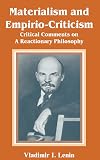
Materialism and Empirio-Criticism
by V. I. Lenin
On This Page
Description
In this classic text, Lenin brilliantly explains the fundamental principles of the materialist philosophy of Marxism. He defends them against idealist attacks from the subjective idealism of Machism, a philosophical trend, which at Lenin's time was becoming very fashionable, even within the workers movement. Step by step, layer by layer, quoting at length from the many trendy philosophical and scientific publications of the day, the book exposes idealism in all its guises. The aim was very show more simple: to bring out in the open the real difference between Marxist dialectical materialism and subjective idealism, which in the last instance always leads to some form of religious world outlook. Analysing the different shades and expressions of Machism internationally, Lenin stressed that "in every philosophical question raised by the new physics, we [trace] the struggle between materialism and idealism." And he showed that: "Behind the mass of new terminological devices, behind the litter of erudite scholasticism, we invariably discerned two principal alignments, two fundamental trends in the solution of philosophical problems. Whether nature, matter, the physical, the external world should be taken as primary, and consciousness, mind, sensation (experience - as the widespread terminology of our time has it), the psychical, etc., should be regarded as secondary - that is the root question which in fact continues to divide the philosophers into two great camps." show lessTags
Recommendations
























Member Reviews
Classic critique of the idealistic approach engulfing science at the beginning of the 20th century.
Ratings
Members
- Recently Added By
Author Information

1,153+ Works 12,785 Members
Creator of the former Soviet Union, Vladimir Ilyich Lenin (family name Ulianov) was born on April 10, 1870 in Simbirsk (later Ulianovsk), Russia, the son of a schools inspector. Lenin received upper class education and obtained a law degree in 1891, but he was moved to oppose the czarist Russian government, partly due to the execution of his show more brother, Alexander, who had participated in a plot to assassinate the Russian emperor. For taking part in revolutionary activities, Lenin was eventually imprisoned, publishing his work, The Development of Capitalism in Russia, from prison in 1899. Three years later, his pamphlet "What Is to Be Done" became the model for Communist philosophy. Lenin helped the Bolshevist movement that overthrew the czarist government and brought an end to Russia's war against Germany. As head of the new government, he put land in the hands of the peasants and brought industry under government control. An assassination attempt in 1918 wounded him, and two strokes in 1922 forced him to severely curtail government duty. He retreated to his country home in Gorki, where he died on January 21, 1924. (Bowker Author Biography) show less
Some Editions
Series
Belongs to Publisher Series
Work Relationships
Common Knowledge
- Canonical title*
- Materialisme en empiriokriticisme : Kritische opmerkingen bij een reactionaire filosofie
- Original publication date
- 1908
- Original language*
- Russisch
*Some information comes from Common Knowledge in other languages. Click "Edit" for more information.
Classifications
Statistics
- Members
- 235
- Popularity
- 138,857
- Reviews
- 1
- Rating
- (3.96)
- Languages
- 10 — Danish, Dutch, English, Finnish, French, German, Italian, Slovak, Spanish, Swedish
- Media
- Paper, Ebook
- ISBNs
- 19
- ASINs
- 24