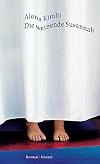
Weeping Susannah
by Alona Kimhi
On This Page
Description
At thirty-three, obsessive, hypersensitive Susannah Rabin lives with her mother, their cloistered world providing a barrier to the excruciating torment of human contact. But then Susannah's mother tells her that they are going to have a guest-- Susannah's cousin, a young man from New York. Susannah is horrified. Until the guest arrives, looking uncannily like Percy Bysshe Shelley. Fascinated by his exoticism, Susannah finds herself going to the movies, meeting his friends, swimming at night. show more But then Susannah's mother becomes troubled by their friendship, and asks the obvious question--"What is he doing in Israel?" show lessTags
Recommendations














































Member Recommendations

Member Reviews
I'm not normally a huge fan of stream-of-consciousness novels, but I really like Susannah Rabin ("no relation") and the restrictive world she has locked herself in. When the novel starts, she is excessively timid and withdrawn (to the point that she pees in a vase in her room so that her bodily functions won't be overheard - a vase that will eventually mirror her development through the novel).
When Neo, whom she calls "the guest," moves in, she at first abhors his presence, until it becomes clear that he has been sent (like Daniel to her namesake) to rescue her, in this case from her own self-destruction, and she falls in love with him, or rather, with his access to the world outside, "[a] world of living people."
What I really liked show more is that it is not "the guest" who eventually frees Susannah - he is merely the impetus to her metamorphosis - it is she, in her roundabout way, who brings about her own rebirth. It's a slow read, as all the little details Susannah mentions add up to the whole at the end, but if you decide to delve into her world, you'll find yourself rewarded, not only with Susannah's ponderings but with a whole world of Tel Avivian and Israeli life. show less
When Neo, whom she calls "the guest," moves in, she at first abhors his presence, until it becomes clear that he has been sent (like Daniel to her namesake) to rescue her, in this case from her own self-destruction, and she falls in love with him, or rather, with his access to the world outside, "[a] world of living people."
What I really liked show more is that it is not "the guest" who eventually frees Susannah - he is merely the impetus to her metamorphosis - it is she, in her roundabout way, who brings about her own rebirth. It's a slow read, as all the little details Susannah mentions add up to the whole at the end, but if you decide to delve into her world, you'll find yourself rewarded, not only with Susannah's ponderings but with a whole world of Tel Avivian and Israeli life. show less
I bought this book for my language collection. The description at Amazon mentioned it was bilingual, English and Hebrew. This edition had only the translation into English. However, I enjoyed reading this book. Kimhi gave me a glimpse of life in Tel Aviv and the status of Hebrew among immigrants. (“There are a couple of documents, you know, my Hebrew’s not so good for all those little letters and complicated words.”) A few friends commented to me that Kimhi's description of Tel Aviv is very different from what they know just as it is different from what I see on American TV. I don’t know then if the urban portrait of Tel Aviv that Kimhi shows through her character is real or symbolic of her character’s extreme depression and show more self-contempt. Most of the novel is narrated through this character’s thoughts, which gives the reader the sense of depression in the first person. show less
Ratings
Members
- Recently Added By
Lists

Books Read in 2020
4,379 works; 124 members
Author Information

11+ Works 128 Members
Series
Belongs to Publisher Series
BvT (0027)
Gallimard, Folio (3946)
Common Knowledge
- Canonical title
- Weeping Susannah
- Original title
- סוזנה הבוכייה
- Original publication date
- 1999
- People/Characters*
- Susannah Rabin
- Important places*
- Israel
- Dedication
- To Inbal, to her bright memory
- First words
- Everyone's used to my name being Susannah Rabin, and they don't ask me any more if I'm any relation to.
- Last words*
- (Click to show. Warning: May contain spoilers.)Na los, mein Kind, geh ruhig. Geh.
- Original language*
- Hebräisch
*Some information comes from Common Knowledge in other languages. Click "Edit" for more information.
Classifications
- Genres
- Fiction and Literature, General Fiction
- DDC/MDS
- 892.436 — Literature & rhetoric Literatures of other languages Afro-Asiatic literatures Jewish, Israeli, and Hebrew Hebrew fiction 1947–2000
- LCC
- PJ5055.26 .I458 .S89 — Language and Literature Oriental languages and literatures Oriental philology and literature Hebrew Literature Individual authors and works
- BISAC
Statistics
- Members
- 56
- Popularity
- 546,716
- Reviews
- 2
- Rating
- (3.73)
- Languages
- 9 — Dutch, English, Finnish, French, German, Hebrew, Italian, Polish, Portuguese
- Media
- Paper
- ISBNs
- 13