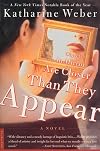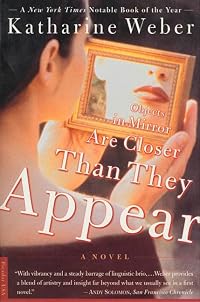
Objects in Mirror Are Closer Than They Appear
by Katharine Weber 
On This Page
Description
Harriet Rose, 26, is an American photographer just winning recognition for her work. A travel fellowship brings her to visit her best friend and former roommate, Anne Gordon, in Switzerland. In an ongoing letter to her boyfriend, Harriet reports on strange developments in Anne's life, most notably her affair with a much older married man, which seems to be leading to a disastrous conclusion. Before she can rescue Anne, events take a series of unexpected turns, and Harriet must reexamine her show more own life and past, and come to terms with the difficulties and possibilities of human relationships. Already excerpted in The New Yorker, Katharine Weber's witty first novel of attraction and deception, a tale with the sensibility of a Margaret Atwood, pulses with cultural references and word games that echo Nabokov. show lessTags
Recommendations































Member Reviews
I read this on a trip to Vermont, which is about as far (politically and geographically) as one can get from my home state without falling into the ocean, or Canada. It was a gloriously sunny day of the sort one can only get at higher latitudes -- the light seems closer, somehow; why would that be?
So I sat on a bench in the sun, gave myself a nice burn, and cried.
I also dog-eared every other page (this, in a library book. I am a terrible terrible person.)
Here's where I say that it's a debut novel and very very good, though a first novel from a very very good author is still a first novel; and here's where I apologize for my rating system, which makes sense to no one but myself and places Pride and Prejudice on par with Objects (the show more latter is better-written); and here's where I apologize, again, for my inability to do any justice to Weber's writing and -- is scope too pretentious a word for such an unpretentious novel? -- her scope.
This is why it's good, why Weber is good: she is not retreating. She says: horrible horrible things will happen and you will have to deal with them. You created the horror - unwillingly, unwittingly; but now it is here and it is your fault. You will live with this. You have no choice. And you will not forget, and you will do it again.
Le Guin called this "equilibrium", capital E, which is a beautiful and unwieldy word for such a deeply nasty, treacherous goblin.
This - that creation of horror, through our essential forgetful sloppiness - is wholly selfish. And even more so, says Weber (and I agree) is that we can forget about it; we can love; and we call that love more important than the evil we've done.
"Benedict: you are my You."
Oh, my god. show less
So I sat on a bench in the sun, gave myself a nice burn, and cried.
I also dog-eared every other page (this, in a library book. I am a terrible terrible person.)
Here's where I say that it's a debut novel and very very good, though a first novel from a very very good author is still a first novel; and here's where I apologize for my rating system, which makes sense to no one but myself and places Pride and Prejudice on par with Objects (the show more latter is better-written); and here's where I apologize, again, for my inability to do any justice to Weber's writing and -- is scope too pretentious a word for such an unpretentious novel? -- her scope.
This is why it's good, why Weber is good: she is not retreating. She says: horrible horrible things will happen and you will have to deal with them. You created the horror - unwillingly, unwittingly; but now it is here and it is your fault. You will live with this. You have no choice. And you will not forget, and you will do it again.
Le Guin called this "equilibrium", capital E, which is a beautiful and unwieldy word for such a deeply nasty, treacherous goblin.
This - that creation of horror, through our essential forgetful sloppiness - is wholly selfish. And even more so, says Weber (and I agree) is that we can forget about it; we can love; and we call that love more important than the evil we've done.
"Benedict: you are my You."
Oh, my god. show less
Ratings
Members
- Recently Added By
Author Information

8+ Works 1,333 Members
Katharine Weber is the author of the novels True Confections, Triangle, The Little Women, The Music Lesson, and Objects in Mirror Are Closer Than They Appear. She lives in Connecticut with her husband, the cultural historian Nicholas Fox Weber.
Katharine Weber is a LibraryThing Author, an author who lists their personal library on LibraryThing.
Awards and Honors
Awards
Common Knowledge
- Canonical title
- Objects in Mirror Are Closer Than They Appear
- Original publication date
- 1995-03-28
- Important places
- Geneva, Geneva, Switzerland; Switzerland
Classifications
Statistics
- Members
- 123
- Popularity
- 264,204
- Reviews
- 3
- Rating
- (3.69)
- Languages
- English, French, German
- Media
- Paper, Ebook
- ISBNs
- 7
- ASINs
- 2