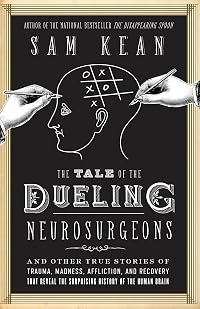
The Tale of the Dueling Neurosurgeons: The History of the Human Brain as Revealed by True Stories of Trauma, Madness, and Recovery
by Sam Kean
On This Page
Description
The author of the bestseller The Disappearing Spoon reveals the secret inner workings of the brain through strange but true stories. Early studies of the human brain used a simple method: wait for misfortune to strike -- strokes, seizures, infectious diseases, horrendous accidents -- and see how victims coped. In many cases their survival was miraculous, if puzzling. Observers were amazed by the transformations that took place when different parts of the brain were destroyed, altering show more victims' personalities. Parents suddenly couldn't recognize their own children. Pillars of the community became pathological liars. Some people couldn't speak but could still sing. In The Tale of the Dueling Neurosurgeons, Sam Kean travels through time with stories of neurological curiosities: phantom limbs, Siamese twin brains, viruses that eat patients' memories, blind people who see through their tongues. He weaves these narratives together with prose that makes the pages fly by, to create a story of discovery that reaches back to the 1500s and the high-profile jousting accident that inspired this book's title.* With the lucid, masterful explanations and razor-sharp wit his fans have come to expect, Kean explores the brain's secret passageways and recounts the forgotten tales of the ordinary people whose struggles, resilience, and deep humanity made neuroscience possible. *"The Tale of the Dueling Neurosurgeons" refers to the case of French king Henri II, who in 1559 was lanced through the skull during a joust, resulting in one of the most significant cases in neuroscience history. For hundreds of years scientists have gained important lessons from traumatic accidents and illnesses, and such misfortunes still represent their greatest resource for discovery. show lessTags
Recommendations






Member Recommendations
The Poisoner's Handbook: Murder and the Birth of Forensic Medicine in Jazz Age New York by Deborah Blum
KCampana Both books report the history of science (specifically of the human body) in an engaging, approachable manner.
Member Reviews
Pretty sure this is now my favorite Sam Kean book. It feels more accessible than his previous books, which I think might be related to this book's content. As interested as I am in the periodic table (the subject of his first book), the brain is so much more fascinating because it is what makes "all this" possible (by that I mean the reading of the book, this review of the book, the fact that this site even exists to review the book, etc.). Kean is always an engaging writer and this is no different. He treats both scientists,patients, and nameless victims with the same respect, all while plumbing the depths of their various obsessions, injuries, and madnesses. Essential reading for anyone who loves a good science read.
Il libro può essere riassunto in una serie di racconti di danni cerebrali dal cui studio sono scaturiti studi e scoperte sul cervello.Scritti benissimo, con uno stile scorrevole e un approfondimento scientifico adatto, credo, a chiunque sia unminimo curioso. Per molti tratti ricorda i capolavori di Oliver Sacks.
Troppo lungo copiare qui (sono pigra) le ultime due paginette del libro per invogliare chiunque ad affrontare questa lettura che, dalla sinossi potrebbe anche spaventare ed è un peccato che gli estratti dei libri includano sempre e solo le prime pagine di un volume. Quindi un consiglio: entrare in una libreria, acchiappare il volume, ed andare direttamente a pagina 375.
Troppo lungo copiare qui (sono pigra) le ultime due paginette del libro per invogliare chiunque ad affrontare questa lettura che, dalla sinossi potrebbe anche spaventare ed è un peccato che gli estratti dei libri includano sempre e solo le prime pagine di un volume. Quindi un consiglio: entrare in una libreria, acchiappare il volume, ed andare direttamente a pagina 375.
In today’s world, there are many ways to look at the brain and how it functions but, in the past, doctors and scientists had to depend on personal observation. In The Tale of the Dueling Neurosurgeons, science writer Sam Kean, gives us a fascinating looks at both the unfortunate folk whose maladies, syndromes, and injuries led to a better understanding of the brain and the doctors and scientists who treated and learned from them.
Kean looks at such phenomena as phantom limbs and syndromes like Cotard’s in which sufferers are convinced they are dead. Among the anecdotes Kean relates is that of King Henry II of France in the 16th c. who began to have seizures and bouts of paralysis after being injured by a lance through his eye during show more a jousting match. Oddly, only one side of his body was affected. His doctors considered opening his skull but, given that he was the king, that seemed a tad dangerous for all concerned so, instead, they examined the brains of executed prisoners. Henry eventually died of a brain hemorrhage but his case hinted at what later doctors would discover, that the two sides of the brain control different functions. And then there’s the case of Phineas Gage whose skull and brain were pierced by a tamping iron in an industrial accident. Gage remained conscious and seemingly unfazed throughout the ordeal of having it removed but, afterwards, his personality changed completely.
Kean’s chatty and often humourous way of describing scientific discoveries not only makes the science accessible to all but it makes it a whole lot of fun to read. However, he doesn't just relate anecdotes but he humanizes these patients making them more than their misfortunes and the learning they provide, something that science writers too rarely do. show less
Kean looks at such phenomena as phantom limbs and syndromes like Cotard’s in which sufferers are convinced they are dead. Among the anecdotes Kean relates is that of King Henry II of France in the 16th c. who began to have seizures and bouts of paralysis after being injured by a lance through his eye during show more a jousting match. Oddly, only one side of his body was affected. His doctors considered opening his skull but, given that he was the king, that seemed a tad dangerous for all concerned so, instead, they examined the brains of executed prisoners. Henry eventually died of a brain hemorrhage but his case hinted at what later doctors would discover, that the two sides of the brain control different functions. And then there’s the case of Phineas Gage whose skull and brain were pierced by a tamping iron in an industrial accident. Gage remained conscious and seemingly unfazed throughout the ordeal of having it removed but, afterwards, his personality changed completely.
Kean’s chatty and often humourous way of describing scientific discoveries not only makes the science accessible to all but it makes it a whole lot of fun to read. However, he doesn't just relate anecdotes but he humanizes these patients making them more than their misfortunes and the learning they provide, something that science writers too rarely do. show less
Research into the human brain comprises an exciting frontier of knowledge today, yet most scientific accounts can dryly bore the average reader. And frankly, a lot of scientists and doctors can benefit from reading narratives of human stories behind scientific discoveries. To fill this gap, Sam Kean chronicles in this book the many functions of the human brain – and of parts of the human brain. He teaches basic neuroscience with the noteworthy interpersonal backstories of how those insights were gleaned through human mishaps. In so doing, he entertains, enlightens, and engages a wide audience of health professionals, scientists, and students of the human condition.
This book opens and closes with perhaps the most famous case in the show more history of neuroscience: The story of Phineas Gage. While managing railroad construction in the mid-19th century, this man improbably had a spear shoot through the front of his skull. His left eye was disabled, and the spear bore a hole in the left-rear frontal lobe of his brain. It flew out immediately, and he survived to tell the tale. Despite many witnesses, medical professionals initially did not believe his tale but confirmed it through witnesses and its effects. Gage lived for over a decade after this freak accident, but his personality changed dramatically in unanticipated ways. At the time, we knew little about brain functioning, but his unique case has taught neurologists lessons for almost 200 years.
Striking human tales like this fill each chapter of Kean’s book. They go into great detail to explain specific lessons of neuroanatomy and neurophysiology that we’ve learned from the stories. Thus, this book describes a history of neurology from the perspective of affected patients who gave us further understanding. The main limitation of this book is that each chapter is somewhat self-contained. It’s hard to keep an overall narrative going throughout the entire book. The attempt is made, but it’s just not too pronounced. Like many subjects in medical science, the minutiae, even those of lively stories, can sometimes prevent the reader from seeing the big picture.
Because this history spans the humanities and the sciences, many audiences can benefit from this work. Budding neuroscientists and medical students can bring some of their dry scientific studies to life. Those involved in the care of neurological patients can benefit from understanding the human impacts of their profession. The curious public can learn about the emerging field of neuroscience. Authors can engage their imagination with scientifically verifiable stories of human quirks. Finally, we all can learn greater compassion for those whose brains may not work quite like the rest of us yet share common human dignity. show less
This book opens and closes with perhaps the most famous case in the show more history of neuroscience: The story of Phineas Gage. While managing railroad construction in the mid-19th century, this man improbably had a spear shoot through the front of his skull. His left eye was disabled, and the spear bore a hole in the left-rear frontal lobe of his brain. It flew out immediately, and he survived to tell the tale. Despite many witnesses, medical professionals initially did not believe his tale but confirmed it through witnesses and its effects. Gage lived for over a decade after this freak accident, but his personality changed dramatically in unanticipated ways. At the time, we knew little about brain functioning, but his unique case has taught neurologists lessons for almost 200 years.
Striking human tales like this fill each chapter of Kean’s book. They go into great detail to explain specific lessons of neuroanatomy and neurophysiology that we’ve learned from the stories. Thus, this book describes a history of neurology from the perspective of affected patients who gave us further understanding. The main limitation of this book is that each chapter is somewhat self-contained. It’s hard to keep an overall narrative going throughout the entire book. The attempt is made, but it’s just not too pronounced. Like many subjects in medical science, the minutiae, even those of lively stories, can sometimes prevent the reader from seeing the big picture.
Because this history spans the humanities and the sciences, many audiences can benefit from this work. Budding neuroscientists and medical students can bring some of their dry scientific studies to life. Those involved in the care of neurological patients can benefit from understanding the human impacts of their profession. The curious public can learn about the emerging field of neuroscience. Authors can engage their imagination with scientifically verifiable stories of human quirks. Finally, we all can learn greater compassion for those whose brains may not work quite like the rest of us yet share common human dignity. show less
This book is a thoroughly researched and almost what I thought I would never say about the topic of neurosurgery and brain disorders - an entertaining piece of writing. If you think this book would be dry. It is not. It is enhanced by a great amount of anecdotal information about the lives of patients both famous and obscure and the doctors who made breakthroughs treating them from the seventeen hundreds to the present day. If you have any curiosity about the wonders of how the brain works, read this book.
This book is a delightful tour around the brain with a knowledgeable and gently humorous guide who never loses focus but is quite prepared to be diverted if there is a chance to enrich the story.
The dueling neurosurgeons of the title represent both Paré and Vesalius (the founder of modern anatomy) who were called upon in 1559 to treat King Henri of France who, while jousting, had suffered a penetrating wound to his eye and brain. Thankfully we have now in pathology more sophisticated tests for examining tissue than what was used by the royal surgeon Paré: “He developed tests to distinguish between fat… and oozing bits of fatty brain tissue (fat floats on water, brain sinks; fat liquefies in a frying pan, brain shrivels.)” And we show more have more sophisticated treatments now too, than the potion of rhubarb and charred Egyptian mummy force-fed to poor Henri. The famous surgeons didn’t manage to save the King, and together they performed his autopsy; the briefly described procedure is quite similar to modern day technique. They did deviate from the usual procedure in that this time they didn’t lop the head off to remove the brain. We don’t do that either nowadays in the autopsy suite.
The book is populated with famous characters from the annals of medical history. They’re all here: Vesalius, Cajal, Golgi, Broca, HM, Penfield, etc., but they are not dusty relics in a history museum. They come alive because Kean describes not just their feats but how their actions propelled forward various concepts and understandings of anatomy and medicine, based on case histories that are vividly and engagingly described. While his tone is frequently light and humorous, he nonetheless stays within bounds and always respects the humanity of the patients.
The evolution of medical thinking is illustrated with these fascinating stories. He has achieved the ideal pop science narrative that seamlessly marries case histories to fundamental neurological concepts.
(Received as ARC via NetGalley from Little, Brown & Co.) show less
The dueling neurosurgeons of the title represent both Paré and Vesalius (the founder of modern anatomy) who were called upon in 1559 to treat King Henri of France who, while jousting, had suffered a penetrating wound to his eye and brain. Thankfully we have now in pathology more sophisticated tests for examining tissue than what was used by the royal surgeon Paré: “He developed tests to distinguish between fat… and oozing bits of fatty brain tissue (fat floats on water, brain sinks; fat liquefies in a frying pan, brain shrivels.)” And we show more have more sophisticated treatments now too, than the potion of rhubarb and charred Egyptian mummy force-fed to poor Henri. The famous surgeons didn’t manage to save the King, and together they performed his autopsy; the briefly described procedure is quite similar to modern day technique. They did deviate from the usual procedure in that this time they didn’t lop the head off to remove the brain. We don’t do that either nowadays in the autopsy suite.
The book is populated with famous characters from the annals of medical history. They’re all here: Vesalius, Cajal, Golgi, Broca, HM, Penfield, etc., but they are not dusty relics in a history museum. They come alive because Kean describes not just their feats but how their actions propelled forward various concepts and understandings of anatomy and medicine, based on case histories that are vividly and engagingly described. While his tone is frequently light and humorous, he nonetheless stays within bounds and always respects the humanity of the patients.
The evolution of medical thinking is illustrated with these fascinating stories. He has achieved the ideal pop science narrative that seamlessly marries case histories to fundamental neurological concepts.
(Received as ARC via NetGalley from Little, Brown & Co.) show less
Most of us have that friend, the one that tells great stories. Not the tall-tale kind of stories. This friend can sit down with a beer of wine after work and tell you all about their day and make it entertaining and interesting, even if you don't really understand what they do.
Imagine this friend is a neurosurgeon or neuroscientist and you'll have this book in a nutshell. Kean fills this book full of fascinating, true anecdotes of horrible things that happen to the human brain and how scientists have used these opportunities to learn more about the our grey (and white) matter and what separates the brain from the mind. He does this all in a very easy, laid-back way, without any silver-spoon language. This whole book is a chat about show more brains over beer in a pub. Which has just taken my mind to: if you had this chat in Wales, you could have a chat about brains over a few pints of Brains at the pub (it's a beer brand in Wales). But I digress...
Lest my description above makes it sound too shallow without enough science, let me stress that the science is here; Kean uses these anecdotes to introduce or illustrate the neuroscience. He succeeds in taking an incredibly complex creation and making the higher levels of its architecture understandable, even for those of us who do not have Ph.D's or M.D.'s.
He has asterisks throughout the text that connect to a Notes section at the back. These include anecdotal asides, clarifications, and suggestions for further reading. If you read the book, these are not to be missed because there's a lot of stunning information here (lobotomobile). There's also a Source list and an index.
I've been a fan of Kean's since he wrote The Disappearing Spoon but I think this one is his best written yet. I went 4.5 stars because I could have done without the details of animal experiments and I skipped those sections, but otherwise I'd unreservedly recommend this book to anyone who has a slight interest in the human brain but doesn't want the interest smothered with dry academic writing. show less
Imagine this friend is a neurosurgeon or neuroscientist and you'll have this book in a nutshell. Kean fills this book full of fascinating, true anecdotes of horrible things that happen to the human brain and how scientists have used these opportunities to learn more about the our grey (and white) matter and what separates the brain from the mind. He does this all in a very easy, laid-back way, without any silver-spoon language. This whole book is a chat about show more brains over beer in a pub. Which has just taken my mind to: if you had this chat in Wales, you could have a chat about brains over a few pints of Brains at the pub (it's a beer brand in Wales). But I digress...
Lest my description above makes it sound too shallow without enough science, let me stress that the science is here; Kean uses these anecdotes to introduce or illustrate the neuroscience. He succeeds in taking an incredibly complex creation and making the higher levels of its architecture understandable, even for those of us who do not have Ph.D's or M.D.'s.
He has asterisks throughout the text that connect to a Notes section at the back. These include anecdotal asides, clarifications, and suggestions for further reading. If you read the book, these are not to be missed because there's a lot of stunning information here (lobotomobile). There's also a Source list and an index.
I've been a fan of Kean's since he wrote The Disappearing Spoon but I think this one is his best written yet. I went 4.5 stars because I could have done without the details of animal experiments and I skipped those sections, but otherwise I'd unreservedly recommend this book to anyone who has a slight interest in the human brain but doesn't want the interest smothered with dry academic writing. show less
Members
- Recently Added By
Lists

Top Five Books of 2015
811 works; 241 members
Author Information

29 Works 9,293 Members
Sam Kean is the author of The Disappearing Spoon, The Violinist's Thumb, and The Tale of the Dueling Neurosurgeons: The History of the Human Brain as Revealed by True Stories of Trauma, Madness, and Recovery all of which were national bestsellers. The Disappearing Spoon was nominated by the Royal Society for one of the top science books of 2010, show more while The Violinist's Thumb was a finalist for PEN's literary science writing award. Kean's stories have appeared in The New York Times Magazine, Slate, Psychology Today, and The New Scientist, among other places, and his work has been featured on "Radiolab" and NPR's "All Things Considered," among other shows. (Bowker Author Biography) show less
Awards and Honors
Awards
Common Knowledge
- Canonical title
- The Tale of the Dueling Neurosurgeons: The History of the Human Brain as Revealed by True Stories of Trauma, Madness, and Recovery
- Original title
- The Tale of the Dueling Neurosurgeons: The History of the Human Brain as Revealed by True Stories of Trauma, Madness, and Recovery
- Original publication date
- 2014
- People/Characters
- Ambrose Pare; Andreas Vesalius; Henri II, King of France; Catherine de Medici; Gabriel Montgomery; Charles Guiteau (show all 37); Camillo Golgi; Ramon y Cajal; Otto Loewi; Lieutenant James Holman; Albert Hofmann; Paul Bach-y-Rita; Anna Coleman Ladd; Arcimboldo; Isabelle Dinoire; George Dedlow; Silas Weir Mitchell; Carleton Gajdusek; Stanley Prusiner; Roberts Bartholow; Mary Rafferty; Wilder Penfield; Benjamin Libet; Henry Gustav Molaison; K.C.; Endel Tulving; Solomon Shereshevsky; Aleksandr Luria; Simon Auburtin; "Tan" Leborgne; M. Lelong; Dr. Paul Broca; Gustave Dax; Roger Sperry; Michael Gazzaniga; Phineas Gage; Clive Wearing
- Epigraph
- The times have been
That, when the brains where out, the man would die
And there an end; but now thy rise again.
William Shakespeare, Macbeth - First words
- Rebus — n., a puzzle that involves piecing together pictures, letters, and sounds to form a hidden word or phrase.
- Last words
- (Click to show. Warning: May contain spoilers.)And he was all of us, too.
- Blurbers
- Stewart, Amy; Schaub, Michael; Cahalan, Susannah
- Original language
- English
Classifications
Statistics
- Members
- 1,090
- Popularity
- 23,436
- Reviews
- 37
- Rating
- (4.02)
- Languages
- 7 — English, Italian, Polish, Portuguese, Spanish, Swedish, Turkish
- Media
- Paper, Audiobook, Ebook
- ISBNs
- 21
- ASINs
- 16