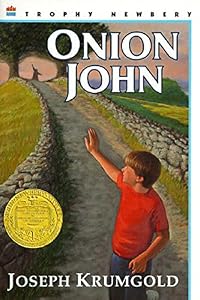
Onion John
by Joseph Krumgold
On This Page
Description
His friendship with the town odd-jobs man, Onion John, causes a conflict between Andy and his father.Tags
Recommendations










Member Reviews
This is my second read, this time for the Newbery group in Children's Books. It def. deserves two reads imo.
The relationship of the father and son especially interested me this time around, because I've recently read a couple of books by [a:Rinker Buck|227099|Rinker Buck|https://images.gr-assets.com/authors/1464871917p2/227099.jpg] and that is one of his main themes.
In this there's the obvious bit about dad wanting to live vicariously through his son... but there's more. In my interpretation, he's also a bit jealous of John, subconsciously fearing that young Andy is seeing John as a father-figure, and somewhat more consciously fearing that Andy will follow in John's footsteps. But Andrew Sr. does realize (probably with help from Mom) show more that he's not being as good a father as he wants to be, and he even manages to apologize his to son. Which is a big deal for a lot of men.
Then there's the character of John, The book makes it clear to us that he's not the town's project, that they can't just use him to make themselves feel proud of their charity. But it leaves us to wonder why John cries when his house is finished. And it leaves us to wonder if John is 'simple' or not, 'superstitious' or not, 'happy' or not. Lots for kids to discuss.
I really liked the art. Simply the essence, but enough detail for a depth of significance. Look at the crowd of ppl watching John cry...
And I enjoyed the specific descriptions of the rituals, including the boys' Halloween party with all the sweets and the different songs played on Onion John Day.
And the little bits of humor, when each boy followed John's example and gave a 'toast.' And when they were allowed to use sledgehammers and crowbars.... Clever silly boys....
And the thing is, Krumgold tried to spread the word that giving people charity is not effective, nor is trying to change them to conform... and we're still doing it and making each other miserable.... show less
The relationship of the father and son especially interested me this time around, because I've recently read a couple of books by [a:Rinker Buck|227099|Rinker Buck|https://images.gr-assets.com/authors/1464871917p2/227099.jpg] and that is one of his main themes.
In this there's the obvious bit about dad wanting to live vicariously through his son... but there's more. In my interpretation, he's also a bit jealous of John, subconsciously fearing that young Andy is seeing John as a father-figure, and somewhat more consciously fearing that Andy will follow in John's footsteps. But Andrew Sr. does realize (probably with help from Mom) show more that he's not being as good a father as he wants to be, and he even manages to apologize his to son. Which is a big deal for a lot of men.
Then there's the character of John, The book makes it clear to us that he's not the town's project, that they can't just use him to make themselves feel proud of their charity. But it leaves us to wonder why John cries when his house is finished. And it leaves us to wonder if John is 'simple' or not, 'superstitious' or not, 'happy' or not. Lots for kids to discuss.
I really liked the art. Simply the essence, but enough detail for a depth of significance. Look at the crowd of ppl watching John cry...
And I enjoyed the specific descriptions of the rituals, including the boys' Halloween party with all the sweets and the different songs played on Onion John Day.
And the little bits of humor, when each boy followed John's example and gave a 'toast.' And when they were allowed to use sledgehammers and crowbars.... Clever silly boys....
And the thing is, Krumgold tried to spread the word that giving people charity is not effective, nor is trying to change them to conform... and we're still doing it and making each other miserable.... show less
Onion John is Andy’s best friend, but Onion John is not an ordinary kid….Onion John is a man who does things his own way. John has lived in Serenity for many years, scavenging to furnish his home, working a little to buy food and supplies. Then he needs a new hinge for his door and suddenly everyone wants to change Onion John, from his home to his ways of making a living to his ways of thinking. The town gets together and decides to build a brand new house for John; it is not really what John wants and before the second day has passed, the house has burned to the ground. Should we change people? Should we try and make everyone fit in? Can it be done? Or does a world need people who don’t quite fit, people like Onion John?
Andy never really thought much about Onion John, an eccentric man that lived in their small town, until the day he discovered he could understand what the man said when no one else could. He starts hanging out with the man, much to his father's chagrin, who has plans for his son to go to MIT and the moon rather than playing around in their small town.
The story centers on relationships, particularly that between Andy and his father. For most of the book, I wasn't sure where things were going and what the author wanted us to think of Andy, his father, and Onion John. Was the friendship a good one, or was it making Andy too fanciful? Is it right to "help" someone by doing something they don't particular want? I couldn't tell if Onion John show more was hard to understand because of an accent or if he was mentally disabled. But in the end, I did appreciate how everything came together and Andy and his father came to an understanding. Interestingly, I think it's the type of book that's more of a lesson for parents and a entertaining story for young readers. show less
The story centers on relationships, particularly that between Andy and his father. For most of the book, I wasn't sure where things were going and what the author wanted us to think of Andy, his father, and Onion John. Was the friendship a good one, or was it making Andy too fanciful? Is it right to "help" someone by doing something they don't particular want? I couldn't tell if Onion John show more was hard to understand because of an accent or if he was mentally disabled. But in the end, I did appreciate how everything came together and Andy and his father came to an understanding. Interestingly, I think it's the type of book that's more of a lesson for parents and a entertaining story for young readers. show less
Too bad about this cover. The book was wonderful! I'm sorry that it took me so long to get around to reading it. I'm grateful that my bookgroup chose it. A great story of friendship and coming of age. I'm so glad that the father and son were finally able to communicate at a deep level. As a child I wonder if I would have appreciated that? I remember my reaction to Boxcar Children getting rescued and felt the same about poor Onion John. Andy's growing up reminded me of my discovery that there was no Santa Claus. My fear that such knowledge would end the goodies. I hated to see him lose the magic. Good discussion with my Vintage Book Circle friends. We all enjoyed this one. Another Newbery that I love as an adult, but didn't quite get as show more a kid. show less
Onion John reminded me a bit of a fellow in my home town. George was difficult to understand when he spoke, like Onion John, but for a different reason. George had a strong speech impediment and he was wheelchair bound. George had a motorized wheel chair long before they became as common as they are now. And George had a "spelling board". It was actually an Ouija board, but George used it to spell out words people had difficulty understanding. And, like Onion John, George wanted to make his own way. And, like Onion John, the town helped out, but in a gentler way. George hauled a little wagon with him and from it he sold knick-knacks. He started one Spring and did fairly well. The "popular" kids would go down and make fun of him and buy show more stuff. But George knew how to handle them. He laughed along with them and teased them back. Soon, he didn't need to use his spelling board with them because they had learned to understand him. Fall came and then winter. The townsfolk, led by the popular kids, said "George can't be out in the weather". So the store he came to set up a kind of lean-to to protect George from most of the weather. And the kids came by to joke with George and buy things from him. With the lean-to, George was able to have a larger stock of things to sell because he could cover things over and no one would steal from George. The tough kids would see to that. Then the store decided the lean-to was an eyesore so everyone got together and paid for a small building to be built, one with heat and electricity, for George to use. He carried an even larger stock of things and named his little store "George's Gyp Joint", loving the play on sounds. Like Onion John, George was seen by the kids of the town as "cool". Onion John reminded me of George and reading the book was, in a way, a walk down memory lane to the same time this story took place. Like Onion John, Goerge never let life get him down. He always made his own way, his own story. show less
Onion John is a genial, eccentric old tramp in the town of Serenity. 12-year old Andrew becomes best friends with the old man, who barely speaks a word of English. Yet, somehow, Andrew can understand him.
At first, Andrew's father wants to keep his son away from the old man, because he wants his boy to grow up to be an engineer, and Onion John's crazy superstitions are, he believes, hazardous to his son's education. But in time, his father decides the town should help out Onion John... by building him a new house. One that Onion John himself doesn't want. But he's too nice to risk hurting anyone's feelings about it.
Although it seems through most of the book that Andy and his relationship with Onion John are the focus, the real point of show more the story is his relationship with his father. show less
At first, Andrew's father wants to keep his son away from the old man, because he wants his boy to grow up to be an engineer, and Onion John's crazy superstitions are, he believes, hazardous to his son's education. But in time, his father decides the town should help out Onion John... by building him a new house. One that Onion John himself doesn't want. But he's too nice to risk hurting anyone's feelings about it.
Although it seems through most of the book that Andy and his relationship with Onion John are the focus, the real point of show more the story is his relationship with his father. show less
I think, if I was 50 years older, I would really appreciate this coming-of-age story and its gentle humor. The conversations sounded so stilted to me, though, and the relationship between Andy and his dad was so strange and dated. I did like Onion John's crazy ideas, and the message of not forcing your ideas on someone else. This book couldn't be written today (can you imagine a story about a weird man who befriends local boys?), but it was probably pretty cool for its time.
Members
- Recently Added By
Lists

Best Newbery Medal Winners
94 works; 53 members

Newbery Medal Winners - By Year
105 works; 7 members

Honey For a Child's Heart
1,152 works; 25 members

Romalda Spalding's Writing Road To Reading
213 works; 3 members

CCE 1000 Good Books List
1,033 works; 12 members

Books Read in 2019
4,052 works; 110 members

Books Read in 2018
4,360 works; 110 members
Author Information

12+ Works 3,438 Members
All Editions
Awards and Honors
Series
Belongs to Publisher Series
Common Knowledge
- Original publication date
- 1959
- People/Characters
- Andy Rusch, Jr.; Andrew Rusch, Sr.; Onion John (John Claibin?); Eechee Ries
- Important places
- Serenity, New Jersey, USA; Hessian Hill, New Jersey, USA
- Dedication
- For my wife Helen
- First words
- Up until I turned twelve years old the kind of friends I had were what you'd expect.
- Last words
- (Click to show. Warning: May contain spoilers.)From the smell of the smoke, it was an oak fire that was burning.
- Original language
- English
Classifications
Statistics
- Members
- 1,952
- Popularity
- 10,787
- Reviews
- 19
- Rating
- (3.43)
- Languages
- English
- Media
- Paper
- ISBNs
- 14
- ASINs
- 11