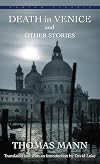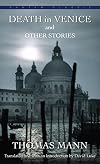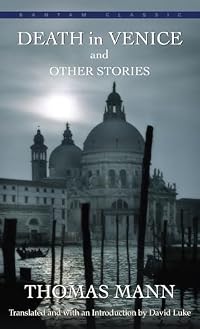
Death in Venice and Other Stories
by Thomas Mann 
On This Page
Description
The Nobel Prize-winning author's masterful novella of eros and obsession, presented alongside other short works of lyrical beauty and psychological depth. In Thomas Mann's immortal novella A Death in Venice, renowned author Gustave Aschenbach faces both middle age and a severe case of writer's block. He resolves to go on holiday in search of inspiration, only to find himself awestruck by the classical beauty of a fourteen-year-old boy. Submitting to his obsession with the youth, Gustave show more slowly loses himself, his dignity, and finally his life. This volume includes six short works by Mann, including "Little Herr Friedmann," "Gladius Dei," Tristan," and "Tonio Kroger," among others. show lessTags
Recommendations

















Member Reviews
This superb translation of Death in Venice and six other stories by Thomas Mann is a tour de force, deserving to be the definitive text for English-speaking readers. These seven stories represent Mann’s early writing career and a level of literary quality Mann himself despaired of ever again matching. In these stories he began to grapple with themes that were to recur throughout his work. In Little Herr Friedemann, a character’s carefully structured way of life is suddenly threatened by an unexpected sexual passion. In Gladius Dei, puritanical intellect clashes with beauty. In Tristan, Mann presents an ironic and comic account of the tension between an artist and bourgeois society.All seven of these stories are accomplished and show more memorable, but it is Death in Venice that truly forms the centerpiece of the collection. The themes that Mann weaves through the shorter pieces come to a climax in this stunning novella, one of the most hauntingly magnificent tales of art and self-destruction ever written. show less
3.5
Very well written, though it’s a bit funny to think that this man saw a pretty child and immediately descended into a multiple-week 100+ page spiral debating mythology, philosophy and beauty and then expired.
Very well written, though it’s a bit funny to think that this man saw a pretty child and immediately descended into a multiple-week 100+ page spiral debating mythology, philosophy and beauty and then expired.
Thomas Mann's novels are far better than his short stories. Period. This collection spans the years of 1896 to 1912 and I found them to be of uneven quality. The one I liked best was Tonio Kröger, which was also Mann's own favorite among his works. It has a much tighter and leaner structure than its more famous counterpart Death in Venice. Though the latter is more evocative and also has more depth, the story took forever to even get started. The same goes for Gladius Dei (an alternative title for it could be 'Savonarola goes to Munich') – it's like Mann can’t help himself going overboard in descriptions of the most uninteresting kind. It must have been more entertaining for himself than for the reader, who isn't given the show more slightest hint about why these descriptions should carry any import until an eternity of pages later - if at all. Surprisingly, I found myself almost siding with the Münchner Savonarola, here called Hieronymus, against the disagreeable bourgeois art-dealer who is his nemesis in this story – though I don’t share his passion for the Madonna, or more to the point: in contrast to Hieronymus, I rather like her undressed. Tristan is another story built upon the Liebestod-theme, like Tonio Kröger, though here it might even amount to murder – or maybe suicide – anyway, it’s death by Wagner, no less! (Ingenius "murder weapon" by the way.)
The Joker is a story in the "superfluous man"-genre, but as only Mann could have written it - while Little Herr Friedemann is transported out of of his orderly existence by a sudden passion, somewhat reminiscent of Death in Venice but written much earlier. Finally, The Road to the Churchyard is one of the shortest of these stories, and it's as short as it is absurdly comical. Here the main character, Lobgott Piepsam, more or less self-destructs on his way to the cemetery to visit the grave of his late wife. Not exactly a comical setup, you say? But then you probably haven’t yet been introduced to Piepsam. – There is quite a lot of self-destruction in several of these stories, so this comical interlude (another was Gladius Dei) was a relief.
I read these stories while traveling back and forth to work, and a good measure of how much I like a book is whether I continue reading it at home; with this book that happened only with a couple of these stories and it has taken me several months to finish reading it. It is possible that this could be due to the translation, but I'm not particularly tempted to give them a try in German. All in all: fascinating at times, boring at others. I’m actually quite relieved to have made it all the way through this book, though I'm nevertheless glad I did.
This work is licensed under a Creative Commons Attribution-NonCommercial-ShareAlike 3.0 Unported License. show less
The Joker is a story in the "superfluous man"-genre, but as only Mann could have written it - while Little Herr Friedemann is transported out of of his orderly existence by a sudden passion, somewhat reminiscent of Death in Venice but written much earlier. Finally, The Road to the Churchyard is one of the shortest of these stories, and it's as short as it is absurdly comical. Here the main character, Lobgott Piepsam, more or less self-destructs on his way to the cemetery to visit the grave of his late wife. Not exactly a comical setup, you say? But then you probably haven’t yet been introduced to Piepsam. – There is quite a lot of self-destruction in several of these stories, so this comical interlude (another was Gladius Dei) was a relief.
I read these stories while traveling back and forth to work, and a good measure of how much I like a book is whether I continue reading it at home; with this book that happened only with a couple of these stories and it has taken me several months to finish reading it. It is possible that this could be due to the translation, but I'm not particularly tempted to give them a try in German. All in all: fascinating at times, boring at others. I’m actually quite relieved to have made it all the way through this book, though I'm nevertheless glad I did.
This work is licensed under a Creative Commons Attribution-NonCommercial-ShareAlike 3.0 Unported License. show less
I'm ambivalent about this one. Perhaps it was the translation I was reading (I think I have the actual Der Tod in Venedig in the house somewhere, but frankly I couldn't face literary German at the moment), but I never really felt at ease when reading this. Not because of any of the themes that Mann tackled, or because of the denseness of the work; they were challenging and thought-provoking aspects, of course, but I found myself able to grapple with them.
What unnerved me was the way in which all the protagonists seemed to be so utterly detached from society, while at the same time being so changed, so warped, so created by its conventions. I suppose this is in part because Mann was so heavily influenced by Nietzche, and I have really show more never liked Nietzche. There was no part of me which felt able to connect to the characters. Von Aschenbach in 'Death in Venice' left me unmoved; the eponymous Tonio Kroger did manage to move me, but only to the extent that I wanted to smack him over the head for his pretentiousness.
When it comes down to style and elegance and observation, I can certainly appreciate Mann's achievement. I just can't like him as a writer show less
What unnerved me was the way in which all the protagonists seemed to be so utterly detached from society, while at the same time being so changed, so warped, so created by its conventions. I suppose this is in part because Mann was so heavily influenced by Nietzche, and I have really show more never liked Nietzche. There was no part of me which felt able to connect to the characters. Von Aschenbach in 'Death in Venice' left me unmoved; the eponymous Tonio Kroger did manage to move me, but only to the extent that I wanted to smack him over the head for his pretentiousness.
When it comes down to style and elegance and observation, I can certainly appreciate Mann's achievement. I just can't like him as a writer show less
For reasons that elude me, Noble Prize winner,Thomas Mann is one of those authors I've always meant to read but somehow have never gotten around to. He's often considered the greatest German novelist of the 20th century, so I opened this collection of short stories with high expectations. But what a huge let down. Each one of the short stories main character centered around a sad, pathetic, looser with an unhealthy
obsession for a women. Every single one ! Boring ! The book ended with the famous novella Death in Venice and I assumed things had to better. But no, once again, another man dealing with an unhealthy obsession. But this time it's even worse, because the obsession is a teenage boy. Perhaps some day I'll try another work by Mann show more which will give a better ideas as to why he is so well renowned. show less
obsession for a women. Every single one ! Boring ! The book ended with the famous novella Death in Venice and I assumed things had to better. But no, once again, another man dealing with an unhealthy obsession. But this time it's even worse, because the obsession is a teenage boy. Perhaps some day I'll try another work by Mann show more which will give a better ideas as to why he is so well renowned. show less
Just you try and fall in love with youth and *not* die! Mann's character wants it so bad that it almost happens.
Mann commented on the life of writers and the poor results produced by those who dabble in writing but don't pursue it as a full career. He also seems to be stating that writers must have something wrong with them to be effective, and this must be something that sets them emotionally apart from others and requires writing to restore balance to them as people. This seems to me to be a view of writing that does not really match reality for most writers. His characters in this collection of stories tend to be writers who make unexpected decisions. There are some touching moments in most of the stories. One story can be interpreted as either a debate between classical and modern values or a disturbing view into one man's initial experience show more with pedophiliac desire. Overall, I was disappointed. show less
Members
- Recently Added By
Lists

Blue Pyramid 1,276 Best Books of All Time
1,248 works; 32 members

Modernism
140 works; 7 members

In Our Time books
4,934 works; 2 members
Author Information

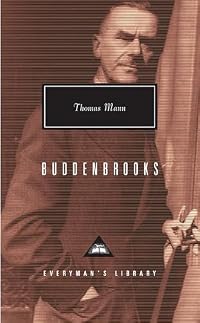
Thomas Mann was born into a well-to-do upper class family in Lubeck, Germany. His mother was a talented musician and his father a successful merchant. From this background, Mann derived one of his dominant themes, the clash of views between the artist and the merchant. Mann's novel, Buddenbrooks (1901), traces the declining fortunes of a merchant show more family much like his own as it gradually loses interest in business but gains an increasing artistic awareness. Mann was only 26 years old when this novel made him one of Germany's leading writers. Mann went on to write The Magic Mountain (1924), in which he studies the isolated world of the tuberculosis sanitarium. The novel was based on his wife's confinement in such an institution. Doctor Faustus (1947), his masterpiece, describes the life of a composer who sells his soul to the devil as a price for musical genius. Mann is also well known for Death in Venice (1912) and Mario the Magician (1930), both of which portray the tensions and disturbances in the lives of artists. His last unfinished work is The Confessions of Felix Krull, Confidence Man (1954), a brilliantly ironic story about a nineteenth-century swindler. An avowed anti-Nazi, Mann left Germany and lived in the United States during World War II. He returned to Switzerland after the war and became a celebrated literary figure in both East and West Germany. In 1929 he was awarded the Nobel Prize for literature. (Bowker Author Biography) show less
Thomas Mann has a Legacy Library. Legacy libraries are the personal libraries of famous readers, entered by LibraryThing members from the Legacy Libraries group.
Some Editions
Series
Belongs to Publisher Series
Work Relationships
Common Knowledge
- Canonical title
- Death in Venice and Other Stories
- Original publication date
- 1903 (Tristan ∙ Tonio Kröger) (Tristan ∙ Tonio Kröger); 1912 (Döden i Venedig) (Döden i Venedig); 1970 (English translation by David Luke) (English translation by David Luke); 1990 (New edition of English translation by David Luke) (New edition of English translation by David Luke)
- Important places
- Venice, Veneto, Italy
- First words
- The present selection of Thomas Mann's stories represents a period in his work of about fifteen years, from his first maturity until just before the First World War. - Introduction by David Luke
It was the nurse's fault. - Last words
- (Click to show. Warning: May contain spoilers.)And later that same day the world was respectfully shocked to receive the news of his death.
- Original language
- German
- Disambiguation notice
- ISBN 0099428652, 0099458454, 0436266628, 0553213334, 0749386231 : Little Herr Friedemann - The Joker - The road to the churchyard - Gladius Dei - Tristan - Tonio Kröger - Death in Venice. [WorldCat, Random House]
Classifications
- Genres
- Fiction and Literature, General Fiction
- DDC/MDS
- 833.912 — Literature & rhetoric German & related literatures German fiction 1900- 1900-1990 1900-1945
- LCC
- PT2625 .A44 .A262 — Language and Literature German, Dutch and Scandinavian literatures German literature Individual authors or works 1860/70-1960
- BISAC
Statistics
- Members
- 832
- Popularity
- 32,839
- Reviews
- 10
- Rating
- (3.83)
- Languages
- Dutch, English, German, Norwegian
- Media
- Paper, Ebook
- ISBNs
- 9
- ASINs
- 10