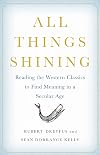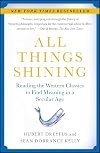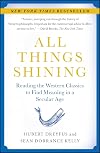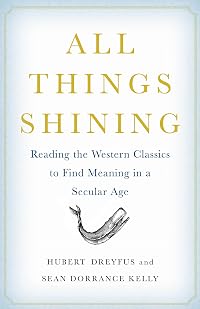
All Things Shining: Reading the Western Classics to Find Meaning in a Secular Age
by Hubert L. Dreyfus, Sean Dorrance Kelly
On This Page
Description
A guide for secular readers cites classic works of literature to illustrate how to achieve passionate, skillful engagement with others for a greater sense of purpose.Tags
Recommendations


























Member Reviews
Every now and then I read a book which makes me wish I were a lot smarter and well-read than I really am. Now, as a librarian, you would probably expect me to have read quite a bit, and I have, but books like this one make me realize how much more there is (even though I already have forty-nine books checked out of my current library). In this work, two philosophers come together to examine what they deem “western classics” and examine their connection with the way our world is today. For those who lean towards the melancholic, “who wants to lure back the shining things, to uncover the wonder we were once capable of experiencing and to reveal a world that sometimes calls forth such a mood; anyone who is done with indecision and show more waiting, with expressionlessness and lostness and sadness and angst, and who is ready for whatever it is that comes next; anyone with hope instead of despair, or anyone with despair that they would like to leave behind, can find something worthwhile in the pages ahead” (xi). And although this is a bold and ambitious claim, I would argue that they succeed.
The first chapters address “contemporary nihilism” in a very unique manner, comparing and contrasting David Foster Wallace and his work “Infinite Jest” with Elizabeth Gilbert’s “Eat Pray Love.” The authors contend that both authors are addressing the “tension between commitment and choice” (27) and that “although each is motivated by a deep sense of confusion and lostness, a sense that the darkness of being adrift is a central feature of the age, nevertheless each feels strongly that the writer’s responsibility is to show the way forward, to offer a vision of the hopeful possibilities available in the modern world” (28). The following chapters jump backwards in history to Homer and other Greek literature, then to Augustine, Dante, Kant, and so on. In each chapter, the authors look at the society and culture which surrounds each writer or work, including the religious and philosophical assumptions that the general population lived with, and how that should affect the modern reading.
This is probably one of the better books I have read recently, even with a quick skimming through. Although the idea of using classic literature to explore philosophy has been done before, this one is particularly poignant as it considers the secular nature of our contemporary society, and makes readers consider what may be lost in a culture that is so disconnected from the sacred. show less
The first chapters address “contemporary nihilism” in a very unique manner, comparing and contrasting David Foster Wallace and his work “Infinite Jest” with Elizabeth Gilbert’s “Eat Pray Love.” The authors contend that both authors are addressing the “tension between commitment and choice” (27) and that “although each is motivated by a deep sense of confusion and lostness, a sense that the darkness of being adrift is a central feature of the age, nevertheless each feels strongly that the writer’s responsibility is to show the way forward, to offer a vision of the hopeful possibilities available in the modern world” (28). The following chapters jump backwards in history to Homer and other Greek literature, then to Augustine, Dante, Kant, and so on. In each chapter, the authors look at the society and culture which surrounds each writer or work, including the religious and philosophical assumptions that the general population lived with, and how that should affect the modern reading.
This is probably one of the better books I have read recently, even with a quick skimming through. Although the idea of using classic literature to explore philosophy has been done before, this one is particularly poignant as it considers the secular nature of our contemporary society, and makes readers consider what may be lost in a culture that is so disconnected from the sacred. show less
I really wanted to like this book. And I liked it more at the end than I did in the middle, but all told it was disappointing and frustrating. It is a parade of anecdotes from the Western canon, each used to illustrate how we have descended from the heights of human flourishing in Homer's Greece to the depths of dull, flat nihilism in this modern age. On the whole I found it patronizing and superficial. It is written in a first-person plural that goes back and forth between a "we" representing the two co-authors and a "we" that (though it is never stated) seems to refer to college-educated white people living in North America. I dislike this book in the first place because I reject its central premise: that "we" are living empty, show more unprecedentedly meaningless lives. I dislike it in the second place because it has a self-satisfied tone: it seems to say "All of Western art has failed you (except Moby-Dick), aren't you glad we came along to set you straight?" The unstated premise of the book, that personal philosophies are able to be willfully adopted, and that they can be valued without regard to their internal logic or relationship to experienced reality, also rubs me wrong. The stickiest parts of this book's arguments are the parts the authors flit over the most delicately. I think of philosophy as being about tackling hard questions, but this book leans more towards easy answers.The book begins and ends with a discussion of David Foster Wallace as a representative of the destructive nihilism of our age. The authors suggest, preposterously, that Wallace's suicide was a result of the failure of his personal philosophy. Such a perspective on the nature of mental illness is offensive and irresponsible. By the end I began to get the sense that, after all, the authors and I agreed on the ways people can and should find meaning in their lives. And it was that glimmer, that sense of failed promise, that sealed my dislike of the book. show less
I very much enjoyed this book even though I disagreed with most of it! I really liked the writing. I constantly found things I wanted to argue about, and it made me think a lot about why I disputed many of their points.
Modern academic philosophers are often criticized for not having anything to say about ordinary life. The discipline thought of as one that addresses the big problems of life seems to have little to say of interest to anyone who actually lives a life. There's some truth to that, but this book is one that does have something to say about ordinary life and how to live one well. And it says it in a very accessible, compelling way.
The authors provide a historical diagnosis of a critical cultural loss -- our loss of an immediate sense of what to do, of what matters, of the values to live by. Early in the book, they recite the story of a man, Wesley Autrey, who without hesitation risked his life to help a man who had fallen onto the subway show more tracks in New York. What's remarkable to them is how rare Autrey's act is, not so much because it was brave as because it was certain and immediate. It's not as if Autrey weighed the pros and cons and decided to act courageously -- he just did. As he says, "I just saw someone who needed help." His perception of the situation dictated his response
While there are trivial examples of such automatic responses to situations in everyday life, ones in which our mettle is tested are rare. Others were on the train platform and didn't do what Autrey did. And the authors believe that such certainty of what to do, of what matters, is something we've lost. And we've lost it because of a centuries-long process of turning ourselves deaf to the call of situations -- the evolution of the individual self, with an autonomous, internal life has produced that deafness. We no longer listen outside ourselves but only within ourselves, for meaning and direction. And that internalized self is no longer capable of finding or creating the kind of values that sustain meaningful lives for us.
They trace this development from a breakdown of Homeric polytheism, through Aeschylus, Plato, Aristotle, Augustine, Aquinas, Dante, Descartes, Kant, and, maybe most pointedly, Herman Melville's Moby Dick. Their analysis of Moby Dick may be the highlight of the book, finding in its characters and plot twists a kind of encyclopedia of the search for meaning in life.
In the end, they settle into something a little surprising. We don't solve the problem of the self by curing the self. We solve it by looking outside the self, to mundane practices and our ability to be receptive to public moods and the call of ordinary meaning in such rituals as family meals, sports events, and the like -- the things that "shine" forth as meaningful in everyday life. Nothing transcendent, nothing requiring great leaps of enlightenment. In fact, it is the opposite -- we've tried so hard to develop individual enlightenment and autonomy of thought in our internal lives that we've neglected those ordinary practices and the swells of meaning in big public events, such as Martin Luther King, Jr.'s Lincoln Memorial speech.
They also warn of a tendency of modern technology (or maybe better, a kind of "technologism" -- a technological world-view) that covers up those everyday practices and sources of meaning and substitutes for them a kind of marshaling of resources and reduction of the efforts of life to "ease". If anything, I'd like to have heard more about this. This is the argument of Heidegger's The Question Concerning Technology, and maybe it would be better to take the topic on to a reading of that book.
Whether the problem the authors diagnose is one of "everyone" or only of a class of intellectually-aware post-moderns is debatable. I wouldn't dismiss its reach into "everyone." In fact, I question the perception I began with, that modern philosophy has little to do with ordinary life. Without speaking of the philosophers and other intellectuals behind the concepts, businessmen speak of "paradigm shifts", public policy experts line up on the side of Rawlsian liberalism, Friedmanesque free market theory, and so on. There's more going on than meets the eye. show less
The authors provide a historical diagnosis of a critical cultural loss -- our loss of an immediate sense of what to do, of what matters, of the values to live by. Early in the book, they recite the story of a man, Wesley Autrey, who without hesitation risked his life to help a man who had fallen onto the subway show more tracks in New York. What's remarkable to them is how rare Autrey's act is, not so much because it was brave as because it was certain and immediate. It's not as if Autrey weighed the pros and cons and decided to act courageously -- he just did. As he says, "I just saw someone who needed help." His perception of the situation dictated his response
While there are trivial examples of such automatic responses to situations in everyday life, ones in which our mettle is tested are rare. Others were on the train platform and didn't do what Autrey did. And the authors believe that such certainty of what to do, of what matters, is something we've lost. And we've lost it because of a centuries-long process of turning ourselves deaf to the call of situations -- the evolution of the individual self, with an autonomous, internal life has produced that deafness. We no longer listen outside ourselves but only within ourselves, for meaning and direction. And that internalized self is no longer capable of finding or creating the kind of values that sustain meaningful lives for us.
They trace this development from a breakdown of Homeric polytheism, through Aeschylus, Plato, Aristotle, Augustine, Aquinas, Dante, Descartes, Kant, and, maybe most pointedly, Herman Melville's Moby Dick. Their analysis of Moby Dick may be the highlight of the book, finding in its characters and plot twists a kind of encyclopedia of the search for meaning in life.
In the end, they settle into something a little surprising. We don't solve the problem of the self by curing the self. We solve it by looking outside the self, to mundane practices and our ability to be receptive to public moods and the call of ordinary meaning in such rituals as family meals, sports events, and the like -- the things that "shine" forth as meaningful in everyday life. Nothing transcendent, nothing requiring great leaps of enlightenment. In fact, it is the opposite -- we've tried so hard to develop individual enlightenment and autonomy of thought in our internal lives that we've neglected those ordinary practices and the swells of meaning in big public events, such as Martin Luther King, Jr.'s Lincoln Memorial speech.
They also warn of a tendency of modern technology (or maybe better, a kind of "technologism" -- a technological world-view) that covers up those everyday practices and sources of meaning and substitutes for them a kind of marshaling of resources and reduction of the efforts of life to "ease". If anything, I'd like to have heard more about this. This is the argument of Heidegger's The Question Concerning Technology, and maybe it would be better to take the topic on to a reading of that book.
Whether the problem the authors diagnose is one of "everyone" or only of a class of intellectually-aware post-moderns is debatable. I wouldn't dismiss its reach into "everyone." In fact, I question the perception I began with, that modern philosophy has little to do with ordinary life. Without speaking of the philosophers and other intellectuals behind the concepts, businessmen speak of "paradigm shifts", public policy experts line up on the side of Rawlsian liberalism, Friedmanesque free market theory, and so on. There's more going on than meets the eye. show less
I read this after seeing the author interviewed on The Colbert Report. I like that the book elevates the positions of Melville and David Foster Wallace in the Western canon, but the attempt to link these authors to the works of antiquity sometimes feels like desperate overreaching. The book quotes extensively and certainly makes me want to go back and reread the source texts. The final chapter is a particularly good synthesis. The author restates in various ways that a new kind of polytheism and social experience may be a path toward (or back to) meaning in the modern world. This view is well defended but seems too narrow to be the only option.
How often do you read something completely new about Homer? This is it--an outstanding book that identifies the source of contemporary spiritual ennui and argues that we need to see the world as Homer's characters do in his epics. The authors' allusions are far-ranging, from Lou Gehrig to Pulp Fiction to Wesley Autrey, the man who, in 2007, leapt onto a subway track and used his body to shield a man who had fallen from an oncoming train. Readers steeped in the intricacies of Kant might balk at times; others might argue that the treatment of Aquinas is too narrow--don't listen to them. Dreyfus and Kelly have an original, striking thesis and they explore it with grace, conviction and good writing. The chapter on Moby-Dick doesn't say show more anything that an intelligent reader of that novel has missed, but it does cary the reader along with their enthusiasm for Melville's view of the world. (They also make you want to read Moby-Dick again, even if you've already done so many times.) The authors use the phrase "whooshing up" as a way to articulate "the most real things" that "well up and take us over, hold us for a while, and then, finally, let us go," like what Achilles experiences in battle, Nureyev finds on the stage, or Pele does scoring a goal. All Things Shining provoked a few whooshing ups in me as I read it. Highly recommended. show less
You could fill a book with what Dreyfus and Kelly don’t know about religion, and especially, Christian theology. And that’s exactly what All Things Shining is.
To begin with, it must be made clear that this book seeks to speak to an oddly narrow audience. It is clearly written for non-philosophers and doesn’t even require a great deal of familiarity with western literature either. However, in order to sympathize with the necessity of (re)finding meaning in a “secular age” one must, in fact, live in (or be otherwise aware of) a “secular age.” That is, the reader (or listener) need not know the literature on modern nihilism but one would be well served to already agree with it. Surely, a very narrow (even superficial) show more audience is intended here.
More to my point, the authors continuously display a shocking ignorance of the religious and theological aspects of the western tradition they critique. Some examples:
In chapter 1, the authors wrongly assume that there were no existential questions in the middle ages. If that were true, there wouldn’t have been theologians trying to make sense of the religiously given. If there wasn’t a desire to examine and search for meaning in life there would have been only deacons, priests, bishops and ritual and not also the explicit attempt to come to self-understanding of the faith at the heart of the Church.
Much is made later on of Wallace’s practice of using extensive endnotes and providing no clear resolution to elements in his writing. Far from being a new “postmodern” development this style very nicely recapitulates the practices of Jewish commentary and Christian scholastic theology.
The authors uncritically assume that being modern (i.e., contemporary) necessitates living in a nihilistic world characterized, by repetition more than argument, as a “secular age” following Charles Taylor. In so doing, they miss the fact that the vast majority of people, especially in the United States, remain fully religious (and not merely “spiritual”). A mere glance politics today demonstrates that we do not, in fact, live in a “secular age” at all.
Dreyfus and Kelly would also have us believe that the philosophical disposition toward “unity” lead to or even is monotheism. This would, of course, have come as something of a surprise to the late antique neoplatonic pagans who were obsessed with the One and remained dedicated to the many gods of the Mediterranean pantheon. They also fail to notice that the dominant monotheism of the West is an odd sort of monotheism. Christian trinitarianism (not to mention the completely ignored matter of the cult of saints, but far more important at the level of personal piety than the doctrine of the Trinity) resists an absolute unity by its very nature.
I could go on, but for little reason. While Dreyfus and Kelly do raise important questions (especially when contextualized within a common literacy) they have provided here a thoroughly skippable glance at themes and texts that deserve far better.
The audio quality is good and the narration well preformed but for an annoying trouble pronouncing the word agape (“Christian love” or “charity”). Someone really should have explained that it’s pronounced like the answer to a question at a Canadian shopping mall; “a Gap, eh?” show less
To begin with, it must be made clear that this book seeks to speak to an oddly narrow audience. It is clearly written for non-philosophers and doesn’t even require a great deal of familiarity with western literature either. However, in order to sympathize with the necessity of (re)finding meaning in a “secular age” one must, in fact, live in (or be otherwise aware of) a “secular age.” That is, the reader (or listener) need not know the literature on modern nihilism but one would be well served to already agree with it. Surely, a very narrow (even superficial) show more audience is intended here.
More to my point, the authors continuously display a shocking ignorance of the religious and theological aspects of the western tradition they critique. Some examples:
In chapter 1, the authors wrongly assume that there were no existential questions in the middle ages. If that were true, there wouldn’t have been theologians trying to make sense of the religiously given. If there wasn’t a desire to examine and search for meaning in life there would have been only deacons, priests, bishops and ritual and not also the explicit attempt to come to self-understanding of the faith at the heart of the Church.
Much is made later on of Wallace’s practice of using extensive endnotes and providing no clear resolution to elements in his writing. Far from being a new “postmodern” development this style very nicely recapitulates the practices of Jewish commentary and Christian scholastic theology.
The authors uncritically assume that being modern (i.e., contemporary) necessitates living in a nihilistic world characterized, by repetition more than argument, as a “secular age” following Charles Taylor. In so doing, they miss the fact that the vast majority of people, especially in the United States, remain fully religious (and not merely “spiritual”). A mere glance politics today demonstrates that we do not, in fact, live in a “secular age” at all.
Dreyfus and Kelly would also have us believe that the philosophical disposition toward “unity” lead to or even is monotheism. This would, of course, have come as something of a surprise to the late antique neoplatonic pagans who were obsessed with the One and remained dedicated to the many gods of the Mediterranean pantheon. They also fail to notice that the dominant monotheism of the West is an odd sort of monotheism. Christian trinitarianism (not to mention the completely ignored matter of the cult of saints, but far more important at the level of personal piety than the doctrine of the Trinity) resists an absolute unity by its very nature.
I could go on, but for little reason. While Dreyfus and Kelly do raise important questions (especially when contextualized within a common literacy) they have provided here a thoroughly skippable glance at themes and texts that deserve far better.
The audio quality is good and the narration well preformed but for an annoying trouble pronouncing the word agape (“Christian love” or “charity”). Someone really should have explained that it’s pronounced like the answer to a question at a Canadian shopping mall; “a Gap, eh?” show less
 This review was written for LibraryThing Early Reviewers.
Members
- Recently Added By
Published Reviews
This book, which was featured on the front page of The New York Times Book Review, comes recommended by some famous Big Thinkers. It is written by well-regarded professors (one of them the chairman of the Harvard philosophy department). This made me rub my eyes with astonishment as I read the book itself, so inept and shallow is it....
Reader, put it down.
Reader, put it down.
added by atbradley
Lists

Shaykh Hamza's Book Recommendations
439 works; 3 members

Books & Films Referenced by Cal Newport's Deep Work
43 works; 1 member
Author Information

29+ Works 2,513 Members
Hubert Lederer Dreyfus was born in Terre Haute, Indiana on October 15, 1929. He received a bachelor's degree in philosophy in 1951, a master's degree in 1952, and a doctorate in 1964 from Harvard University. He taught at Brandeis University and the Massachusetts Institute of Technology before joining the philosophy department at the University of show more California, Berkeley in 1968. He wrote or co-wrote numerous books during his lifetime including Alchemy and Artificial Intelligence, What Computers Can't Do: A Critique of Artificial Reason, Michel Foucault: Beyond Structuralism and Hermeneutics written with Paul Rabinow, Mind Over Machine: The Power of Human Intuition and Expertise in the Era of the Computer, What Computers Still Can't Do, Philosophy: The Latest Answers to the Oldest Questions, All Things Shining: Reading the Western Classics to Find Meaning in a Secular Age written with Sean D. Kelly, and Skillful Coping: Essays on the Everyday Phenomenology of Everyday Perception and Action. He and Mark Wrathall edited numerous guides devoted to existentialism, phenomenology, and Heidegger's philosophy. He died of cancer on April 22, 2017 at the age of 87. (Bowker Author Biography) show less
1+ Work 581 Members
Series
Belongs to Publisher Series
Common Knowledge
- Canonical title*
- Ogni cosa risplende: i classici e il senso dell'esistenza
- Original title
- All Things Shining
- Original publication date
- 2011
- People/Characters
- Wesley Autrey; Charles Foster Kane; Bill Bradley; Francesca da Rimini; Emma Bovary; William Shakespeare (show all 15); René Descartes (1596-1650); Friedrich Nietzsche (1844-1900); David Foster Wallace; Martin Luther (1483-1546); Immanuel Kant (1724-1804); Herman Melville; Pip; Queequeg; Lou Gehrig
- Blurbers
- Taylor, Charles; Van Doren, Charles; Gregorian, Vartan; Borgmann, Albert
*Some information comes from Common Knowledge in other languages. Click "Edit" for more information.
Classifications
- Genres
- Nonfiction, Philosophy, Literature Studies and Criticism, Religion & Spirituality, General Nonfiction
- DDC/MDS
- 200 — Religion The Bible & Christianity Religion
- LCC
- BL80.3 .D74 — Philosophy, Psychology and Religion Religions. Mythology. Rationalism Religions. Mythology. Rationalism Religions of the world
- BISAC
Statistics
- Members
- 581
- Popularity
- 50,469
- Reviews
- 28
- Rating
- (3.46)
- Languages
- English, German, Italian, Portuguese
- Media
- Paper, Audiobook, Ebook
- ISBNs
- 12
- ASINs
- 10