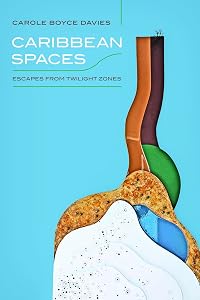
Caribbean Spaces: Escapes from Twilight Zone
by Carole BoyceDavies
On This Page
Description
"Drawing on both personal experience and critical theory, Carole Boyce Davies illuminates the dynamic complexity of Caribbean culture and traces its migratory patterns throughout the Americas. Both a memoir and a scholarly study, Caribbean Spaces: Escapes from Twilight Zones explores the multivalent meanings of Caribbean space and community in a cross-cultural and transdisciplinary perspective. From her childhood in Trinidad and Tobago to life and work in communities and universities in show more Nigeria, Brazil, England, and the United States, Carole Boyce Davies portrays a rich and fluid set of personal experiences. She reflects on these movements to understand the interrelated dynamics of race, gender, and sexuality embedded in Caribbean spaces, as well as many Caribbean people's traumatic and transformative stories of displacement, migration, exile, and sometimes return. Ultimately, Boyce Davies reestablishes the connections between theory and practice, intellectual work and activism, and personal and private space. "-- "Both a memoir and a scholarly study, this project explores the multivalent meanings of Caribbean space and community in a cross-cultural and transdisciplinary perspective. Drawing on experiential knowledge and theory, Boyce Davies has crafted this set of reflective essays to illuminate the dynamic and ever-changing complexity of Caribbean culture and to trace its migratory patterns in and between the Americas. In weaving the private spaces of the author's individual story with public spaces of Caribbean culture, Boyce Davies crosses many cultural and disciplinary boundaries. Such movements are necessary to understand the interrelated dynamics of race, gender, and sexuality embedded in Caribbean spaces, and also many Caribbean people's traumatic and transformative stories of displacement, migration, and exile. From there, she dwells on the way her knowledge has informed her political vision as it links to broader, black diaspora matters including the 1960s civil rights movement, the environmental catastrophes of Haiti, the failure of the New Orleans levies, technologies such as the iPhone and GPS, and how all these things are understood and informed by a Caribbean logic. Family narratives, local knowledge, poems, literary analyses, descriptions of artwork, and accounts of spiritual practices are cohesively used to sustain a comprehensive theoretical analysis fostered by the author's extensive fieldwork and research. Ultimately, Boyce Davies reestablishes the link between theory and practice and intellectual work and activism which, the author argues, marked the beginning of Black Studies itself"-- show lessTags
Members
- Recently Added By
Author Information

12+ Works 293 Members
Awards and Honors
Classifications
- Genres
- Anthropology, Nonfiction, History, Sociology, Science & Nature
- DDC/MDS
- 305.8960729 — Society, government, & culture Social sciences, sociology & anthropology Social group - Age, Gender, Ethnicity Ethnic and national groups Other ethnic and national groups Africans and people of African descent; Blacks of African origin standard subdivisions / located in North America
- LCC
- F2191 .B55 .B69 — Local History of the United States, Canada and Latin America Latin America. Spanish America Caribbean area. Caribbean Sea
- BISAC
Statistics
- Members
- 8
- Popularity
- 2,138,556
- Languages
- English
- Media
- Paper, Ebook
- ISBNs
- 3