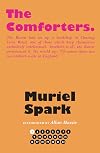
The Comforters
by Muriel Spark
On This Page
Description
With easy, sunny eeriness, Spark lights up the darkest things: blackmail, a drowning, nervous breakdowns, a ring of smugglers, a loathsome busybody, a diabolic bookseller, human evil.Tags
Recommendations

















Member Reviews
Muriel Spark should be credited with being one of the most inventive writers of the 20th century. This book is no exception, and will certainly keep you thinking throughout. There is only one problem with this otherwise excellent novel - it doesn't feel like it actually goes anywhere. There is forward momentum of a sort, but it feels like this is a parody of momentum, just as the book itself is a parody of a book.
Playful and mischievous, this book walks us through a carefully crafted web of coincidences led by a quirky cast of characters. Caroline is the most intriguing as she walks awake among her own, recording their stories. This is the door to greater philosophy: are we the masters or the puppets of our lives? do we have free will or is our destiny re-ordained? While Sparks hints to an answer, the tale is fluid enough that there is no clear answer, making this book both delightful and impish.
A gloriously offbeat, subversive novel that set the pattern for Spark's literary output, where the only thing you could be sure of was that you hadn't a clue what might be coming next. Some of the usual themes are here - Catholicism, the shabbier side of literary London - but this is a novel that thinks it's an absurdist play, in which there's some kind of dangerous leak in the fabric of unreality and the characters become aware that they are characters in a work of fiction, and some of them start to fight against that idea. And not just any work of fiction, but one built on an improbable conspiracy and a set of coincidences so convoluted that it would challenge the ingenuity of Dickens to fit them all into a novel three times the show more length of this one. We have a main viewpoint character, Caroline, who is meant to be writing a book on The Novel, but who keeps being disturbed by the tapping of a typewriter and the voice of what is indisputably an omniscient narrator telling her what she is thinking; we have a 78-year-old granny who runs an international diamond-smuggling gang; we have an embittered old retainer who literally disappears whenever the action doesn't require her and whose bosom seems to be of endless fascination to Caroline; we have a bookseller who dabbles in satanism and despises people who buy books; we have a manufacturer of preserved figs who always manages to be away on a religious retreat when something happens in the story, and much more. It's all pretty crazy, and Spark tells us about it with her usual light, ironic detachment, managing to bring the story to the most conventional conclusion narrative inevitability could demand whilst still making us fully aware of how silly a convention it is that novels should end in that particular way. Not her best book, of course, but still very entertaining sixty years on, and well worth a look. show less
Caroline Rose is in a state. She’s hearing voices. And typewriters. The voices appear to be narrating her innermost thoughts. The ones she’s just had. It’s almost as though she were merely a character in a novel. And what would that make of Laurence, her particular friend, or the phony Baron, or Laurence’s grandmother, Louisa Depp, who may actually be involved in a diamond smuggling gang? Honestly there might as well also be black masses and miracles, witches and merchant seamen. Caroline is convinced that if this is a novel, it must be terrible, and she, for one, intends to break out of it if it’s the last thing she does.
Muriel Spark’s audacious first novel is as tricksy and zany as a Marx Brothers film. It gets tiresome show more after a while, but perhaps our tolerance for zaniness is stunted these days. Certainly the writing is full of verve and enthusiasm. Though whether or not it somehow explores the very nature of form in the modern novel may be overstating things. It’s hard to imagine now how Spark’s peers must have responded to her daring, or how much they must have feared her emergence into her full powers as a comic novelist.
Certainly recommended if only as a wonderful introduction to this comic master. show less
Muriel Spark’s audacious first novel is as tricksy and zany as a Marx Brothers film. It gets tiresome show more after a while, but perhaps our tolerance for zaniness is stunted these days. Certainly the writing is full of verve and enthusiasm. Though whether or not it somehow explores the very nature of form in the modern novel may be overstating things. It’s hard to imagine now how Spark’s peers must have responded to her daring, or how much they must have feared her emergence into her full powers as a comic novelist.
Certainly recommended if only as a wonderful introduction to this comic master. show less
'The decor of Brompton Oratory makes me ill,' she told him, as another excuse. For when he had met her after the Mass she had turned most sour.
'You don't refer to the "decor" of a church,' he said - 'at least, I think not.'
'What is it then?'
'I'm not sure of the correct term. I've never heard it called a "decor".'
'Very useful, your having been brought up a Catholic,' said Caroline. 'Converts can always rely on your kind for instruction in the non-essentials.'
I can hardly believe that this was Muriel Spark's first book. Witty, catty and delightful, it starts out as the story of Caroline Rose, a Catholic convert who starts to have auditory hallucinations of an author narrating and typing out the real-life story of Caroline and her friends show more and acquaintances.
But Caroline disappears into hospital and out of the story for a large chunk of the book, as 'the author' doesn't know how to describe hospitals, and another character, the manipulative, blackmailing Mrs Hogg disappears into thin air when she walks out of a room or falls asleep, as the other characters see her as someone who has no private life.
Caroline's boyfriend Laurence believes that his grandmother is running a diamond smuggling ring and her eccentric friend The Baron sees devil worshippers around every corner, but who can we believe? “Is the world a lunatic asylum then? Are we all courteous maniacs discreetly making allowances for everyone else's derangement?” show less
'You don't refer to the "decor" of a church,' he said - 'at least, I think not.'
'What is it then?'
'I'm not sure of the correct term. I've never heard it called a "decor".'
'Very useful, your having been brought up a Catholic,' said Caroline. 'Converts can always rely on your kind for instruction in the non-essentials.'
I can hardly believe that this was Muriel Spark's first book. Witty, catty and delightful, it starts out as the story of Caroline Rose, a Catholic convert who starts to have auditory hallucinations of an author narrating and typing out the real-life story of Caroline and her friends show more and acquaintances.
But Caroline disappears into hospital and out of the story for a large chunk of the book, as 'the author' doesn't know how to describe hospitals, and another character, the manipulative, blackmailing Mrs Hogg disappears into thin air when she walks out of a room or falls asleep, as the other characters see her as someone who has no private life.
Caroline's boyfriend Laurence believes that his grandmother is running a diamond smuggling ring and her eccentric friend The Baron sees devil worshippers around every corner, but who can we believe? “Is the world a lunatic asylum then? Are we all courteous maniacs discreetly making allowances for everyone else's derangement?” show less
Just before the libraries closed, I borrowed the longest Muriel Spark novels that I hadn't read yet: this and [b:The Mandelbaum Gate|120156|The Mandelbaum Gate|Muriel Spark|https://i.gr-assets.com/images/S/compressed.photo.goodreads.com/books/1171821151l/120156._SY75_.jpg|457517]. 'The Comforters', as it turns out, was her first published novel. I doubt I'd have realised that without it being pointed out in the introduction, as Spark already has her assured narrative voice and arch wit fully developed. The plot is perhaps not as tight as some of her later, shorter novellas, though. There is also a central conceit more explicitly experimental than I've found in her other fiction: one of the main characters becomes aware that she's in a show more novel. This meta twist is treated in characteristically deadpan fashion. Caroline, the character experiencing it, unsurprisingly assumes at first that she is delusional and receives a variety of unhelpful advice from friends, relatives, and her boyfriend Laurence. I found Laurence a very entertaining character, essentially a Useless Sherlock Holmes. He is very nosy and has a remarkable eye for detail, but by temperament and inclination doesn't draw useful conclusions from what he discovers. When he does uncover something interesting, like a smuggling ring involving his grandmother, he cannot keep it to himself.
The darkly farcical plot of 'The Comforters' revolves around secrets incompetently concealed and blackmail ineptly attempted. The dramatic climaxes are sudden, apparently random events that appear dropped in by the novelist, who Caroline can sometimes eavesdrop on. As usual with Spark, Catholicism is a running theme, the dialogue is witty and tart, and several characters are convincingly unbearable people. Georgina Hogg and the Baron are especially memorable creations and Louisa is magnificently enigmatic. Mental illness is a more significant theme here than in other Spark novels. My favourite moments tended to centre upon this:
Muriel Spark's writing is a balm in troubled times, definitely recommended as lockdown reading. show less
The darkly farcical plot of 'The Comforters' revolves around secrets incompetently concealed and blackmail ineptly attempted. The dramatic climaxes are sudden, apparently random events that appear dropped in by the novelist, who Caroline can sometimes eavesdrop on. As usual with Spark, Catholicism is a running theme, the dialogue is witty and tart, and several characters are convincingly unbearable people. Georgina Hogg and the Baron are especially memorable creations and Louisa is magnificently enigmatic. Mental illness is a more significant theme here than in other Spark novels. My favourite moments tended to centre upon this:
"I'm sure, Willi," said Caroline, "that you are suffering from the emotional effects of Eleanor leaving you. I am sure, Willi, that you should see a psychiatrist."
"If what you say were true," he said, "it would be horribly tactless of you to say it. As it is I make allowances for your own disorder."
"Is the world a lunatic asylum then? Are we all courteous maniacs discreetly making allowances for everyone else's derangement?"
"Largely," said the Baron.
"I resist the proposition," Caroline said.
"That is an intolerant attitude."
"It's the only alternative to demonstrating the proposition," Caroline said.
"I don't know," said the Baron, "really why I continue to open my mind to you."
Muriel Spark's writing is a balm in troubled times, definitely recommended as lockdown reading. show less
'this is a very remote world I'm in now', 26 Jun. 2012
By
sally tarbox
This review is from: The Comforters (VMC) (Paperback)
Strange little book with a totally silly plot: Caroline, a recent convert to Catholicism, has started hearing voices and a 'ghost typewriter'.
Meanwhile her (Job's) comforters have their own preoccupations: boyfriend Laurence is investigating his grandmother who is part of a diamond smuggling gang. (Grandmother Louisa is undoubtedly the best drawn character in the book- half gipsy with her Bulgarian cigarettes and taste for cooking offal.)
His mother is only interested in Catholic charity work, even towards the objectionable Mrs Hogg whom Caroline so dislikes. And her friend the Baron is obsessed with black show more magic...
Spark's poetic writing shines through: I loved such phrases as 'Louisa sat beside the wireless cuddled in the entranced carcass of Laurence's voice'.
And I found Ali Smith's introduction most enlightening to read when I'd finished the book. But I was glad to get to the end. show less
By
sally tarbox
This review is from: The Comforters (VMC) (Paperback)
Strange little book with a totally silly plot: Caroline, a recent convert to Catholicism, has started hearing voices and a 'ghost typewriter'.
Meanwhile her (Job's) comforters have their own preoccupations: boyfriend Laurence is investigating his grandmother who is part of a diamond smuggling gang. (Grandmother Louisa is undoubtedly the best drawn character in the book- half gipsy with her Bulgarian cigarettes and taste for cooking offal.)
His mother is only interested in Catholic charity work, even towards the objectionable Mrs Hogg whom Caroline so dislikes. And her friend the Baron is obsessed with black show more magic...
Spark's poetic writing shines through: I loved such phrases as 'Louisa sat beside the wireless cuddled in the entranced carcass of Laurence's voice'.
And I found Ali Smith's introduction most enlightening to read when I'd finished the book. But I was glad to get to the end. show less
Members
- Recently Added By
Lists

Best of Scottish Literature
35 works; 6 members

A Novel Cure
742 works; 23 members

le donne raccontano
116 works; 1 member

Tonikat reading completed on Librarything journals
329 works; 2 members
Author Information

101+ Works 22,824 Members
Muriel Spark has been called "our most chillingly comic writer since Evelyn Waugh" by the London Spectator, and the New Yorker praised her novel Memento Mori ri (1959) as "flawless." Her fiction is marked by its remarkable diversity, wit, and craftsmanship. "She happens to be, by some rare concatenation of grace and talent, an artist, a show more serious---and most accomplished---writer, a moralist engaged with the human predicament, wildly entertaining, and a joy to read" (SRSR). She became widely known in the United States when the New Yorker devoted almost an entire issue to The Prime of Miss Jean Brodie (1961). Set in Edinburgh in the 1930s, this is the story of a schoolteacher, her unorthodox approach to life, and its effect on her select group of adolescent girls. Though their idol turns out to have feet of clay, she leaves an indelible mark on their lives. The Girls of Slender Means (1963), also warmly praised, is a sardonic look at the vivacity of youth and the anxieties of young womanhood. Reviewing The Mandelbaum Gate (1965) for the New Republic, Honor Tracy wrote: "There is an abundance here of invention, humor, poetry, wit, perception, that all but takes the breath away. . . . The story, in fact, is pure adventure, with the suspense as artfully maintained as anywhere by Graham Greene, but this is only one ingredient. There are memorable descriptions of the Holy Land, fascinating insights into the jumble of intrigue and piety surrounding the Holy Places, and penetrating studies of Arabs. . . . In each of [Spark's] novels heretofore one of her qualities has tended to predominate over the others. Here for the first time they are all impressively marshaled side by side, resulting in her best work so far." The daughter of an Englishwoman and a Scottish-Jewish father, Spark was born and educated in Edinburgh. After her marriage in 1938, she lived for some years in Central Africa, a period rarely reflected in her work. During World War II, she returned to Britain, where she worked in the Political Intelligence Department of the Foreign Office after the breakup of her marriage. She has been a magazine editor and written poetry and literary criticism. Spark has lived in London's Camberwell section, the setting of The Ballad of Peckham Rye (1960), but now makes her home in New York. Her novels reflect her conversion to Roman Catholicism. (Bowker Author Biography) Writer Muriel Spark was born in Edinburgh on February 1, 1918. In 1934-1935 she took a course in commercial correspondence and précis writing at Heriot-Watt College. After her marriage in 1937, she lived for some years in Central Africa. During World War II, she returned to Britain, where she worked in the Political Intelligence Department of the Foreign Office after the breakup of her marriage. After the war, she began her literary career. She became General Secretary of the Poetry Society, worked as an editor and wrote studies of Mary Shelley, John Masefield and the Brontë sisters. Her first book of poetry, The Fanfarlo and Other Verse, was published in 1952 and her first novel, The Comforters, was published in 1957. She wrote over twenty books including The Prime of Miss Jean Brodie and The Finishing School. She won numerous awards and honors including the 1965 James Tait Black Memorial Prize for The Mandelbaum Gate, the 1992 U. S. Ingersoll Foundation T. S. Eliot Award, the 1997 David Cohen British Literature Prize for Lifetime Achievement, and in 1993 she became Dame Commander of the Order of the British Empire in recognition of her services to literature. The Scottish Arts Council created the Muriel Spark International Fellowship in 2004. She died on April 13, 2006. (Bowker Author Biography) show less
Some Editions
Series
Belongs to Publisher Series
Work Relationships
Common Knowledge
- Canonical title
- The Comforters
- Original title
- The Comforters
- Original publication date
- 1957
- Dedication
- To Alan and Edwina Barnsley
With Love - First words
- In 1957, the year of first publication of The Comforters, angry young men were all the rage in literary Britain. (Introduction)
On the first day of his holiday Laurence Manders woke to hear his grandmother's voice below. - Quotations
- However, as soon as Mrs. Hogg stepped into her room she disappeared, she simply disappeared. She had no private life whatsoever. God knows where she went in her privacy.
'The decor of Brompton Oratory makes me ill,' she told him, as another excuse. For when he had met her after the Mass she had turned most sour.
'You don't refer to the "decor" of a church,' he said - 'at least, I think not... (show all).'
'What is it then?'
'I'm not sure of the correct term. I've never heard it called a "decor".'
'Very useful, your having been brought up a Catholic,' said Caroline. 'Converts can always rely on your kind for instruction in the non-essentials.'
Louisa opened a drawer in the kitchen dresser, ... brought out her airmail writing paper and her fountain pen and wrote a note of six lines. ... Next she put away her fountain pen, then the writing paper, took up the note and... (show all) went out into her garden. - Last words
- (Click to show. Warning: May contain spoilers.)As vibrant as ever, more than fifty years after its first appearance, it still knocks the stuffing out of the realist tradition, and probably always will. (Introduction)
(Click to show. Warning: May contain spoilers.)He saw the bits of paper come to rest, some on the scrubby ground, some among the deep marsh weeds, and one piece on a thorn-bush; and he did not then foresee his later wonder, with a curious rejoicing, how the letter had gotten into the book. - Blurbers
- Waugh, Evelyn; Rankin, Ian
Classifications
Statistics
- Members
- 588
- Popularity
- 50,039
- Reviews
- 25
- Rating
- (3.71)
- Languages
- 7 — English, French, German, Italian, Russian, Spanish, Turkish
- Media
- Paper, Ebook
- ISBNs
- 20
- ASINs
- 14