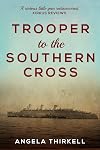
Trooper to the Southern Cross
by Angela Thirkell
On This Page
Tags
Recommendations





















Member Reviews
Not the sort of thing you would expect from Thirkell, but more like a bastard child of Henry Lawson and Joseph Conrad: a "doomed vessel" full of violent, insubordinate, and uncontrollable Diggers on their way back to Australia after the first world war.
The narrator is an affable but rather thoughtless Australian Army surgeon, travelling first-class on the ship together with his new English wife and a handful of other officers and their families. The introduction to the Virago edition suggests, plausibly enough, that the character of the narrator is largely based on the author's second husband, George Thirkell, whilst she herself appears as the slightly shrewish Mrs Colonel Jerry.
The story, such as it is, deals with the officers' show more attempts to keep the unruly Other Ranks in order. The atmosphere is probably nearer to Stalky and Co. than to Lord Jim: there's no real sense of imminent shipwreck, but there's some pretty serious psychological warfare going on, as well as a surprising amount of physical violence. The treatment of the common soldiery is very similar to the mixture of patronising admiration and fear that we find in middle-class second world war writers like Anthony Powell and Evelyn Waugh. It borrows techniques from writers like Kipling and Lawson who genuinely did admire working-class men, but subverts them in sometimes rather unpleasantly snobbish ways.
The major's narrative is an enjoyably rambling mixture of army reminiscences, colourful Australian idiom, and total incomprehension of women in general and English middle-class ones in particular. Thirkell obviously wants us to appreciate his kind-hearted nature, playfulness, and laconic response to danger, but at the same time she mocks him for his passion for tomato sauce and for the way he treats Celia-the-doormat, his wife. So, a bit of a strange mixture, but nonetheless quite an entertaining little period piece. show less
The narrator is an affable but rather thoughtless Australian Army surgeon, travelling first-class on the ship together with his new English wife and a handful of other officers and their families. The introduction to the Virago edition suggests, plausibly enough, that the character of the narrator is largely based on the author's second husband, George Thirkell, whilst she herself appears as the slightly shrewish Mrs Colonel Jerry.
The story, such as it is, deals with the officers' show more attempts to keep the unruly Other Ranks in order. The atmosphere is probably nearer to Stalky and Co. than to Lord Jim: there's no real sense of imminent shipwreck, but there's some pretty serious psychological warfare going on, as well as a surprising amount of physical violence. The treatment of the common soldiery is very similar to the mixture of patronising admiration and fear that we find in middle-class second world war writers like Anthony Powell and Evelyn Waugh. It borrows techniques from writers like Kipling and Lawson who genuinely did admire working-class men, but subverts them in sometimes rather unpleasantly snobbish ways.
The major's narrative is an enjoyably rambling mixture of army reminiscences, colourful Australian idiom, and total incomprehension of women in general and English middle-class ones in particular. Thirkell obviously wants us to appreciate his kind-hearted nature, playfulness, and laconic response to danger, but at the same time she mocks him for his passion for tomato sauce and for the way he treats Celia-the-doormat, his wife. So, a bit of a strange mixture, but nonetheless quite an entertaining little period piece. show less
Set just after WWI, Trooper to the Southern Cross is narrated by Major Bowen, a former military doctor. He and his wife Celia book passage on a trooper ship, the Rudolstadt, from England to Australia. On board are former military personnel, diggers, prisoners, and others, and this novel is the story of their voyage.
The novel is based on personal experience. Angela Thirkell came from an illustrious family; her grandfather was the painter Edward Burne-Jones, her father was the first biographer of William Morris, her brother was Denis Mackail (author of Greenery Street, published by Persephone), Rudyard Kipling and Stanley Baldwin were first cousins, her son was Colin MacInnes, and JM Barrie was her godfather. Thirkell’s second husband show more was George Thirkell, one of the first Australians to enlist in WWI. In January 1920, the couple, newly married and with Thirkell’s children from her previous marriage in tow, set sail for Australia on the troopship SS Friedrichsruh.
Thirkell fictionalizes the experiences by making Major Bowen and Celia childless, but she gives another couple on board two children, who pull the same pranks that Thirkell’s own children pulled while on board make it into the book (locking lavatory doors from the inside, for example). The voyage was not without incident; the Germans sabotaged the ship (which prohibited alcohol) and there was also a riot. You also get the sense that the cross-dressing Irish digger was also not totally fictional.
It’s an entertaining novel; although there’s not much plot to speak of, I enjoyed it. You really get the feel for how claustrophobic it must have been on board. The author’s use of Australian dialect is a bit annoying and takes away from the pace of the novel, but after a while I got used to it. Thirkell was a stranger to Australian ways, but she observes them quite beautifully in this book, contrasting them sharply with the ways of the English. She certainly took every opportunity of mocking the Australians by cleverly making her main character a member of that nation, and frequently making him the butt of her jokes. show less
The novel is based on personal experience. Angela Thirkell came from an illustrious family; her grandfather was the painter Edward Burne-Jones, her father was the first biographer of William Morris, her brother was Denis Mackail (author of Greenery Street, published by Persephone), Rudyard Kipling and Stanley Baldwin were first cousins, her son was Colin MacInnes, and JM Barrie was her godfather. Thirkell’s second husband show more was George Thirkell, one of the first Australians to enlist in WWI. In January 1920, the couple, newly married and with Thirkell’s children from her previous marriage in tow, set sail for Australia on the troopship SS Friedrichsruh.
Thirkell fictionalizes the experiences by making Major Bowen and Celia childless, but she gives another couple on board two children, who pull the same pranks that Thirkell’s own children pulled while on board make it into the book (locking lavatory doors from the inside, for example). The voyage was not without incident; the Germans sabotaged the ship (which prohibited alcohol) and there was also a riot. You also get the sense that the cross-dressing Irish digger was also not totally fictional.
It’s an entertaining novel; although there’s not much plot to speak of, I enjoyed it. You really get the feel for how claustrophobic it must have been on board. The author’s use of Australian dialect is a bit annoying and takes away from the pace of the novel, but after a while I got used to it. Thirkell was a stranger to Australian ways, but she observes them quite beautifully in this book, contrasting them sharply with the ways of the English. She certainly took every opportunity of mocking the Australians by cleverly making her main character a member of that nation, and frequently making him the butt of her jokes. show less
Virago Modern Classic No. 171: Angela Thirkell married an Australian Captain George Thirkell after the First World War and moved to Australia in 1920 with two children from a previous marriage, She only stayed a couple of years, but developed a shrewd ear for Aussie colloquialisms.
Trooper to the Southern Cross is a satirical account of the hellish trip the family endured on the sabotaged troop ship SS Friedrischsruh in 1920. Angela Thirkell also gently satirises her laid back husband through the character of the narrator, a laconic Aussie doctor, and herself as the somewhat uptight Mrs Jerry. The ship they travelled on was carrying a contingent of prisoners who caused much mayhem.
The blurb says it "is an hilarious and affectionate show more satire on the manners and mores of Australia. It is also one of Barry Humphries' favourite books." show less
Trooper to the Southern Cross is a satirical account of the hellish trip the family endured on the sabotaged troop ship SS Friedrischsruh in 1920. Angela Thirkell also gently satirises her laid back husband through the character of the narrator, a laconic Aussie doctor, and herself as the somewhat uptight Mrs Jerry. The ship they travelled on was carrying a contingent of prisoners who caused much mayhem.
The blurb says it "is an hilarious and affectionate show more satire on the manners and mores of Australia. It is also one of Barry Humphries' favourite books." show less
Sorry, Angela Thirkell, didn't finish this one. Couldn't get into it, flipped ahead and it seemed not to get better.
Ratings
Members
- Recently Added By
Lists

water on the brain: maritime fiction
74 works; 18 members

World War I Fiction
94 works; 15 members
Author Information

47+ Works 8,519 Members
Some Editions
Awards and Honors
Notable Lists
Series
Belongs to Publisher Series
Virago Modern Classics (171)
Common Knowledge
- Alternate titles
- What Happened on the Boat
- Original publication date
- 1934
- People/Characters
- Major Bowen; Mrs Jerry; Celia
- First words
- I have always wanted to write the story of the old 'Rudolstadt' which took a shipload of Australian troops home after the War, but there were so many reasons against it.
If an idyllic childhood be the foundation of a happy life, then Angela Thirkell was ideally prepared. (Introduction) - Quotations
- Jerry said: “Here, Tom, I want to introduce Mrs Fairchild to you.” Mrs Fairchild gave one wifely look at her husband and walked right away from me. ... Poor old Jerry dashed off after his wife, and I heard him trying to a... (show all)rgue with her, but she just climbed over a gate into a field.’ They meet again, later, and the properly instructed husband says, ‘See here, Tom, I want to introduce you to my wife.’ ‘That’s better’, says Mrs Fairfield, and invites him to a meal. ‘I don’t mind if I do,’ said I. Mrs Jerry turned to her friend and said, ‘That means Major Bowen thanks me very much and is delighted to accept.’ ... It seems she had kept some of her English ideas ... One of her ideas was about introducing people. You or I would say to a pal: “Here, Joe, I want you to know the missis”. Or if you wanted to do it very correctly: “I want to introduce Mrs Robinson to you”. But this wasn’t right according to Mrs Jerry’s ideas ... The idea was that you must introduce your pal to your wife and not your wife to your pal, though where the difference comes in you can search me.
- Last words
- (Click to show. Warning: May contain spoilers.)It may be literary, but I still think mine is better.
(Click to show. Warning: May contain spoilers.)It would probably come as a surprise to Angela Thirkell - not to mention her myriad admirers - that her most enduring claim on our attention should be a book which she wrote under a male pseudonym and with an Australian subject. (Introduction) - Disambiguation notice
- Originally published under the pseudonym 'Leslie Parker'
Classifications
Statistics
- Members
- 97
- Popularity
- 332,436
- Reviews
- 4
- Rating
- (3.18)
- Languages
- English
- Media
- Paper, Ebook
- ISBNs
- 2
- ASINs
- 6