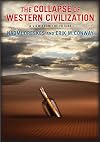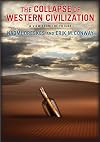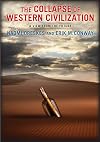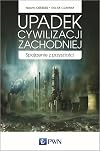
The Collapse of Western Civilization: A View from the Future
by Naomi Oreskes, Erik M. Conway
On This Page
Description
The year is 2393, and the world is almost unrecognizable. Clear warnings of climate catastrophe went ignored for decades, leading to soaring temperatures, rising sea levels, widespread drought and-finally-the disaster now known as the Great Collapse of 2093, when the disintegration of the West Antarctica Ice Sheet led to mass migration and a complete reshuffling of the global order. Writing from the Second People's Republic of China on the 300th anniversary of the Great Collapse, a senior show more scholar presents a gripping and deeply disturbing account of how the children of the Enlightenment-the political and economic elites of the so-called advanced industrial societies-failed to act, and so brought about the collapse of Western civilization. In this haunting, provocative work of science-based fiction, Naomi Oreskes and Eric M. Conway imagine a world devastated by climate change. Dramatizing the science in ways traditional nonfiction cannot, the book reasserts the importance of scientists and the work they do and reveals the self-serving interests of the so called "carbon combustion complex" that have turned the practice of science into political fodder. Based on sound scholarship and yet unafraid to speak boldly, this book provides a welcome moment of clarity amid the cacophony of climate change literature. show lessTags
Recommendations









Member Reviews
I absolutely loathe doom-mongering. That's not (entirely) the result of rational analysis, but rather an emotional aversion to people who only see the negative and unnecessarily exaggerate it, as if there isn't enough misery in the world already. And while I'm at it: I also have no interest in futurism, in people who think they can predict the future with near-infallible certainty. What arrogance.
Nevertheless, this dystopian novelette was written by respected historians of science, affiliated with Harvard and Purdue University, in the US. They paint a picture of the apocalyptic world of 2393, almost unrecognizably changed by global warming and its catastrophic consequences. Through a Chinese historian they describe how things got this show more far, and they do so partly with scientific arguments, certainly, but also with a fair amount of guesswork presented as fact (such as the second Black Death epidemic that decimated the world population). They rightly denounce that the world at the beginning of the 21st century was unwilling to fully acknowledge the impact of the climate crisis. But then the moralistic finger is pointed: that unwillingness is due to the reductionist positivism of the scientific community, to the deliberate obstruction by interest groups and politicians (a new conspiracy theory is being marketed with the "carbon-combustion complex"), and to market fundamentalism—ultimately, to the capitalist system. It is therefore telling that they praise China's centralist and dirigiste approach.
Clearly, this is intended as a warning, and the authors certainly deserve credit for that, because global warming is, also in my view, the greatest challenge of our time. However, the way they do it demonstrates profound arrogance and, above all, a lack of insight into the human psyche. By unleashing doom-mongering and ideologically biased analyses on people, they achieve the opposite effect. The policies of the gang currently in power in Washington prove this abundantly. No, perhaps I’m to harsh, but I don't know who this will interest, except those who are convinced. show less
Nevertheless, this dystopian novelette was written by respected historians of science, affiliated with Harvard and Purdue University, in the US. They paint a picture of the apocalyptic world of 2393, almost unrecognizably changed by global warming and its catastrophic consequences. Through a Chinese historian they describe how things got this show more far, and they do so partly with scientific arguments, certainly, but also with a fair amount of guesswork presented as fact (such as the second Black Death epidemic that decimated the world population). They rightly denounce that the world at the beginning of the 21st century was unwilling to fully acknowledge the impact of the climate crisis. But then the moralistic finger is pointed: that unwillingness is due to the reductionist positivism of the scientific community, to the deliberate obstruction by interest groups and politicians (a new conspiracy theory is being marketed with the "carbon-combustion complex"), and to market fundamentalism—ultimately, to the capitalist system. It is therefore telling that they praise China's centralist and dirigiste approach.
Clearly, this is intended as a warning, and the authors certainly deserve credit for that, because global warming is, also in my view, the greatest challenge of our time. However, the way they do it demonstrates profound arrogance and, above all, a lack of insight into the human psyche. By unleashing doom-mongering and ideologically biased analyses on people, they achieve the opposite effect. The policies of the gang currently in power in Washington prove this abundantly. No, perhaps I’m to harsh, but I don't know who this will interest, except those who are convinced. show less
Naomi Oreskes is *pissed*. She has a right to be, after writing of Merchants of Doubt and seeing the same damn thing happen again and again. The framing for this book is a Chinese historian writing about the collapse of Western civilization due to climate change from the year 2300, but the frame is really weak. What this essay actually about is recent events in climate change policies, such as the collapse of the 2009 Copenhagen Climate Change Conference, and a cold, clinical future history of ice sheets melting, mass migration, plague, famine, geoengineering disasters, and as the title would suggest, the end of Western civilization. The first part, about recent developments, is well-documented with footnotes. The speculation is backed show more up by scientific papers, but is distant and far from compelling as literature.
Oreskes takes out most of her ire on two groups. The first is the neoliberal carbon-combustion complex, a political, financial, and technological assemblage that profits off of burning fossil fuels, and uses it's ideological muscle to prevent even the slightest preparation for the oncoming disaster. The second group are Baconian reductionist scientists, who's cult-like love of objectivity prevented them from understanding human and planetary systems together, or speaking in the proper tone to alert the rest of humanity. For what it's worth, I think Oreskes is mostly right about the neoliberal carbon-combustion complex as dangerously short-sighted wreckers driving our political system, but Oreskes is a historian of science (and I'm one too, sorta), and slamming reductionism and specialization in science seems very abstruse. It's not even a particularly interesting or heated contribution to the never-ending argument on epistemology and scientific methods.
So yeah, this book is short, angry, oddly balanced, and not particularly literary. It's well researched, but unlikely to be enjoyable or interesting to anyone who doesn't already agree with Oreskes. show less
Oreskes takes out most of her ire on two groups. The first is the neoliberal carbon-combustion complex, a political, financial, and technological assemblage that profits off of burning fossil fuels, and uses it's ideological muscle to prevent even the slightest preparation for the oncoming disaster. The second group are Baconian reductionist scientists, who's cult-like love of objectivity prevented them from understanding human and planetary systems together, or speaking in the proper tone to alert the rest of humanity. For what it's worth, I think Oreskes is mostly right about the neoliberal carbon-combustion complex as dangerously short-sighted wreckers driving our political system, but Oreskes is a historian of science (and I'm one too, sorta), and slamming reductionism and specialization in science seems very abstruse. It's not even a particularly interesting or heated contribution to the never-ending argument on epistemology and scientific methods.
So yeah, this book is short, angry, oddly balanced, and not particularly literary. It's well researched, but unlikely to be enjoyable or interesting to anyone who doesn't already agree with Oreskes. show less
The Collapse of Western Civilization: A View from the Future by Naomi Oreskes and Erik Conway is a look back at the planet earth from the year 2393. Oreskes is the professor of History of Science at Harvard and previously served as professor of history and social sciences at the University of California San Diego. She holds a PhD in Geological Research and History of Science from Sanford University. In addition to the a great number of professional papers, she is also the author of Merchants of Doubt.
How will history look back at the latter half of the twentieth century and the beginning half of the twenty-first century? How will the future look on what we are doing today? The answer is not very favorable. Oreskes takes a look at show more civilization and the how we got where we are today by playing a thought game. What would a researcher in 2393 find when studying the century spanning roughly from 1950 to 2050?
To put things into perspective, I studied history as an undergraduate in the 1990s. To look back 400 years into the past as Oreskes is doing, we need to see what the was world like 400 years ago. In America, Jamestown was being settled and the first African slaves are being brought to British North America. In Europe, Galileo is forced to recant. In the British Islands, the English Civil War is being fought, and John Napier is inventing logarithms. Things look rather backward from today’s standard. But, at the same time it must be remembered that people are acting as they best saw fit. Even still, man should have been smart enough to know enslaving people was wrong and that the church should not dictate to science, but then man does something he does quite well; he rationalizes.
Today we have that same rationalization process, but our rationalizations have a far more serious effect on the entire planet. The warning signs are all around us, changing weather patterns, rising CO2 levels, glaciers and ice retreating, and species being threatened with extinction. We rationalize though. We have independent sounding think tanks tell us that it's just normal change. What those think tanks don’t tell us is who funds them: those who have an interest in selling the very things causing climate change.
The first part of the book is filled with information that is all around us that we refuse to see. From 1761 through 2012, 365 billion tons of carbon dioxide have been released into the atmosphere. Half of that 365 billion tons has been released since the mid-1970s. The 1970s, we as a people, believed that the best way to deal with pollution was to dilute it. Soon taller smoke stacks were built to help spread the pollution away from the local area, but there is only so much dilution before you reach saturation.
The future did not have all the answers either, Attempts to correct the problems sometimes increased the damage. The look back did show some current examples, like natural gas. Using cleaner burning natural gas (fracking), as a clean alternative to coal would have helped. But rather than using natural gas to replace coal we use it in addition to coal.
An interesting study of political philosophy is included. Western thought from Classical Liberalism and Neoliberalism (conservatism in the US, Friedman and Hayek), which viewed individual rights and economic freedom as ideals, contributed to the problem. Unregulated industry and the idea that government is not the solution, but the problem contributes to burning through of resources without regard to the consequences. Communism is not the answer either; it proved its failure quicker than its opponent’s. The political tie in is important and interesting because it shows how we got to where we are and why we are choosing to do nothing about it.
The book concludes with Conway interviewing Oreskes. The Collapse of Western Civilization is sure to stir up some controversy and meet harsh resistance, much like Galileo did. Climate change remains a hotly debated subject in America, but, then so does evolution. I think we in the West refuse to see the writing on the wall. We want to use our resume as proof that we are right. We won the cold war. We create technology. We have a powerful military. We enjoy a very high standard of living. We cannot be wrong. Thirty years ago the adult population could ignore what we are doing to the planet. Chances are they would not live to see a catastrophe. But as we continue to burn through resources at an increasing pace with little regard to the consequences, that catastrophe moves closer and closer to the current generations. One day it will be here, and then nothing will stop it. show less
People, get ready
The Collapse of Western Civilization: A View From the Future by Naomi Oreskes and Erik M. Conway (Columbia University Press, $9.95)
The authors of Merchants of Doubt: How a Handful of Scientists Obscured the Truth on Issues From Tobacco Smoke to Global Warming, Naomi Oreskes and Erik M. Conway, now turn their attention to the consequences of ignoring the science surrounding climate change.
Writing from 2393, a Chinese historian living in the Second People’s Republic of China examines the West in the 21st century to determine where it all went wrong.
The Collapse of Western Civilization: A View From the Future puts the “Great Collapse” in 2093, the result of continued reliance on fossil fuels, false belief that show more fracking would serve as a “bridge” to renewals, and the so-called “Western values” (a constantly-growing economy, individual rights) which are the hallmarks of the West will also lead to its destruction. It doesn’t succeed as science fiction, but then it’s not supposed to; it’s a pretty decent polemic, though, especially given the paucity of long-term thinking in regards to the future of our culture.
And frankly, given the way that we now know everyone from the Pentagon to the insurance companies is preparing for climate-fueled collapse, they may not be too far off the mark.
Reviewed on Lit/Rant: www.litrant.tumblr.com show less
The Collapse of Western Civilization: A View From the Future by Naomi Oreskes and Erik M. Conway (Columbia University Press, $9.95)
The authors of Merchants of Doubt: How a Handful of Scientists Obscured the Truth on Issues From Tobacco Smoke to Global Warming, Naomi Oreskes and Erik M. Conway, now turn their attention to the consequences of ignoring the science surrounding climate change.
Writing from 2393, a Chinese historian living in the Second People’s Republic of China examines the West in the 21st century to determine where it all went wrong.
The Collapse of Western Civilization: A View From the Future puts the “Great Collapse” in 2093, the result of continued reliance on fossil fuels, false belief that show more fracking would serve as a “bridge” to renewals, and the so-called “Western values” (a constantly-growing economy, individual rights) which are the hallmarks of the West will also lead to its destruction. It doesn’t succeed as science fiction, but then it’s not supposed to; it’s a pretty decent polemic, though, especially given the paucity of long-term thinking in regards to the future of our culture.
And frankly, given the way that we now know everyone from the Pentagon to the insurance companies is preparing for climate-fueled collapse, they may not be too far off the mark.
Reviewed on Lit/Rant: www.litrant.tumblr.com show less
This short book is a report by a future Chinese academic on the collapse of civilization in the 21st
century, caused by global warming and pollution. It purports to recount the disaster with perspective that
usually only time can provide. We today are too closely involved to see the forest for the trees. That is
usually the case. Yet most of us can see the forest, burning, and that is a different issue the book delves
into with gusto. Science has been shunted aside in favor of "freedom" and the dollar.
The basic premise of a historian looking back to see what happened is valid, but the authors don't go nearly
far enough. The rank stupidity shown by the politicians of the 20th century is no different from the rank
stupidity of the church show more in the thousand years before, when it burned scientists at the stake for uttering
facts it did not want to hear, regardless of provability. Basically, it was always this way. There have
always been entrenched interests to defend, empires to defend, wealth to defend, and of course power to
expand. Our author from the future missed that.
It is instructive to see how a future Chinese academic might view the economic history of the west, citing
capitalism vs communism and neoliberalism and market fundamentalism (in the religious fervor sense). But
that academic would surely have also discovered and reported the simple truism that separates all of it for
the purposes of his report: Communism failed because it did not tell the economic truth about prices.
Capitalism failed because it did not tell the ecological truth about prices. That in a nutshell has driven
the greed machine to the heights we see today. (It is touched on in the glossary.) The greater good is a
concept discredited in the USA, and the result is a planet swamped for example, in 88,000 new chemical
compounds since WWII, only three of which have been tested. (This is touched on in the Q&A, where they
compare the lack of chemical testing to exhaustive testing in pharmaceuticals.) Government went from being
the solution in the trustbuster age, to the problem in the Reagan era. The results were predictable and were
predicted. The market fundamentalists just told everyone where they could go. And we are. Faster than we
thought.
The "report" is only about 60 pages. More of a pamphlet than a book. There follows a lexicon of terms we in
the present currently use and abuse. This also helps give perspective, as does the Q&A with the authors that
follows. The combination of those three nonstandard components makes this an unusual book that would be
refreshing if it weren't so hurtful. show less
century, caused by global warming and pollution. It purports to recount the disaster with perspective that
usually only time can provide. We today are too closely involved to see the forest for the trees. That is
usually the case. Yet most of us can see the forest, burning, and that is a different issue the book delves
into with gusto. Science has been shunted aside in favor of "freedom" and the dollar.
The basic premise of a historian looking back to see what happened is valid, but the authors don't go nearly
far enough. The rank stupidity shown by the politicians of the 20th century is no different from the rank
stupidity of the church show more in the thousand years before, when it burned scientists at the stake for uttering
facts it did not want to hear, regardless of provability. Basically, it was always this way. There have
always been entrenched interests to defend, empires to defend, wealth to defend, and of course power to
expand. Our author from the future missed that.
It is instructive to see how a future Chinese academic might view the economic history of the west, citing
capitalism vs communism and neoliberalism and market fundamentalism (in the religious fervor sense). But
that academic would surely have also discovered and reported the simple truism that separates all of it for
the purposes of his report: Communism failed because it did not tell the economic truth about prices.
Capitalism failed because it did not tell the ecological truth about prices. That in a nutshell has driven
the greed machine to the heights we see today. (It is touched on in the glossary.) The greater good is a
concept discredited in the USA, and the result is a planet swamped for example, in 88,000 new chemical
compounds since WWII, only three of which have been tested. (This is touched on in the Q&A, where they
compare the lack of chemical testing to exhaustive testing in pharmaceuticals.) Government went from being
the solution in the trustbuster age, to the problem in the Reagan era. The results were predictable and were
predicted. The market fundamentalists just told everyone where they could go. And we are. Faster than we
thought.
The "report" is only about 60 pages. More of a pamphlet than a book. There follows a lexicon of terms we in
the present currently use and abuse. This also helps give perspective, as does the Q&A with the authors that
follows. The combination of those three nonstandard components makes this an unusual book that would be
refreshing if it weren't so hurtful. show less
"The Collapse of Western Civilization" is probably more of a long magazine article rather than a short book, but in either case, is an interesting prediction made by the authors of what the future could look like if world governments fail to take steps to reduce continued carbon emissions into our atmosphere. The authors write as if they are historians from several hundred years in the future, looking back and trying to explain how past governments (e.g., our current leaders) could have ignored the known science of the day and failed to take the necessary steps to prevent global climate change. The premise of the book is that greenhouse gasses continued to accumulate in the atmosphere during our time, and that the deleterious effects of show more those emissions led to wide-spread flooding around the world due to sea level rise; water and food supply issues; and other predicted climate changes. It's an interesting twist to the climate change debate, e.g., not looking at what the future might be like from our perspective, but looking back at today's decisions made or not made from our great-great-great-grandchildren's perspective. show less
A quick read. A retrospective of our current age. A requiem for the dying.
Members
- Recently Added By
Published Reviews
ThingScore 100
added by melmore
Lists

Speculative non-fiction
25 works; 2 members
Author Information

10+ Works 2,100 Members
Naomi Oreskes, Ph.D. Stanford, is Associate Professor of History at the University of California, San Diego. She lives in Del Mar, California.

8+ Works 1,807 Members
Erik M. Conway serves as historian, Jet Propulsion Laboratory, Pasadena, California
Common Knowledge
- Canonical title*
- Il crollo della civiltà occidentale: una storia del futuro
- Original title
- The Collapse of Western Civilization: A View from the Future
- Original publication date
- 2014
- Original language*
- Englisch
*Some information comes from Common Knowledge in other languages. Click "Edit" for more information.
Classifications
- Genre
- Nonfiction
- DDC/MDS
- 909.09821 — History & geography History World history Other Geographic Classifications Other Classifications Ocean And Sea Basins The West; the Atlantic region
- LCC
- CB158 .O64 — Auxiliary Sciences of History History of Civilization History of Civilization Forecasts of future progress
- BISAC
Statistics
- Members
- 350
- Popularity
- 90,597
- Reviews
- 9
- Rating
- (3.65)
- Languages
- 5 — English, French, German, Italian, Polish
- Media
- Paper, Audiobook, Ebook
- ISBNs
- 11
- UPCs
- 2
- ASINs
- 5