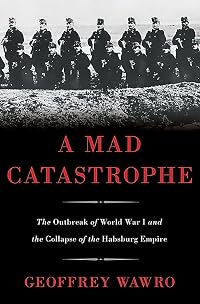
A Mad Catastrophe: The Outbreak of World War I and the Collapse of the Habsburg Empire
by Geoffrey Wawro
On This Page
Description
"The Austro-Hungarian army that marched east and south to confront the Russians and Serbs in the opening campaigns of World War I had a glorious past but a pitiful present. Speaking a mystifying array of languages and lugging outdated weapons, the Austrian troops were hopelessly unprepared for the industrialized warfare that would shortly consume Europe. As prizewinning historian Geoffrey Wawro explains in A Mad Catastrophe, the doomed Austrian conscripts were an unfortunate microcosm of the show more Austro-Hungarian Empire itself-both equally ripe for destruction. After the assassination of the Austrian Archduke Franz Ferdinand in June 1914, Germany goaded the Empire into a war with Russia and Serbia. With the Germans massing their forces in the west to engage the French and the British, everything-the course of the war and the fate of empires and alliances from Constantinople to London-hinged on the Habsburgs' ability to crush Serbia and keep the Russians at bay. However, Austria-Hungary had been rotting from within for years, hollowed out by repression, cynicism, and corruption at the highest levels. Commanded by a dying emperor, Franz Joseph I, and a querulous celebrity general, Conrad von Hotzendorf, the Austro-Hungarians managed to bungle everything: their ultimatum to the Serbs, their declarations of war, their mobilization, and the pivotal battles in Galicia and Serbia. By the end of 1914, the Habsburg army lay in ruins and the outcome of the war seemed all but decided. Drawing on deep archival research, Wawro charts the decline of the Empire before the war and reconstructs the great battles in the east and the Balkans in thrilling and tragic detail. A Mad Catastrophe is a riveting account of a neglected face of World War I, revealing how a once-mighty empire collapsed in the trenches of Serbia and the Eastern Front, changing the course of European history. "-- show lessTags
Recommendations






Member Reviews
All World Wars have been started and lost by natives of Austria. Is there something peculiar in the water of the not so blue Danube? Budapest is also known as a city of suicides, so self-destructive activities seem to be in the water (see also the Nibelungen saga). For Geoffrey Wawro, Hungary is the key culprit whose destructive behavior in the failed Austro-Hungarian marriage made Austria go postal in the face of a mad Serbian act of aggression.
Wawro chiefly blames Franz Joseph and uses a string of abusive adjectives among which "senile" is still the most friendly. His charge does not make sense, though. If Franz Joseph is some kind of demented King Lear on the throne, his lack of compos mentis restricts his guilt. It was the men show more around Franz Joseph who took the fatal decisions. Wawro is on much firmer (and traditional) ground in blaming the incompetence, corruption and backwardness of the k.u.k. army, part of which Wawro blames on the undeclared budgetary war of Hungary against Austrian rule by starving the beast to a level that made the army unusable as a tool for war.
The previous books of Wawro were mostly about Germany and Prussia in particular. He therefore sees Austria through the lense of a mediocre Prussia. In reality, the muddling through of Austria was and is the normal state of affairs of most empires and Prussian militarism the exception. Wawro also seems not to be too familiar with Austrian history prior to 1864, so that his judgments are often unfair and incomplete if one considers a wider span of history than the 50 years he tends to focus on. The Habsburg family had managed to hang on for more than 400 years by their strategy on relying more on marriages and diplomacy instead of war. The death of archduke Franz Ferdinand, a firm opponent of war in the Balkans (where "thieves and regicides" lived), was doubly tragic as it put two of the worst generals in history in the driver's seat: Franz Conrad von Hötzendorf and Oskar Potiorek. Wawro is justly scathing about their dismal and inexcusable performance. They wargamed their plans and lost - heavily. Instead of going back to the drawing board and making sure that they had a winning strategy, they executed their dismal plans - and lost as predicted.
One element Wawro does not really deal with is the deadly combination of green troops (mobilized in July, sent into war in August) into a campaign theater with severely deficient logistics. In the Western theater, civilian infrastructure could compensate for the deficiencies in logistics. In South-eastern and Eastern Europe, only the bare minimum of infrastructure existed, so that the green troops quickly began to suffer for any incompetence and idiocy. The latter was in abundance in Hötzendorf and Potiorek's planning - having troops march through Bosnia instead of crossing the Danube opposite Belgrade or having the troops disembark from the trains more than 100 km from their target. Underperforming Russian czarist logistics was no mean feat.
The book actually ends too soon, as the real question is why Austria-Hungary stayed in the war in 1915, having lost nearly half a million men in half a year, decimated its NCO and officer corps as well as lost almost all major battles, especially as it was fighting mostly for honor and no territorial gains. Hatred against Serbia and later Italy certainly was a powerful motivator. The main bloodletting, however, happened in the East against Russia about a territory neither the Russians nor the Austrians cared at all. show less
Wawro chiefly blames Franz Joseph and uses a string of abusive adjectives among which "senile" is still the most friendly. His charge does not make sense, though. If Franz Joseph is some kind of demented King Lear on the throne, his lack of compos mentis restricts his guilt. It was the men show more around Franz Joseph who took the fatal decisions. Wawro is on much firmer (and traditional) ground in blaming the incompetence, corruption and backwardness of the k.u.k. army, part of which Wawro blames on the undeclared budgetary war of Hungary against Austrian rule by starving the beast to a level that made the army unusable as a tool for war.
The previous books of Wawro were mostly about Germany and Prussia in particular. He therefore sees Austria through the lense of a mediocre Prussia. In reality, the muddling through of Austria was and is the normal state of affairs of most empires and Prussian militarism the exception. Wawro also seems not to be too familiar with Austrian history prior to 1864, so that his judgments are often unfair and incomplete if one considers a wider span of history than the 50 years he tends to focus on. The Habsburg family had managed to hang on for more than 400 years by their strategy on relying more on marriages and diplomacy instead of war. The death of archduke Franz Ferdinand, a firm opponent of war in the Balkans (where "thieves and regicides" lived), was doubly tragic as it put two of the worst generals in history in the driver's seat: Franz Conrad von Hötzendorf and Oskar Potiorek. Wawro is justly scathing about their dismal and inexcusable performance. They wargamed their plans and lost - heavily. Instead of going back to the drawing board and making sure that they had a winning strategy, they executed their dismal plans - and lost as predicted.
One element Wawro does not really deal with is the deadly combination of green troops (mobilized in July, sent into war in August) into a campaign theater with severely deficient logistics. In the Western theater, civilian infrastructure could compensate for the deficiencies in logistics. In South-eastern and Eastern Europe, only the bare minimum of infrastructure existed, so that the green troops quickly began to suffer for any incompetence and idiocy. The latter was in abundance in Hötzendorf and Potiorek's planning - having troops march through Bosnia instead of crossing the Danube opposite Belgrade or having the troops disembark from the trains more than 100 km from their target. Underperforming Russian czarist logistics was no mean feat.
The book actually ends too soon, as the real question is why Austria-Hungary stayed in the war in 1915, having lost nearly half a million men in half a year, decimated its NCO and officer corps as well as lost almost all major battles, especially as it was fighting mostly for honor and no territorial gains. Hatred against Serbia and later Italy certainly was a powerful motivator. The main bloodletting, however, happened in the East against Russia about a territory neither the Russians nor the Austrians cared at all. show less
Dr. Wawro is definitely not impressed with the leadership and strategic skills of Austrian General Conrad von Hotzendorf!! This book presents the early period of WWI from the perspective of Austria-Hungary. It covers the diplomatic moves, the military mobilization, and the opening strategy and battles of the AH army. Without giving away the entire work in a review, basically AH in general and Conrad von Hotzendorf in particular bundled all aspects of the start of the war which led to disaster. I found this book well written (not my first reading of Wawro's books) and fascinating. Wawro has apparently done his homework in researching this book.
To say the least, Conrad v Hotzendorf should have court martialed and probably executed for his show more performance during the war. At one point, according to Wawro, Conrad quips to a colleague "if Archduke Franz Ferdinand were still alive, he would have had me executed." Interesting. This is a fine read for anyone interested in a close look at the performance of the Austro-Hungarian Army, its leadership and the diplomats during the start of WWI, show less
To say the least, Conrad v Hotzendorf should have court martialed and probably executed for his show more performance during the war. At one point, according to Wawro, Conrad quips to a colleague "if Archduke Franz Ferdinand were still alive, he would have had me executed." Interesting. This is a fine read for anyone interested in a close look at the performance of the Austro-Hungarian Army, its leadership and the diplomats during the start of WWI, show less
Geoffrey Wawro offers a thorough analysis of the collapse of Austria-Hungary during the Great War.
The first part of the book seeks to describe the inner workings of the Hapsburg government and the forces pulling the government apart. The multinational problems of the Dual Monarchy give perspective to the challenges the Empire faced during a time of heightened nationalism, particularly the forces of pan-slavism. These problems were exacerbated by the aging Emperor Franz Joseph, who comes off as a less than competent leader for these difficult times facing Austria-Hungary.
The rest of the book, fully two-thirds, deals with the sheer disaster of the Great War and the complete inability of the Hapsburg army to effectively fight a modern show more war. Not only does Wawro demonstrate how poorly the Empire was prepared in terms of material and equipment (the shortage of shells and ammunition even led to calls to restrict shelling without approval), but he also shows how out-moded Austrian tactics were, even employing infantry bayonet charges in the face of machine gun fire. The situation was so deplorable that even the tiny Serbian army was able to best the Austrians through multiple invasions of Serbia during the war. Further, the equally ill-equipped Russians proved superior to the Austrians by virtue of the former's significantly greater number of troops.
One certainly gains great insight into the military causes of the implosion of the the Hapsburg government. However, Wawro does not demonstrate the effect these battlefield disasters had on the political front. The reader gains no insight into how the Hapsburg government tried to shore up its political institutions in the face of impending military defeat. Although, Wawro does try to demonstrate that those leading the war effort were being duplicitous with the political leaders of the Empire, one still feels that the political side of the Hapsburg collapse is being ignored in this book.
Based on his previous works, one understands Wawro to be a supreme military historian, so one can understand why he tells the story of the Collapse of the Hapsburg Empire the way he does. However, this does not change the reality that there is far more to this story than is presented here. This takes nothing from the contribution that this book makes to our understanding of the role of Austria-Hungray in the Great War. There is a solid contribution to the historian's understanding of the eastern front presented here and, as such, this book deserves to be read by those seeking to udnerstand the Great War. show less
The first part of the book seeks to describe the inner workings of the Hapsburg government and the forces pulling the government apart. The multinational problems of the Dual Monarchy give perspective to the challenges the Empire faced during a time of heightened nationalism, particularly the forces of pan-slavism. These problems were exacerbated by the aging Emperor Franz Joseph, who comes off as a less than competent leader for these difficult times facing Austria-Hungary.
The rest of the book, fully two-thirds, deals with the sheer disaster of the Great War and the complete inability of the Hapsburg army to effectively fight a modern show more war. Not only does Wawro demonstrate how poorly the Empire was prepared in terms of material and equipment (the shortage of shells and ammunition even led to calls to restrict shelling without approval), but he also shows how out-moded Austrian tactics were, even employing infantry bayonet charges in the face of machine gun fire. The situation was so deplorable that even the tiny Serbian army was able to best the Austrians through multiple invasions of Serbia during the war. Further, the equally ill-equipped Russians proved superior to the Austrians by virtue of the former's significantly greater number of troops.
One certainly gains great insight into the military causes of the implosion of the the Hapsburg government. However, Wawro does not demonstrate the effect these battlefield disasters had on the political front. The reader gains no insight into how the Hapsburg government tried to shore up its political institutions in the face of impending military defeat. Although, Wawro does try to demonstrate that those leading the war effort were being duplicitous with the political leaders of the Empire, one still feels that the political side of the Hapsburg collapse is being ignored in this book.
Based on his previous works, one understands Wawro to be a supreme military historian, so one can understand why he tells the story of the Collapse of the Hapsburg Empire the way he does. However, this does not change the reality that there is far more to this story than is presented here. This takes nothing from the contribution that this book makes to our understanding of the role of Austria-Hungray in the Great War. There is a solid contribution to the historian's understanding of the eastern front presented here and, as such, this book deserves to be read by those seeking to udnerstand the Great War. show less
Distilling down a generation's research for the general reader, Wawro aims to disperse the fog that still allows Vienna to escape its share of culpability in creating the disaster that was the Great War. While if you have read the specialist military history you'll be aware that Habsburg military leaders such as Conrad and Potiorek have come in for their just share of criticism, Wawro ends this book with a meditation on how Emperor Franz Joseph has been allowed to waltz off into history essentially unstained by culpability. What might be disappointing for some readers is that this book essentially ends in with events in the Spring of 1915 and does not deal in detail with the Italian campaign; the point by which the Habsburg polity had show more devolved into a German puppet state. show less
An insightful, learned chronicle of how imperial hubris and meaningless slaughter in the First World War brought the crumbling multinational dual monarchy to collapse and the Hapsburg dynasty to an ignominious end.
Tedious, slow account of Hapsburg misfortunes at the outbreak of WWI. Reads like a hatchet job on poor Austria Hungary, making me wonder about the author's objectivity. shouldn't have finished this one.
unbelievable and obscene tragedy of wwi
Members
- Recently Added By
Lists

Books about World War I
80 works; 14 members
Author Information

10+ Works 1,239 Members
Geoffrey Wawro studied at Brown and Yale and is a professor of history and Director of the Military History Center at the University of North Texas. The author of five books, including Quicksand and The Franco-Prussian War, Wawro lives in Dallas, Texas.
Awards and Honors
Awards
Common Knowledge
- Canonical title
- A Mad Catastrophe: The Outbreak of World War I and the Collapse of the Habsburg Empire
- Original publication date
- 2014
- People/Characters
- Emperor Franz Joseph
- Important places
- Sarajevo; Austro-Hungarian Empire
- Important events
- World War I
Classifications
Statistics
- Members
- 247
- Popularity
- 131,764
- Reviews
- 7
- Rating
- (4.04)
- Languages
- Chinese, English
- Media
- Paper, Audiobook, Ebook
- ISBNs
- 4
- ASINs
- 5