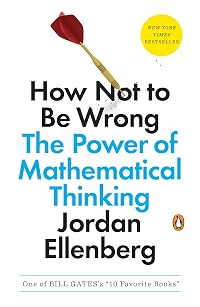
How Not to Be Wrong: The Power of Mathematical Thinking
by Jordan Ellenberg 
On This Page
Description
"In How Not to Be Wrong, Jordan Ellenberg shows us that math isn't confined to abstract incidents that never occur in real life, but rather touches everything we do--the whole world is shot through with it. Math allows us to see the hidden structures underneath the messy and chaotic surface of our world. It's a science of not being wrong, hammered out by centuries of hard work and argument. Armed with the tools of mathematics, we can see through to the true meaning of information we take for show more granted: How early should you get to the airport? What does "public opinion" really represent? Why do tall parents have shorter children? Who really won Florida in 2000? And how likely are you, really, to develop cancer? How Not to Be Wrong presents the surprising revelations behind all of these questions and many more, using the mathematician's method of analyzing life and exposing the hard-won insights of the academic community to the layman--minus the jargon. Ellenberg pulls from history as well as from the latest theoretical developments to provide those not trained in math with the knowledge they need. "-- show lessTags
Recommendations




Member Recommendations
themulhern Ellenberg's extends the use of mathematics to analyze arguments a bit further; both books are kind of funny.
OscarWilde87 Putting the fun back in math
Member Reviews
In order to pick up this book, I guess you have to have at least a faint interest in mathematics. Otherwise, the word 'mathematical' in the title will probably scare you off. However, not being wrong anymore sounds like a good enough prospect to make up for all the maths in the book, right? How Not to Be Wrong: The Power of Mathematical Thinking starts out by giving a reason why mathematical thinking can be a helpful skill in everyone's life and what math can reveal about improving your chances to win the lottery, understanding different systems to elect a president, and many more. The titles of chapters such as "Everyone is obese", "How much is that in dead Americans?" or "Miss more planes!" show first, that math can be fun, and show more second, that the intended audience of the book are not math professors but rather everyone.
Anticipating readers' feeling towards mathematics, Jordan Ellenberg attempts to answer the most-asked question in math classes first: "So, when am I going to use this?" Ellenberg encourages people to look deeper into things and discover the math in our everyday lives. However, he is very straightforward and also admits that there are aspects of your mathematical education that you might not specifically need anymore. But why should you still learn maths? Ellenberg argues that there is so much more to maths than just adding and subtracting numbers or doing fractions. Math classes improve your way of thinking about many aspects in your life - or at least, math classes should do that. This issue is still debated among math teachers. There are still the ones who prefer the traditional approach of having students practice doing fractions and solving yet another sometimes often slightly math-related problem until they finally discover an algorithm that they can use for a very limited range of problems 'normal' people don't have, anyway. And then there is the more modern approach to teach students the meaning behind what they are doing and to promote critical thinking before mindlessly applying algorithms to problems. This is not to say that students should not learn algorithms anymore. They still should, to my (and Ellenberg's) mind. However, this is just the foundation of what maths is all about. The following quotation sums up Ellenberg's view quite nicely and I couldn't agree more.
At the same time, Ellenberg admits that not everything can be solved with one hundred percent certainty, even though this is often expected of mathematicians. Sometimes, for example when asked to predict which presidential candidate is going to win a certain state, mathematicians can provide a probability, but not rule out uncertainty entirely. However:
The book also touches upon a topic many of us discuss around here. Are pop fiction and classic literature - literature with a capital 'L', if you may - mutually exclusive? Or framed differently: Is reading pop fiction a waste of time, and is classic literature always worth the time and effort you put in reading? Ellenberg compares this to the phenomenon of how the guys (or women, for that matter) you meet are either handsome and mean or nice and ugly, but never nice and handsome. He says that we do not even look at the mean and ugly ones so they are ruled out anyway. The triangle of acceptable men, then, which he defines as either nice or handsome is naturally only a small portion of all the men you can meet. And the nice and handsome men are an even smaller part of all the men available. Therefore, the chance of meeting a nice and handsome man has to be quite small logically. If you substitute the two axes from 'ugly' to 'handsome' and 'mean' to 'nice' with 'bad' to 'good' and 'classic' to 'popular', you end up with a similar situation for literary works. If you want to look up the whole reasoning, either read the book or look up Berkson's fallacy. Here goes Ellenberg and his answer seems quite intelligent to me:
To sum up, I enjoyed reading How Not to Be Wrong: The Power of Mathematical Thinking a lot, not only because I agree with what Ellenberg writes to a large extent. No matter if you are interested in mathematics or not, you will probably find this book quite interesting and will probably (not certainly, of course!) not be sorry about picking it up. 4 stars. show less
Anticipating readers' feeling towards mathematics, Jordan Ellenberg attempts to answer the most-asked question in math classes first: "So, when am I going to use this?" Ellenberg encourages people to look deeper into things and discover the math in our everyday lives. However, he is very straightforward and also admits that there are aspects of your mathematical education that you might not specifically need anymore. But why should you still learn maths? Ellenberg argues that there is so much more to maths than just adding and subtracting numbers or doing fractions. Math classes improve your way of thinking about many aspects in your life - or at least, math classes should do that. This issue is still debated among math teachers. There are still the ones who prefer the traditional approach of having students practice doing fractions and solving yet another sometimes often slightly math-related problem until they finally discover an algorithm that they can use for a very limited range of problems 'normal' people don't have, anyway. And then there is the more modern approach to teach students the meaning behind what they are doing and to promote critical thinking before mindlessly applying algorithms to problems. This is not to say that students should not learn algorithms anymore. They still should, to my (and Ellenberg's) mind. However, this is just the foundation of what maths is all about. The following quotation sums up Ellenberg's view quite nicely and I couldn't agree more.
"Working an integral or performing linear regression is something that a computer can do quite effectively. Understanding whether the result makes sense - or deciding whether the method is the right one to use in the first place - requires a guiding human hand. When we teach mathematics we are supposed to be explaning how to be that guide. A math course that fails to do so is essentially training the student to be a very slow, buggy version of Microsoft Excel. And let's be frank: that really is what many of our math courses are doing."
At the same time, Ellenberg admits that not everything can be solved with one hundred percent certainty, even though this is often expected of mathematicians. Sometimes, for example when asked to predict which presidential candidate is going to win a certain state, mathematicians can provide a probability, but not rule out uncertainty entirely. However:
"Math gives us a way of being unsure in a principled way: not just throwing up our hands and saying 'huh,' but rather making a firm assertion: 'I'm not sure, and this is roughly how not-sure I am.' Or even more: 'I'm unsure, and you should be too.'"
The book also touches upon a topic many of us discuss around here. Are pop fiction and classic literature - literature with a capital 'L', if you may - mutually exclusive? Or framed differently: Is reading pop fiction a waste of time, and is classic literature always worth the time and effort you put in reading? Ellenberg compares this to the phenomenon of how the guys (or women, for that matter) you meet are either handsome and mean or nice and ugly, but never nice and handsome. He says that we do not even look at the mean and ugly ones so they are ruled out anyway. The triangle of acceptable men, then, which he defines as either nice or handsome is naturally only a small portion of all the men you can meet. And the nice and handsome men are an even smaller part of all the men available. Therefore, the chance of meeting a nice and handsome man has to be quite small logically. If you substitute the two axes from 'ugly' to 'handsome' and 'mean' to 'nice' with 'bad' to 'good' and 'classic' to 'popular', you end up with a similar situation for literary works. If you want to look up the whole reasoning, either read the book or look up Berkson's fallacy. Here goes Ellenberg and his answer seems quite intelligent to me:
"Literary snobbery works the same way. You know how popular novels are terrible? It's because the masses don't appreciate quality. It's because the Great Sphere of Novels, and the only novels you ever hear about are the ones in the Acceptable Triangle, which are either popular or good."
To sum up, I enjoyed reading How Not to Be Wrong: The Power of Mathematical Thinking a lot, not only because I agree with what Ellenberg writes to a large extent. No matter if you are interested in mathematics or not, you will probably find this book quite interesting and will probably (not certainly, of course!) not be sorry about picking it up. 4 stars. show less
Если вы, как и гипотетическая студентка в начале этой книги, иногда задаетесь вопросом «Зачем нужно учить все эти логарифмы и интегралы, неужели все это в жизни потребуется?», то вам стоит ее прочесть. Потому что автор показывает, где и как математика, а вернее, умение рассуждать математически, приходит на помощь в реальном мире обывателя. Впрочем, добавляет он, наиболее востребованных во взрослой жизни show more разделов в школе как раз и не преподают (да и в большинстве вузов лишь мимоходом): речь о теории вероятности и статистике. Что прискорбно, ибо и СМИ, и политики любят бомбардировать людей статистикой и прогнозами, которые трудно воспринимать критически. Однако теперь книга Элленберга, написанная с хорошим юмором (да, математикам он совсем не чужд) и парадоксальными на первый взгляд примерами из окружающей действительности, позволит не только лучше разбираться в происходящем, но и даст немало возможностей продемонстрировать приятелям в баре, какие они, в сущности, двоечники. show less
I’ve known Jordan since high school; he’s exactly as smart and unassuming as his writing makes him seem. This book is mostly about the power of statistical thinking, and the need to understand probabilities, though there are some interesting detours into geometry and bits of math history. I’m an easy sell on the need to make statistical literacy a key part of all citizens’ education; I’d recommend this book as a helpful explanation of the reasons why. The opening anecdote, about why the air force was wrong about which parts of the planes it needed to increase the armor on, is truly fantastic. (Short version: planes were coming back heavily shot up in the wings etc., but not that shot up in the engine. Should engine shielding show more be reduced to achieve a valuable reduction in weight? Answer: no. That conclusion reflects a misunderstanding of the observation, which was of planes that came back, not the full set of planes. Planes that came back took fewer hits to the engine than to the rest of the plane, and if you (plausibly) assume a standard distribution of bullet holes instead of some aversion of German bullets to engines, then the most likely explanation is that planes that took more hits to the engine disproportionately failed to come back. Put more shielding on the engine, and less on the wings. Math!) show less
A popular entry in the category, mathematics for the uninformed, this one addresses many of the usual intellectual problems, e.g. regression to the mean, the law of large numbers, what a p value means, expected value, etc. I think most readers with a technical education will be familiar with all the "answers", so what's so good about this book? The author writes well, he does not avoid the use of some mathematical symbols and graphs, and, both a strength and a weakness, he does not tell a straight story, but mixes related concepts and different historical figures together to perhaps make the chapters more approachable.
Okay, it's true, I did request this book from the library, I did check it out and sit down to read it. But I really had absolutely no idea how much I would enjoy it, and I definitely did not expect to stay up all night because I just didn't want to put it down.
Jordan Ellenberg, professor of mathematics at the University of Wisconsin-Madison (home of my graduate school, for full disclosure) has written a book about math: not how you learned it in high school, but how it really is, both for professional mathematicians and in the day-to-day world where mathematical thinking is useful. If someone had taught me math like this when I was a kid, I'd be making a whole lot more money than I am right now.
We're not talking about addition and show more subtraction here, or even algebra or calculus. Well, a little calculus. And some geometry. But stop, don't run away, it's really not that scary. Because mostly what we're talking about - what Ellenberg is talking about in this book - is the way math works, the way that math shapes the world, and the way we can use math to change the way we interact with the world.
He uses the story of Abraham Wald in the introduction, to suck you in to his way of thinking. Wald was a mathematician working for the military during the Second World War when they came to him with a problem. Here are the planes that come back covered in bullet holes, the generals said. We need you to tell us where to put the armor. The generals were figuring somewhere on the wings, which was where there were more bullet holes than anywhere else. But Wald said, no, you put the armor on the engines. Why? Because the planes with bullet holes in the wings came back. The ones with bullets in the engines? They weren't flying home at all.
That kind of logic is at the core of what Ellenberg is teaching with this book. And I gotta say, it's pretty effective. By the end of the book, I understood for the first time the point of purely theoretical math.* Also, I kind of want to play with non-Euclidean geometry. And not in a Lovecraftian way, for once.
As a bonus, Ellenberg is pretty damn entertaining while he's teaching. Examples range from baseball statistics to politics to con artists, and the book is liberally scattered with amusing footnotes. For example, from a description of how not to add percentages, using the Florida 2000 election as an illustration:
He also uses an XKCD cartoon as an example. So he's obviously a man of refined and distinguished tastes.
I could get all dramatic and say that this is an important book and everyone should read it because it will help them - to paraphrase the title - be less wrong all the time, but that would sound preachy, and I hate that. Instead I shall say that this is a massively enlightening and entertaining book, and if you like having your mind blown but always suffered through trig by looking things up in the back of the book and praying you'd remember the formulas long enough to get through the test, you might enjoy How Not To Be Wrong more than you might think.
*It's because math is based on a very few basic principles, out of which you can create complex structures, but because there are so few building blocks those complex structures tend to generalize well. So you do some math to describe one thing, and then you elaborate on that math in a purely theoretical way, and then it turns out that the same math describes a completely different thing. Which is kind of mind-blowing, really. show less
Jordan Ellenberg, professor of mathematics at the University of Wisconsin-Madison (home of my graduate school, for full disclosure) has written a book about math: not how you learned it in high school, but how it really is, both for professional mathematicians and in the day-to-day world where mathematical thinking is useful. If someone had taught me math like this when I was a kid, I'd be making a whole lot more money than I am right now.
We're not talking about addition and show more subtraction here, or even algebra or calculus. Well, a little calculus. And some geometry. But stop, don't run away, it's really not that scary. Because mostly what we're talking about - what Ellenberg is talking about in this book - is the way math works, the way that math shapes the world, and the way we can use math to change the way we interact with the world.
He uses the story of Abraham Wald in the introduction, to suck you in to his way of thinking. Wald was a mathematician working for the military during the Second World War when they came to him with a problem. Here are the planes that come back covered in bullet holes, the generals said. We need you to tell us where to put the armor. The generals were figuring somewhere on the wings, which was where there were more bullet holes than anywhere else. But Wald said, no, you put the armor on the engines. Why? Because the planes with bullet holes in the wings came back. The ones with bullets in the engines? They weren't flying home at all.
That kind of logic is at the core of what Ellenberg is teaching with this book. And I gotta say, it's pretty effective. By the end of the book, I understood for the first time the point of purely theoretical math.* Also, I kind of want to play with non-Euclidean geometry. And not in a Lovecraftian way, for once.
As a bonus, Ellenberg is pretty damn entertaining while he's teaching. Examples range from baseball statistics to politics to con artists, and the book is liberally scattered with amusing footnotes. For example, from a description of how not to add percentages, using the Florida 2000 election as an illustration:
Yes, I, too, know that one guy who thought both Gore and Bush were tools of the capitalist overlords and it didn't make a difference who won. I am not talking about that guy.
He also uses an XKCD cartoon as an example. So he's obviously a man of refined and distinguished tastes.
I could get all dramatic and say that this is an important book and everyone should read it because it will help them - to paraphrase the title - be less wrong all the time, but that would sound preachy, and I hate that. Instead I shall say that this is a massively enlightening and entertaining book, and if you like having your mind blown but always suffered through trig by looking things up in the back of the book and praying you'd remember the formulas long enough to get through the test, you might enjoy How Not To Be Wrong more than you might think.
*It's because math is based on a very few basic principles, out of which you can create complex structures, but because there are so few building blocks those complex structures tend to generalize well. So you do some math to describe one thing, and then you elaborate on that math in a purely theoretical way, and then it turns out that the same math describes a completely different thing. Which is kind of mind-blowing, really. show less
Okay, I admit it - I'm a math nerd. I was a math major for a couple of years in college, I do math in my head for fun, and I love to read good books on mathematical subjects.
You can safely ignore this. You don't have to be a math nerd to enjoy and get a great deal out of this book. In fact, it's written for people who are not math fans in any way. You can follow along easily without having to know much more than basic arithmetic.
To say that Ellenberg can teach you what calculus is on a single page is a bit much. But it's kind of true. More importantly, he will show you why calculus is important to know and understand, just to evaluate the world around you. The book addresses statistical analysis more than other areas of math, with many show more specific examples of how using a proper understanding of stats and probabilities can make your political and health news reading more informative.
This book helps people understand why math isn't for mathematicians. It also answers the age-old question of math class, "When am I ever going to use this stuff?".
Ellenberg also has a nice, breezy style of writing. He makes the subject reachable via his words, not just their content.
Great book. This is probably closer to a 4.5 than 4 stars. show less
You can safely ignore this. You don't have to be a math nerd to enjoy and get a great deal out of this book. In fact, it's written for people who are not math fans in any way. You can follow along easily without having to know much more than basic arithmetic.
To say that Ellenberg can teach you what calculus is on a single page is a bit much. But it's kind of true. More importantly, he will show you why calculus is important to know and understand, just to evaluate the world around you. The book addresses statistical analysis more than other areas of math, with many show more specific examples of how using a proper understanding of stats and probabilities can make your political and health news reading more informative.
This book helps people understand why math isn't for mathematicians. It also answers the age-old question of math class, "When am I ever going to use this stuff?".
Ellenberg also has a nice, breezy style of writing. He makes the subject reachable via his words, not just their content.
Great book. This is probably closer to a 4.5 than 4 stars. show less
(Done - those of you who have already liked this may want to reread now!)
I like math. I want to be reminded of how cool it can be, and how relevant. But all the books like this, including this, that I've attempted to read have too much explication of the maths and not enough of what it actually means. For example, a chapter will start by explaining that c a = a c and just a paragraph later will expect us to know what a quadratic equation is, what it means, and how to solve it. What I'm saying is, these books need to be vetted by regular ppl... like Ellenberg's reluctant students, perhaps?
I'm gonna read it all, even if by 'read' I mean 'skim' for significant portions, because there are interesting tidbits. But gosh. So far so show more disappointing.
-----
Ok done. So, the thing is, by 'skimmed' I mean 'read.' And by 'read' I mean 'studied.' And by done, I mean analyzed enough to record all the book-darts you can see below. Oy.
What does that footnote about the 'real divide' between statistics and mathematics mean? I always assumed that statistics were a kind of maths, like logic and probability and topology... are those mathematics or am I just so wrong that I need to go back to Jr. High instead of reading books like this?
And besides, the title is wrong not only because it misleads about the content, but because the idiom only makes logical sense if it's stated as How to Not Be Wrong. (My son, who is at uni. to be a math teacher at the high school or college level, agrees to the point where it's been not easy to ask him to help me get through the sticky points of this book.)
Some bookdarts, mostly from footnotes:
InvestigateF.H. King, the inventor, one hundred years ago, of the cylindrical silo.
Investigate [b:Winning Ways for Your Mathematical Plays|1293306|Winning Ways for Your Mathematical Plays Volume 1|Elwyn R. Berlekamp|https://i.gr-assets.com/images/S/compressed.photo.goodreads.com/books/1340795911l/1293306._SX50_.jpg|1502705].
Investigate Martin Gardner's "The Laffer Curve" from [b:The Night Is Large|415075|The Night Is Large Collected Essays, 1938-1995|Martin Gardner|https://i.gr-assets.com/images/S/compressed.photo.goodreads.com/books/1311979276l/415075._SY75_.jpg|2705004].
My son did explain the difference between standard deviation and normal distribution to me, but I need to Investigate for reinforcement->mastery.
Investigate Charles Minard's chart of Napoleon's retreat from Russia and Florence Nightingale's 'coxcomb graph' that revealed the high rate of fatal infections re' the Crimean War for early examples of Data Visualization.
Investigate Musipedia.org - is it easy enough for me to use? Not likely, but maybe my son could.
Investigate Tom Lehrer's "Lobachevsky."
Two points about the necessity of replication: "The significance test is the detective, not the judge" which means that if you get a Significant Result, it means more research is needed, and yet if "your study measures a four-year-old's ability to delay gratification and then relates these measurements with life outcomes thirty years later, you can't just pop out a replication."
ManyLabs, addressing the problem of insufficiently performed and/or published replication trials, did find, in Nov. 2013, that of the first 13 studies addressed, 10 were successfully replicated. I need to see if I can find out which 3 were *not* happy-making!
One thing Ellenberg explained to me that I'd never mastered before: You know how it is that many school classrooms have two kids with the same birthday, even though it's a couple of dozen kids and 365 possible days? Well, the thing is, the relevant number of *pairs* of kids is what matters... when there are 30 people, the possible number of pairs is 435, and each pair has a 1 in 365 likelihood of a match, which is 70% odds.
A concept I did find satisfying to read about here was about "The Triumph of Mediocrity," aka 'regression to the mean.' To simplify, any time chance or luck has any influence, over time or over subjects, given time or more subjects, less extreme outcomes will occur. A ballplayer who has a strong season has everything going for him, and he's not going to get stronger and stronger over more seasons because luck is involved. Past performance is no guarantee of future results. Larger sample sizes and longer trials will give more valuable data.
I really didn't like how the book got more and more about politics and sociology as it went along. For just one example, Ellenberg presents & uses a chart labelled "Average income within state." Any of us who have survived middle school know that 'averages' are pretty darn meaningless. And income? Compared to what? Cost of living? Lifestyle including percent urban and number of children/family compared to number of retirees? What? An immediate search with google gives an obviously better data set: https://www.infoplease.com/business-finance/poverty-and-income/percent-people-po.... an academic search of any effort would surely give something much more interesting.
Speaking of averages, my son, as a youngster, learned about "box and whiskers" aka "box plot." I wish I had. And I wish it was used more often in the media and popular culture as it seems interesting, easy, useful, unambiguous, and helpful. (But I do need to Investigate for mastery & confidence.)
-----------
The thing is, even though the final chapter is titled 'how to be right,' Ellenberg never really gives anything. He's stuck at what he told his editor he wanted to do, which is "... yell at people, at length, how great math is." A better thing to tell reluctant students is, imo, what Charles Darwin wrote. From Darwin's memoirs:
"I attempted mathematics, and even went during the summer of 1828 with a private tutor (a very dull man) to Barmouth, but I got on very slowly. The work was repugnant to me, chiefly from my not being able to see any meaning in the early steps in algebra. This impatience was very foolish, and in after years I have deeply regretted that I did not proceed far enough at least to understand something of the great leading principles of mathematics, for men thus endowed seem to have an extra sense."
----------
Ok, I admit it. Lots of bookdarts means lots of things to think about. I guess I won't discourage you from reading this. Just, don't try to understand every technicality or divergence, take your time with the bits you do find interesting, and don't have the high expectations that I did. show less
I like math. I want to be reminded of how cool it can be, and how relevant. But all the books like this, including this, that I've attempted to read have too much explication of the maths and not enough of what it actually means. For example, a chapter will start by explaining that c a = a c and just a paragraph later will expect us to know what a quadratic equation is, what it means, and how to solve it. What I'm saying is, these books need to be vetted by regular ppl... like Ellenberg's reluctant students, perhaps?
I'm gonna read it all, even if by 'read' I mean 'skim' for significant portions, because there are interesting tidbits. But gosh. So far so show more disappointing.
-----
Ok done. So, the thing is, by 'skimmed' I mean 'read.' And by 'read' I mean 'studied.' And by done, I mean analyzed enough to record all the book-darts you can see below. Oy.
What does that footnote about the 'real divide' between statistics and mathematics mean? I always assumed that statistics were a kind of maths, like logic and probability and topology... are those mathematics or am I just so wrong that I need to go back to Jr. High instead of reading books like this?
And besides, the title is wrong not only because it misleads about the content, but because the idiom only makes logical sense if it's stated as How to Not Be Wrong. (My son, who is at uni. to be a math teacher at the high school or college level, agrees to the point where it's been not easy to ask him to help me get through the sticky points of this book.)
Some bookdarts, mostly from footnotes:
InvestigateF.H. King, the inventor, one hundred years ago, of the cylindrical silo.
Investigate [b:Winning Ways for Your Mathematical Plays|1293306|Winning Ways for Your Mathematical Plays Volume 1|Elwyn R. Berlekamp|https://i.gr-assets.com/images/S/compressed.photo.goodreads.com/books/1340795911l/1293306._SX50_.jpg|1502705].
Investigate Martin Gardner's "The Laffer Curve" from [b:The Night Is Large|415075|The Night Is Large Collected Essays, 1938-1995|Martin Gardner|https://i.gr-assets.com/images/S/compressed.photo.goodreads.com/books/1311979276l/415075._SY75_.jpg|2705004].
My son did explain the difference between standard deviation and normal distribution to me, but I need to Investigate for reinforcement->mastery.
Investigate Charles Minard's chart of Napoleon's retreat from Russia and Florence Nightingale's 'coxcomb graph' that revealed the high rate of fatal infections re' the Crimean War for early examples of Data Visualization.
Investigate Musipedia.org - is it easy enough for me to use? Not likely, but maybe my son could.
Investigate Tom Lehrer's "Lobachevsky."
Two points about the necessity of replication: "The significance test is the detective, not the judge" which means that if you get a Significant Result, it means more research is needed, and yet if "your study measures a four-year-old's ability to delay gratification and then relates these measurements with life outcomes thirty years later, you can't just pop out a replication."
ManyLabs, addressing the problem of insufficiently performed and/or published replication trials, did find, in Nov. 2013, that of the first 13 studies addressed, 10 were successfully replicated. I need to see if I can find out which 3 were *not* happy-making!
One thing Ellenberg explained to me that I'd never mastered before: You know how it is that many school classrooms have two kids with the same birthday, even though it's a couple of dozen kids and 365 possible days? Well, the thing is, the relevant number of *pairs* of kids is what matters... when there are 30 people, the possible number of pairs is 435, and each pair has a 1 in 365 likelihood of a match, which is 70% odds.
A concept I did find satisfying to read about here was about "The Triumph of Mediocrity," aka 'regression to the mean.' To simplify, any time chance or luck has any influence, over time or over subjects, given time or more subjects, less extreme outcomes will occur. A ballplayer who has a strong season has everything going for him, and he's not going to get stronger and stronger over more seasons because luck is involved. Past performance is no guarantee of future results. Larger sample sizes and longer trials will give more valuable data.
I really didn't like how the book got more and more about politics and sociology as it went along. For just one example, Ellenberg presents & uses a chart labelled "Average income within state." Any of us who have survived middle school know that 'averages' are pretty darn meaningless. And income? Compared to what? Cost of living? Lifestyle including percent urban and number of children/family compared to number of retirees? What? An immediate search with google gives an obviously better data set: https://www.infoplease.com/business-finance/poverty-and-income/percent-people-po.... an academic search of any effort would surely give something much more interesting.
Speaking of averages, my son, as a youngster, learned about "box and whiskers" aka "box plot." I wish I had. And I wish it was used more often in the media and popular culture as it seems interesting, easy, useful, unambiguous, and helpful. (But I do need to Investigate for mastery & confidence.)
-----------
The thing is, even though the final chapter is titled 'how to be right,' Ellenberg never really gives anything. He's stuck at what he told his editor he wanted to do, which is "... yell at people, at length, how great math is." A better thing to tell reluctant students is, imo, what Charles Darwin wrote. From Darwin's memoirs:
"I attempted mathematics, and even went during the summer of 1828 with a private tutor (a very dull man) to Barmouth, but I got on very slowly. The work was repugnant to me, chiefly from my not being able to see any meaning in the early steps in algebra. This impatience was very foolish, and in after years I have deeply regretted that I did not proceed far enough at least to understand something of the great leading principles of mathematics, for men thus endowed seem to have an extra sense."
----------
Ok, I admit it. Lots of bookdarts means lots of things to think about. I guess I won't discourage you from reading this. Just, don't try to understand every technicality or divergence, take your time with the bits you do find interesting, and don't have the high expectations that I did. show less
Members
- Recently Added By
Published Reviews
ThingScore 100
Mr. Ellenberg's key point: Mathematics is not some strange language used by a few single-minded experts. Rather, it is a powerful extension of our common sense, one that anyone can employ to tackle real-life problems.
added by tim.taylor
Ellenberg’s talent for finding real-life situations that enshrine mathematical principles would be the envy of any math teacher. He presents these in fluid succession, like courses in a fine restaurant, taking care to make each insight shine through, unencumbered by jargon or notation. Part of the sheer intellectual joy of the book is watching the author leap nimbly from topic to topic, show more comparing slime molds to the Bush-Gore Florida vote, criminology to Beethoven’s Ninth Symphony. The final effect is of one enormous mosaic unified by mathematics. show less
added by tim.taylor
Lists

Top Five Books of 2014
1,064 works; 398 members

Guttabois
27 works; 1 member

Phi Beta Kappa reading list
260 works; 8 members

The Hermenautic Bookshelf
111 works; 6 members

Finished in 2024
19 works; 1 member
Author Information

8 Works 2,888 Members
Jordan Ellenberg is an American Mathematician and is currently the Vilas Distinguished Achievement Professor of Mathematics at the University of Wisconsin at Madison. He was born in 1971 and grew up in Potomac, Maryland. Both of his parents were statisticians, which may have helped Ellenberg excel in mathematics from a young age. He competed for show more the U. S. in the International Mathematical Olympiad three times, winning two gold medals and a silver. After receiving his undergraduate degree from Harvard University in 1993, Ellenberg obtained a master's degree in fiction writing from Johns Hopkins University. He then returned to Harvard to complete his Ph.D. in math. Ellenberg has written both fiction and non-fiction. His novel, The Grasshopper King, was a finalist for the New York Library Young Lions Fiction Award in 2004. He has been writing about math for a general audience for a number of years, and his work has appeared in the New York Times, the Wall Street Journal, Wired, the Washington Post and the Boston Globe. He also occasionally writes a column entitled "Do the Math" for the on-line magazine Slate. His book, How Not to Be Wrong: The Power of Mathematical Thinking was named to multiple bestseller lists. (Bowker Author Biography) show less
Jordan Ellenberg is a LibraryThing Author, an author who lists their personal library on LibraryThing.
Some Editions
Awards and Honors
Awards
Work Relationships
Common Knowledge
- Canonical title*
- Miten välttää virheet : matemaattisen ajattelun voima
- Original title
- How not to be wrong : the power of mathematical thinking
- Alternate titles
- How not to be wrong : the hidden maths of everyday life
- Original publication date
- 2014
- People/Characters
- Daniel Bernoulli; Georges-Louis Leclerc, Comte de Buffon; George W. Bush; Marquis de Condorcet; Charles Darwin [Charles Robert: 1809-1882]; R. A. Fisher (show all 54); Francis Galton; Richard Hamming; James Harvey; David Hilbert; Blaise Pascal; Eliyahu Rips; Yoav Rosenberg; Horace Secrist; Gerald Selbee; Claude Shannon; Terry Tao; Amos Tversky; Robert Vallone; Voltaire "François-Marie Arouet", 1694-1778; John von Neumann; Abraham Wald; David Foster Wallace; Doron Witztum; Yitang Zhang; Jude Wanniski; Greg Mankiw; Archimedes; Zeno; Augustin-Louis Cauchy; Mark Twain; J. E. Kerrich; Abraham de Moivre; Michael Dov Weissmandl; Michael Drosnin; John Arbuthnot; B. F. Skinner; John Mitchell; Jerzy Neyman; Egon Pearson; William Paley; Edmond Halley; Joseph-Emile Barbier; Nicolas Bernoulli; Daniel Ellsberg; Winston Churchill; Gino Fano; Thomas Hales; Harold Hotelling; Alphonse Bertillon; Bertrand Russell; Gottlob Frege; John Ashbery; Kurt Gödel
- Important places
- Burlington, Vermont, USA; Pleiades
- Important events
- Burlington, Vermont 2009 mayoral election; Florida 2000 presidential election; World War II; Zenith Radio Corporation telepath broadcasts (1937); Atkins v. Virginia (2002)
- Epigraph
- "What is best in mathematics deserves not merely to be learnt as a task, but to be assimilated as a part of daily thought, and brought again and again before the mind with ever-renewed encouragement."
Bertrand Russell... (show all), "The Study of Mathematics" (1902) - Dedication
- for Tanya
- First words
- Right now, in a classroom somewhere in the world, a student is mouthing off to her math teacher. - When Am I Going To Use This?
- Publisher's editor
- Dickerman, Colin; Moyers, Scott
- Blurbers
- Pinker, Steven; Strogatz, Steven; Paulos, John Allen; Gowers, Timothy; Goldstein, Rebecca Newberger; McConnachie, James (show all 15); Finlayson, Iain; Bird, Orlando; Bellos, Alex; Mann, Tony; Kingston, Rob; Livio, Mario; Suri, Manil; Oullette, Jennifer; Miller, Laura
- Original language
- English
*Some information comes from Common Knowledge in other languages. Click "Edit" for more information.
Classifications
Statistics
- Members
- 2,374
- Popularity
- 8,243
- Reviews
- 35
- Rating
- (3.83)
- Languages
- 7 — English, Finnish, French, Hungarian, Italian, Polish, Portuguese
- Media
- Paper, Audiobook, Ebook
- ISBNs
- 20
- UPCs
- 2
- ASINs
- 18