Brothers in Hope: The Story of the Lost Boys of Sudan
by Mary Williams
On This Page
Description
Eight-year-old Garang, orphaned by a civil war in Sudan, finds the inner strength to help lead other boys as they trek hundreds of miles seeking safety in Ethiopia, then Kenya, and finally in the United States.Tags
Recommendations

Member Reviews
Based on true stories told to the author by the young men who were Lost Boys. Garang, an 8-year-old boy is far from home, tending his cattle herd when war comes to his village and destroys it. He meets up with thousands of other boys who also can't find their families. They walk an arduous 1,000-mile trek to Ethiopia and safety in a refugee camp where they are fed and educated. Garang meets a white man working there named Tom, to whom he tells his story of losing his family. Then war comes to Ethiopia and everyone in the camp must flee. The boys hit the road once more, headed to Kenya and another refugee camp. Life at the Kenya camp is one of survival. When Garang has grown into a young man he meets Tom again. Tom tells him about life show more in the United States. The U.S. has offered to take in the Lost Boys. Garang has hope for his future and new life. show less
“Brothers in Hope: The Story of the Lost Boys of Sudan” is a powerful story of children experiencing war. The author, Mary Williams, tells the true story of Garang and his journey of fleeing from war in his home country of Sudan. Above all else, Garang showed the power of perseverance when times get tough— he constantly remembers the words of his father, “your heart and mind are strong. There is nothing you cannot do,” to get him through the tough times that he experiences on his trek to safety as well as in the refugee camps he lives in.
I enjoyed reading “Brothers in Hope” for a variety of reasons. First, the writing in this story is well organized and flows at a nice pace for young readers. It is in chronological order show more of Garang’s journey for freedom, beginning “when my village was attacked” to the end of his journey when “the United States is offering you and your brothers a home.” The chronological organization adds a unique element to the story because you become invested in Garang’s journey as well as the boys he traveled to safety with. Since the story was told in a first person point-of-view, the reader connects to Garang on a deeper level, almost rooting for his safety and well-being. Additionally, the use of supporting characters, such as Chuti and the boys, aids in the author’s well-developed story because it shows the magnitude of displacement and loss caused by the civil war that destroyed Sudan. Chuti was just a five year old boy that “cried for his mother” but was forced to preserve and walk thousands of miles to safety. By utilizing the story of Chuti in her writing, the author makes the reader feel more connected with the story and helps put into perspective the complete devastation experienced across the country of Sudan by people of all ages. Overall, I would recommend “Brothers in Hope” for students in the upper-elementary school years because of the moral message of perseverance and the well-written, accurate story of Civil War in Sudan. show less
I enjoyed reading “Brothers in Hope” for a variety of reasons. First, the writing in this story is well organized and flows at a nice pace for young readers. It is in chronological order show more of Garang’s journey for freedom, beginning “when my village was attacked” to the end of his journey when “the United States is offering you and your brothers a home.” The chronological organization adds a unique element to the story because you become invested in Garang’s journey as well as the boys he traveled to safety with. Since the story was told in a first person point-of-view, the reader connects to Garang on a deeper level, almost rooting for his safety and well-being. Additionally, the use of supporting characters, such as Chuti and the boys, aids in the author’s well-developed story because it shows the magnitude of displacement and loss caused by the civil war that destroyed Sudan. Chuti was just a five year old boy that “cried for his mother” but was forced to preserve and walk thousands of miles to safety. By utilizing the story of Chuti in her writing, the author makes the reader feel more connected with the story and helps put into perspective the complete devastation experienced across the country of Sudan by people of all ages. Overall, I would recommend “Brothers in Hope” for students in the upper-elementary school years because of the moral message of perseverance and the well-written, accurate story of Civil War in Sudan. show less
I really enjoyed Brothers in Hope: The story of the lost boys of Sudan, by Mary Williams. One reason I enjoyed this story was the watch the growth of the protagonist Garang throughout the story. At the beginning when war broke out in Sudan, Garang was afraid and frustrated with why his parents lost him. As the story progresses, we watch Garang transition into a leadership role where he is in charge of keeping a group of young boys alive and getting them to safety. As well, there is a moment when a young boy is crying for his parents and does not understand why his parents left him. When this occurred, Garang took it upon himself to explain to the young boy that his parents did not leave him on purpose and that he would never leave him. show more It took Garang's experience of feeling this same type of way at some point to help another child process these feelings. By the end of the story, Garang had become a leader of a refugee camp helping those in the same position as him.
Another reason why I enjoyed this book was for its plot. Growing up, I have always been told about the lost boys of Sudan but never really understood this story. Brothers in Hope was formatted in such a clear and understandable way that students of all upper elementary school levels could understand. The plot was organized in a clear chronological way. As well, the story was paced well for how long each part of the story was discussed. Although it is somewhat of a long read for a children's book, it hits every important detail from how these boys of Sudan became lost, to their hard ships and finally to what happened when they reached a safe-haven.
Overall, the big idea of this book is for children to understand the story of The Lost Boys. The book is based on a true historical event that has happened within the last decade. It is important for children to learn about events such as this one. Another big idea of this book is to never lose hope. If Garang and the boys that he traveled with lost hope, they would have never made it to the refugee camp alive. It was this idea of hope and strength within one another that pushed them through this hardship. show less
Another reason why I enjoyed this book was for its plot. Growing up, I have always been told about the lost boys of Sudan but never really understood this story. Brothers in Hope was formatted in such a clear and understandable way that students of all upper elementary school levels could understand. The plot was organized in a clear chronological way. As well, the story was paced well for how long each part of the story was discussed. Although it is somewhat of a long read for a children's book, it hits every important detail from how these boys of Sudan became lost, to their hard ships and finally to what happened when they reached a safe-haven.
Overall, the big idea of this book is for children to understand the story of The Lost Boys. The book is based on a true historical event that has happened within the last decade. It is important for children to learn about events such as this one. Another big idea of this book is to never lose hope. If Garang and the boys that he traveled with lost hope, they would have never made it to the refugee camp alive. It was this idea of hope and strength within one another that pushed them through this hardship. show less
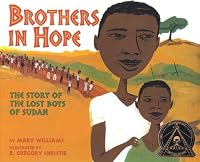
I like this book for two main reasons. My first reason are the beautiful illustrations. The style of the illustrations is much different than most others I have seen, but so is the style of the book itself. The illustrations are able to clearly show the reader what the characters are doing in each scene. While the boys are traveling, they are facing a great struggle. They are all hungry, tired, and scared, and that can be seen in the detail of the boys' faces. My second reason for liking this book is the character development throughout. The main character, Garang, is one of the younger boys that is chosen to lead a group. When he first begins helping, he firmly believes that he cannot lead these boys to safety. Not only does he lead show more his entire group to safety, through both Ethiopia and Kenya, but he also helps some of the American leaders of the refugee camp to teach young boys and take care of them. He cares for his group of boys, as well as others, the way that he was being taught to care for cattle as a young boy. I think the big idea of this story is something that I found in one of the last quotes of the story. "Your heart and mind are strong. There is nothing you cannot do." Garang, as well as other refugees were all strong throughout the war. They had to flee their country after their families had died in order to stay safe and make a life for themselves. they were able to accomplish so much through being strong, physically and mentally, and students can see that the characters were able to survive and think about how strong they can be. show less
This story is about a boy named Garang and a group of brave orphan boys known as the Lost Boys. Forced to flee their town of Sudan and head to Ethiopia on foot because of civil war. The boys' ages ranged from 5-15 years old but despite their youth they came together and traveled through the elements of Mother Nature. These boys united, staying alive by sleeping during the day and traveling at night. As you read this book you can feel the heat of the sun and the emotions the boys are going through during their incredible journey. I cannot imagine losing my family and trying to be in charge of children while also very young myself. Once the Lost Boys made it to the refugee camp in Ethiopia they realize the war had spread there as well. show more They had to once again flee, this time to Kenya. After being there a while, Garang is greeted by his old friend Tom and told they will have a second chance at life and will be able to move to the United States! Not many people get a second chance, but these boy not only got that chance but also deserved it. This story of perseverance touched me because it puts everything into perspective. When compared to the Lost Boys problems, all my struggles seem minor. show less
The story of Garang's journey escaping war was a heart breaking one. The illustrations add further understanding to his and all the lost boys' struggles. In every photo there is multiple bright colors despite the dark story of lost children. The contrast between the images and the journey are very effective. I highly recommend this book especially with everything going on in our world today. This could teach children many things, one being that most refugees are not evil or wanting to cause harm, they simply wish they had a home and as humans we should help them.
Brothers In Hope is a fictional book based on actual events. The lost boys of Sudan are a real group of boys that were forced to walk close to one thousand miles to find refuge. In this story, a eight year old boy named Garang, is caring for his cattle when his village is attacked. His family is killed and he is left to care for himself and other boys on a long journey to safety in Ethiopia. The story is powerful and I found the illustrations to be equally powerful. The medium of art is paint. The colors in the illustrations make you feel like you are in Africa. In the story an American man named Tom helps the boys when they arrive at the refugee camp and eventually helps them find a new home in the United States. I noticed that in the show more illustrations Tom is much bigger than the boys and other adults in the story. I think the illustrator may have done this on purpose to show Tom as a powerful character in the story. This would be a great book to read to students. It tells a story but is also very educational. show less
Members
- Recently Added By
Lists

A Child's Book Tour of East Africa ::: Ethiopia, Kenya, Sudan, Uganda
68 works; 4 members
Author Information
3 Works 456 Members
All Editions
Awards and Honors
Awards
Distinctions
Common Knowledge
Classifications
- DDC/MDS
- 362.87 — Social sciences Social problems and social services Social problems of and services to groups of people Problems of and services to other groups
- LCC
- PZ7 .W66699 .B — Language and Literature Fiction and juvenile belles lettres Fiction and juvenile belles lettres Juvenile belles lettres
- BISAC
Statistics
- Members
- 401
- Popularity
- 77,125
- Reviews
- 51
- Rating
- (4.46)
- Languages
- English
- Media
- Paper, Ebook
- ISBNs
- 3