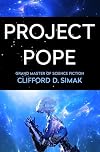
Project Pope
by Clifford D. Simak
On This Page
Description
Robot believers at the far end of the galaxy endeavor to create a true religion, but their efforts could be shattered by a shocking revelationFar in the future, on the remote planet End of Nothing, sentient robots are engaged in a remarkable enterprise. They call their project Vatican-17: an endeavor to create a truly universal religion presided over by a pope, whose extreme godliness and infallible artificial intelligence are fed by telepathic human Listeners who psychically delve into the show more mysteries of the universe. But the great and holy mission could be compromised by one shocking revelation that threatens to inspire serious crises of faith among the spiritual, truth-seeking robotic acolytes while tearing them into warring religious factions. For the Listener Mary is claiming that she has just discovered Heaven.
There are those among the Clifford D. Simak faithful who consider Project Pope his masterpiece. But whether the crowning literary achievement of a multiple Hugo and Nebula Award–winning science fiction Grand Master or merely another brilliant novel of speculative fiction to stand among his many, Simak’s breathtaking search for God in the machine ingeniously blends science and spirituality in a truly miraculous way that few science fiction writers, if any, have been able to accomplish. show less
Tags
Recommendations





















Member Reviews
Simak has yet to disappoint. Some books are stronger than others, but all have been good. This one is among the stronger books, right up there with The City and Waystation. As I have come to expect, this book is rife with quirky and interesting characters, including a robot cardinal, plucky human protagonists, a gruff backwoods loner, and weird but friendly aliens. These literary gears mesh nicely, but it is the broader, underlying theme that (for me, at least) sets Simak a giant step apart from other speculative fiction and sci-fi writers.
This book follows a fork in development of sentient life and wonders about a race of sentient and self-reproducing robots that seek to build their own Vatican and pursue the creation of an infallible show more Pope capable of pursuing universal knowledge. For the robots, designed by humans to pursue specific ends, they replicate future generations in their own image and develop appreciation for the beauty of data and logic and knowledge. Knowledge becomes the center of their “faith” and the basis of their Vatican. Mix in humans and we get an interesting exploration of religious faith and knowledge and how the two parallel but get confused with one another. The pursuit of faith (Christian faith, as alluded to in this book) is the everlasting reward of Heaven, a stopping point. The pursuit of knowledge has no stopping point: an answer to leads to new questions, and so it is never completely satisfied. Interestingly, the flaw in the pursuit of knowledge is that it is directional, we pursue understanding of what we see as important, rather than being open to surprise. These tensions are a running theme in the book and are subtle and thoughtfully made central to the story. show less
This book follows a fork in development of sentient life and wonders about a race of sentient and self-reproducing robots that seek to build their own Vatican and pursue the creation of an infallible show more Pope capable of pursuing universal knowledge. For the robots, designed by humans to pursue specific ends, they replicate future generations in their own image and develop appreciation for the beauty of data and logic and knowledge. Knowledge becomes the center of their “faith” and the basis of their Vatican. Mix in humans and we get an interesting exploration of religious faith and knowledge and how the two parallel but get confused with one another. The pursuit of faith (Christian faith, as alluded to in this book) is the everlasting reward of Heaven, a stopping point. The pursuit of knowledge has no stopping point: an answer to leads to new questions, and so it is never completely satisfied. Interestingly, the flaw in the pursuit of knowledge is that it is directional, we pursue understanding of what we see as important, rather than being open to surprise. These tensions are a running theme in the book and are subtle and thoughtfully made central to the story. show less
Clifford Simak wrote some very entertaining science fiction novels, including a few that may reasonably be regarded as classics in the field. This, unfortunately, is not one of them.
The novel centers on an order of religious robots on a planet they've named Vatican-17, who have attempted to build a robotic pope who will be truly infallible, and who are using human psychics to search for Heaven, which might or might not be a real place you can actually visit.
All of which sounds like it could perhaps make for some interesting musings, or maybe for some satirical humor, on the subjects of artificial intelligence and religion. It does neither, though. Instead, it seems to mostly consist of characters sitting around telling each other the show more same stuff over and over and over, none of which was particularly interesting in the first place. Neither the world nor the theology of these robots ever feels very well-developed, and the plot is thin enough that the whole thing could probably have been cut down from 300+ pages to novella-length, and been the better for it. And then there's the ending, which kind of feels like it belongs in another story entirely (but not necessarily a better one). show less
The novel centers on an order of religious robots on a planet they've named Vatican-17, who have attempted to build a robotic pope who will be truly infallible, and who are using human psychics to search for Heaven, which might or might not be a real place you can actually visit.
All of which sounds like it could perhaps make for some interesting musings, or maybe for some satirical humor, on the subjects of artificial intelligence and religion. It does neither, though. Instead, it seems to mostly consist of characters sitting around telling each other the show more same stuff over and over and over, none of which was particularly interesting in the first place. Neither the world nor the theology of these robots ever feels very well-developed, and the plot is thin enough that the whole thing could probably have been cut down from 300+ pages to novella-length, and been the better for it. And then there's the ending, which kind of feels like it belongs in another story entirely (but not necessarily a better one). show less
I'm of two minds on this one. It's quite strong on showing us some pretty wonderful worldbuilding, a robot Pope with robot Cardinals on a super-remote world in a distant future, spending many thousands of years trying to come to the idea of a perfect religion.
In this respect, it's perfect Simak. A lot of crystalline exploration of the idea of the Holy and what is good and all in all, it's a pretty awesome treatment of AIs (hereforeto referred to as robots) doing right by themselves and all the other races in the universe. If it feels like a nostalgic homage to the humans that created them in the distant past, then you're right. Most of the robots alive today only have vague ideas about humanity.
I think Simak does the subject nice show more justice, capturing an island of peace and contemplation only available to robots because those pesky humans always seem to f*** it up. :) Of course, the book doesn't end here. The search for Heaven takes a high-math turn and ancient beings who may or may not be a species of angels have been watching over this distant world and with the help of a few humans and a baby (something), the adventure makes a schism in the robot religion.
This is all pretty cool. So why did I knock off a star?
The writing, actually. Sometimes it skims where it could dive deep and the characters and dialogue were kinda lame at parts. *shrug* It annoyed me because the other concepts and turns were pretty damn high quality. :) show less
In this respect, it's perfect Simak. A lot of crystalline exploration of the idea of the Holy and what is good and all in all, it's a pretty awesome treatment of AIs (hereforeto referred to as robots) doing right by themselves and all the other races in the universe. If it feels like a nostalgic homage to the humans that created them in the distant past, then you're right. Most of the robots alive today only have vague ideas about humanity.
I think Simak does the subject nice show more justice, capturing an island of peace and contemplation only available to robots because those pesky humans always seem to f*** it up. :) Of course, the book doesn't end here. The search for Heaven takes a high-math turn and ancient beings who may or may not be a species of angels have been watching over this distant world and with the help of a few humans and a baby (something), the adventure makes a schism in the robot religion.
This is all pretty cool. So why did I knock off a star?
The writing, actually. Sometimes it skims where it could dive deep and the characters and dialogue were kinda lame at parts. *shrug* It annoyed me because the other concepts and turns were pretty damn high quality. :) show less
Simak characters speak with a gracious mid-20th century mid-western formality of speech. Most
of the characters speak similarly. There is little to tell between them, but it is enough. I like his short sentences. Each sentence is a complete, clear thought. I think a fine radio play might be made of this story, which is largely dialogue. What little is not, could be made so, or assigned to a narrator.
Clifford Simak has always struck me as a gentle writer. I'm not quite sure what I mean because people kill and are killed, hurt and are mistreated, and there is danger physical and ideological. But always there seems to be a goodness in everything and things work out. Everyone is likeable, villians can be pitied. There is mystery: enough is show more explained, but never everything. show less
of the characters speak similarly. There is little to tell between them, but it is enough. I like his short sentences. Each sentence is a complete, clear thought. I think a fine radio play might be made of this story, which is largely dialogue. What little is not, could be made so, or assigned to a narrator.
Clifford Simak has always struck me as a gentle writer. I'm not quite sure what I mean because people kill and are killed, hurt and are mistreated, and there is danger physical and ideological. But always there seems to be a goodness in everything and things work out. Everyone is likeable, villians can be pitied. There is mystery: enough is show more explained, but never everything. show less
Not sure why it happens that the man (Dr. Jason) Tennyson and the woman Jill (Roberts, journalist) arrived on this planet just as the robots' Search for Knowledge and for a constructed Faith also arrived. But so it did, and so we learn about these robots who are interested in humans and in relitions, and about humans, and about a bunch of other truly alien aliens.
The sexism is much more minor than one might expect. Social drinking is totally a thing, but there's no tobacco or drug use, and the sex is totally off-stage. The characters are better developed than expected, too, but in a subtle manner for the careful reader. There are 'loose ends' and unanswered questions, I think, but maybe I didn't read quite carefully enough.
In fact, most show more of the book is quiet and so, if one has not been reading attentively, the drama near the end and the end itself may seem out-of-proportion and out-of-place... but Simak is skilled, and there's a lot of fodder here for a group discussion and/or a reread. I particularly liked puzzling out which characters we could take at face value and which were not all they seemed, not trustworthy....
Recommended if my comments make it seem interesting, or if you've wanted to read a bit more Simak.... show less
The sexism is much more minor than one might expect. Social drinking is totally a thing, but there's no tobacco or drug use, and the sex is totally off-stage. The characters are better developed than expected, too, but in a subtle manner for the careful reader. There are 'loose ends' and unanswered questions, I think, but maybe I didn't read quite carefully enough.
In fact, most show more of the book is quiet and so, if one has not been reading attentively, the drama near the end and the end itself may seem out-of-proportion and out-of-place... but Simak is skilled, and there's a lot of fodder here for a group discussion and/or a reread. I particularly liked puzzling out which characters we could take at face value and which were not all they seemed, not trustworthy....
Recommended if my comments make it seem interesting, or if you've wanted to read a bit more Simak.... show less
Robo-Pope. Clever and funny - the book, not the robo-pope, he barely gets a look in but that's the peculiar detail that made me pick up the book so maybe it'll work for you too. You won't regret it although it's fair to warn you it's more of a wistful and gentle sci-fi tale than a life changing epiphany the theme would suggest.
Thisis one of Simak's best fantasy worlds, one of his best stories, and the emotion that is coming througth is that love and respect for ALL living things, and he really has some "things" in this one! How about a mulit-tenanctaled being that plops up and down and is called, natch, ploopper, but who has the ability to push out of himself a mini-atomic explosion. And there's the "bubblies," a race of smoky beings encapsulated in a robotic suit so they don't drift away from themselves, to to speak. Yes, this book makes one wonder just what Clifford Simak smoked in the privacy of his own home.
Members
- Recently Added By
Lists

Books Read in 2014
2,343 works; 89 members

Books Read in 2025
4,091 works; 97 members
Author Information

385+ Works 25,270 Members
Some Editions
Awards and Honors
Awards
Series
Belongs to Publisher Series
Work Relationships
Common Knowledge
- Canonical title
- Project Pope
- Original publication date
- 1981
- First words
- Thomas Decker was half an hour from home when Whisperer stopped him in his tracks.
- Last words
- (Click to show. Warning: May contain spoilers.)"To those of us," he said, "who really kept the faith."
The others drank the toast.
Theodosius tipped back his head and solemnly poured the liquor on his chin.
Classifications
Statistics
- Members
- 636
- Popularity
- 45,517
- Reviews
- 14
- Rating
- (3.56)
- Languages
- 7 — Bulgarian, English, French, German, Italian, Portuguese, Swedish
- Media
- Paper, Audiobook, Ebook
- ISBNs
- 12
- ASINs
- 12