Complete Writings with Variant Readings (Oxford Standard Authors Series) {Keynes, ed.}
by William Blake
On This Page
Description
Works by Blake supplemented by his letters and engravings are presented with punctuation corrections and the new readings rendered by American scholars.Tags
Recommendations
















Member Reviews
Having found a reference to An Island in the Moon, I was pleased to read this book in which it was contained. Blake has always been one of my favourite authors who I had ranked alongside Roald Dahl and Spike Milligan. I also accredited Blake for passing my English literature exam, when the “unseen poem” transpired to be A Poison Tree – a poem I already knew by heart. I was surprised I hadn’t acquired this book sooner. I had no expectation Blake lived in the 1700s (assumed he was later), and so found his longer poems more heavily influenced by religion than if he had lived in a later period. I enjoyed his attempts at creating a mythology of Britain (Albion) and Hell related to biblical texts, and his reoccurring themes of Los, show more Albion etc. It was easy to see the influences of these poems to authors such as Alan Moore, and Neil Gaiman. Indeed, in his poem Auguries of Innocence, I saw the lyrics of both The Levellers (“…if the sun and moon were both to doubt, sure enough they’d both go out”), and The Doors “Some are born to sweet delight some are born to endless night…realms of bliss”). I was most informed through this book that his famous poem, commonly known as Jerusalem, was the preface to his long poem entitled Milton, whereas he penned another long poem entitled Jerusalem which does not contain the hymn. Blake’s insistence at having illustrated works confirms to me he was one of the first Graphic Novelists. He spent his life illustrating his own and other author’s works, and his images add so much to the text. Blake also comes across as quite mischievous, I found his responses to books he has annotated quite humorous, rude and occasionally offensive (had the original authors read what he had written). His version of the Lord’s Prayer (a parody) was surprisingly aggressive and made me think of the Sex Pistols. Blake’s letters enhanced my understanding enormously. I did find I preferred his shorter poems – the long ones were repetitive, and the narratives hard to follow; but these long ones to me were a worthy attempt at creating a historical mythology of the religion of Britain, incorporating both the old and new testaments of the bible. show less
Blake defies categories. His best poems (and brief sayings, I would add) have a permanent place in world literature. Five stars for those.
Urizen, Milton and Jerusalem to read now
Ex libris Marie Scott-James
Clarissa, with love from Grandpa and Paul, Dec 1957
Clarissa, with love from Grandpa and Paul, Dec 1957
Ratings
Members
- Recently Added By
Lists

Lovecraft's 'Supernatural Horror in Literature' Reading List
216 works; 8 members

Philip Ward's Lifetime Reading Plan
592 works; 22 members

University literature
145 works; 5 members

Literary Works Read in College
316 works; 15 members

Harold Bloom - The Western Canon: C. The Democratic Age
336 works; 15 members
Author Information

501+ Works 20,199 Members
William Blake's poems, prophecies, and engravings represent his strong vision and voice for rebellion against orthodoxy and all forms of repression. Born in London in November 1757; his father, a hosier of limited means, could do little for the boy's education. However, when the young Blake's talent for design became apparent, his wise father sent show more him to drawing school at the age of 10. In 1771 Blake was apprenticed to an engraver. Blake went on to develop his own technique, a method he claimed that came to him in a vision of his deceased younger brother. In this, as in so many other areas of his life, Blake was an iconoclast; his blend of printing and engraving gave his works a unique and striking illumination. Blake joined with other young men in support of the Revolutions in France and America. He also lived his own revolt against established rules of conduct, even in his own home. One of his first acts after marrying his lifetime companion, Catherine Boucher, was to teach her to read and write, rare for a woman at that time. Blake's writings were increasingly styled after the Hebrew prophets. His engravings and poetry give form and substance to the conflicts and passions of the elemental human heart, made real as actual characters in his later work. Although he was ignored by the British literary community through most of his life, interest and study of his work has never waned. Blake's creativity and original thinking mark him as one of the earliest Romantic poets, best known for his Songs of Innocence (1789) and Songs of Experience (1794) and The Tiger. Blake died in London in 1827. (Bowker Author Biography) show less
All Editions
Awards and Honors
Series
Belongs to Publisher Series
Work Relationships
Common Knowledge
- Canonical title
- Complete Writings with Variant Readings (Oxford Standard Authors Series) {Keynes, ed.} (Oxford Standard Authors Series)
- People/Characters
- William Blake; Emanuel Swedenborg
- Important places
- London, England, UK
- First words
- This Edition of William Blake seeks to supply a sounder and more uncluttered text for reading than has been heretofore available, with a full apparatus of variant and deleted passages for for study.
- Last words
- (Click to show. Warning: May contain spoilers.)I find that I am not so well as I thought I must not go on in a youthful Style----however I am upon thr mending hand to day & hope to soon look as I did for I have been yellow accompanied by all the old Symtoms.
- Disambiguation notice
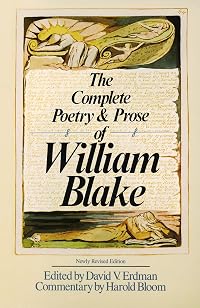
- This is the edition edited by Geoffrey Keynes. Do not combine with the edition edited by David Erdman, with commentary by Harold Bloom, which has significant additional material.
Classifications
Statistics
- Members
- 479
- Popularity
- 63,372
- Reviews
- 4
- Rating
- (4.14)
- Languages
- English, French, Croatian
- Media
- Paper
- ISBNs
- 4
- ASINs
- 29