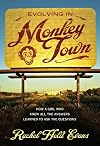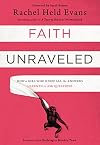
Faith Unraveled: How a Girl Who Knew All the Answers Learned to Ask the Questions
by Rachel Held Evans
On This Page
Description
How an evolving spiritual journey leads to an unshakeable faith Eighty years after the Scopes Monkey Trial made a spectacle of Christian fundamentalism and brought national attention to her hometown, Rachel Held Evans faced a trial of her own when she began to have doubts about her faith. In Faith Unraveled, Rachel recounts growing up in a culture obsessed with apologetics, struggling as her own faith unraveled one unexpected question at a time. In order for her faith to survive, Rachel show more realizes, it must adapt to change and evolve. Using as an illustration her own spiritual journey from certainty to doubt to faith, Evans challenges you to disentangle your faith from false fundamentals and to trust in a God who is big enough to handle your tough questions. In a changing cultural environment where new ideas seem to threaten the safety and security of the faith, Faith Unraveled is a fearlessly honest story of survival. show lessTags
Recommendations




Member Recommendations
Member Reviews
Rachel Held Evans and her two sisters grew up in a fundamentalist family in Dayton, Tennessee, a place best known for the 1925 Scopes Monkey Trial that H.L. Mencken so deliciously sent up. Equal parts memoir, Christian philosophy, and explication of modern fundamentalism, Evolving in Monkey Town provides something for Christians and agnostics alike. I found myself really invested in Evans’ spiritual evolution, if you’ll pardon the pun.
Despite living in Kentucky, home of snake handling, the Church of Christ (non-instrumental), and crackpots like Governor Matt Bevin and Senator Rand Paul (an Aqua Buddhist), I learned quite a bit from this slim volume. I was completely unfamiliar with both Bryan College (located in Dayton) and show more “Christian worldview” (a sort of scientific fundamentalism and quite an oxymoron), and Evans explains both its origins and its finer points. And I really appreciated Evans reminding me that an open mind, loving respect, and constant questioning is the best way to build a relationship with God — and each other show less
Despite living in Kentucky, home of snake handling, the Church of Christ (non-instrumental), and crackpots like Governor Matt Bevin and Senator Rand Paul (an Aqua Buddhist), I learned quite a bit from this slim volume. I was completely unfamiliar with both Bryan College (located in Dayton) and show more “Christian worldview” (a sort of scientific fundamentalism and quite an oxymoron), and Evans explains both its origins and its finer points. And I really appreciated Evans reminding me that an open mind, loving respect, and constant questioning is the best way to build a relationship with God — and each other show less
Just Wow. Rachel writes so well. Her turns of phrase, her visual analogies, are so visceral- this is some of the finest modern non-fiction writing I've had the pleasure to read. For instance, "Failure to adapt explains why wooly mammoths didn't survive the end of the Ice Age and why we get pigeon poop stuck on our windshields instead of dodo poop." The way she puts a sentence and an image together is so very evocative.
And Rachel writes *real*. I sense no guile in her, as she writes with humility, criticizing her own past beliefs and present beliefs. And she mirrors my own faith journey- though I haven't really reached anything close to her level of humility. Rachel starts off in a Biblically literal family, evangelical if not show more fundamentalist. Gradually she realizes that faith is about asking questions, not being right. Through the lenses of evolution, a big topic in her town, and the status of women, a topic dear to her heart, Rachel comes to see that Biblical orthodoxy is not clear precisely so that we can have discussions in community. Despite this, she finds that the adjective "Biblical" is uses primarily as a weapon, to tear down conversation and community, rather than to build faith through questioning.
My faith journey is the same, but Rachel, a decade younger than me, has progressed beyond me. I learn from her, and her words continue to ruminate in my brain. She writes of fundamentalism as "holding so tightly to your beliefs that your fingernails leave imprints on the palm of your hand." They are "So fearful of losing their grip on faith, they squeeze the life out of it." And "When you count each one of your beliefs as absolutely essential, change is never an option. When change is never an option, you have to hope that the world stays exactly as it is so as not to mess with your view of it." Some Christians are "more offended by the idea of everyone going to heaven than by the idea of everyone going to hell." Yup. All true, in my experience. Christians have focused on certain sins, while giving a pass to others. This is certainly not a new observation. Phrasing it as that she sometimes wonders what the world would be like if American Protestants focused on a different sin than homosexuality- that is a novel take that I had not considered before. Rachel's imagination, the foundation of hope, makes this the enticing book that it is.
But what are we to do about this? Can Christianity be saved? Happily, according to Rachel, it already has within it the genesis of salvation. She says, "I'm an evolutionist because I believe that sometimes God uses changes in the environment to pry idols from our grip and teach us something new." "If there's one thing I know for sure, it's that faith can survive just about anything, so long as it's able to evolve." I hadn't realized it before I read her, but yes- that *is* what the Bible talks about when it talks about faith- or itself!
Until she began this journey of self-discovery, and Jesus discovery, she "never realized how important hope is to belief." That is what faith is about. Not facts. Hope. If we're going to be Biblical about it. "We aren't saved by information. We're saved by restored relationship with God." And following Christ is "about living as an incarnation of Jesus, as Jesus lived as an incarnation of God."
There are certainly those who erroneously claim that Rachel is no Christian, or rejects the Bible, or criticizes fundamentalism without praise. But one is allowed to criticize one's own faith and experiences, from the inside. And as for the Bible, it is rather her high view of scripture that demands she takes it seriously. "Womanhood, like the Bible, is far too lovely and mysterious and transcendent to systematize or explain." You can say that the entire Bible needs to be taken literally (and not actually mean it). Or you can praise it in the superlative poetic as Rachel does. As for me and my house, I prefer Rachel's approach. It's more life affirming, and life changing. show less
And Rachel writes *real*. I sense no guile in her, as she writes with humility, criticizing her own past beliefs and present beliefs. And she mirrors my own faith journey- though I haven't really reached anything close to her level of humility. Rachel starts off in a Biblically literal family, evangelical if not show more fundamentalist. Gradually she realizes that faith is about asking questions, not being right. Through the lenses of evolution, a big topic in her town, and the status of women, a topic dear to her heart, Rachel comes to see that Biblical orthodoxy is not clear precisely so that we can have discussions in community. Despite this, she finds that the adjective "Biblical" is uses primarily as a weapon, to tear down conversation and community, rather than to build faith through questioning.
My faith journey is the same, but Rachel, a decade younger than me, has progressed beyond me. I learn from her, and her words continue to ruminate in my brain. She writes of fundamentalism as "holding so tightly to your beliefs that your fingernails leave imprints on the palm of your hand." They are "So fearful of losing their grip on faith, they squeeze the life out of it." And "When you count each one of your beliefs as absolutely essential, change is never an option. When change is never an option, you have to hope that the world stays exactly as it is so as not to mess with your view of it." Some Christians are "more offended by the idea of everyone going to heaven than by the idea of everyone going to hell." Yup. All true, in my experience. Christians have focused on certain sins, while giving a pass to others. This is certainly not a new observation. Phrasing it as that she sometimes wonders what the world would be like if American Protestants focused on a different sin than homosexuality- that is a novel take that I had not considered before. Rachel's imagination, the foundation of hope, makes this the enticing book that it is.
But what are we to do about this? Can Christianity be saved? Happily, according to Rachel, it already has within it the genesis of salvation. She says, "I'm an evolutionist because I believe that sometimes God uses changes in the environment to pry idols from our grip and teach us something new." "If there's one thing I know for sure, it's that faith can survive just about anything, so long as it's able to evolve." I hadn't realized it before I read her, but yes- that *is* what the Bible talks about when it talks about faith- or itself!
Until she began this journey of self-discovery, and Jesus discovery, she "never realized how important hope is to belief." That is what faith is about. Not facts. Hope. If we're going to be Biblical about it. "We aren't saved by information. We're saved by restored relationship with God." And following Christ is "about living as an incarnation of Jesus, as Jesus lived as an incarnation of God."
There are certainly those who erroneously claim that Rachel is no Christian, or rejects the Bible, or criticizes fundamentalism without praise. But one is allowed to criticize one's own faith and experiences, from the inside. And as for the Bible, it is rather her high view of scripture that demands she takes it seriously. "Womanhood, like the Bible, is far too lovely and mysterious and transcendent to systematize or explain." You can say that the entire Bible needs to be taken literally (and not actually mean it). Or you can praise it in the superlative poetic as Rachel does. As for me and my house, I prefer Rachel's approach. It's more life affirming, and life changing. show less
What happened to the millions of Holocaust victims immediately after their death? Did God consign them to eternal torture for not believing in his Son?
If that question doesn’t bother you, then don’t bother with this book. If you do wrestle with it, Evan’s memoir will remind you that you’re not the only person on this journey.
Evolving in Monkey Town is the story of Evan’s spiritual journey from a fundamentalist with all the correct answers to an honest believer. If you were raised in a fundamentalist setting, this book will resonate. Evans has a knack for describing the absurdities of fundamentalism with grace and plenty of humour.
I should warn you that this book will make you think through issues many of us prefer to leave show more buried, such as the fate of people who have never heard of Jesus. The challenge, however, is well worth accepting for any believer looking to grow up. Loving God with all our heart as well as our mind demands nothing less. show less
If that question doesn’t bother you, then don’t bother with this book. If you do wrestle with it, Evan’s memoir will remind you that you’re not the only person on this journey.
Evolving in Monkey Town is the story of Evan’s spiritual journey from a fundamentalist with all the correct answers to an honest believer. If you were raised in a fundamentalist setting, this book will resonate. Evans has a knack for describing the absurdities of fundamentalism with grace and plenty of humour.
I should warn you that this book will make you think through issues many of us prefer to leave show more buried, such as the fate of people who have never heard of Jesus. The challenge, however, is well worth accepting for any believer looking to grow up. Loving God with all our heart as well as our mind demands nothing less. show less
Wow, this is a great book. If you have grown up in a very conservative, Fundamentalist church, and have ever had deep questions and doubts, you will likely resonate with Rachel. She comes across as an honest seeker and a sensitive soul. She also, in my opinion, accurately diagnoses the reason that so many young people become turned off to the church.
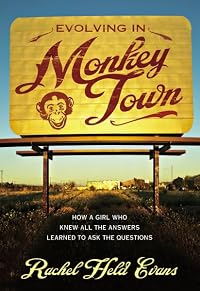
Faith Unraveled: How a Girl Who Knew All the Answers Learned to Ask Questions was originally called Evolving in Monkey Town with the same subtitle. The Scopes monkey trial took place in Rachel Held Evans' hometown in 1925 and acts as a neat metaphor for what the book is about: belief, doubt, politics, and fundamentalism. She wrote it after years of wrestling with her conservative evangelical Christian upbringing in the Bible belt and the doubt she experienced as an adult.
Rachel, a pastor's daughter, went to Christian schools and college where she and her classmates were taught to be Christian apologists and debaters, concerned more with winning souls and dunking on nonbelievers than they were about determining what they really believed show more and if they believed it. Rachel's crisis of faith was relatable, and I felt for her. She also includes some short chapters about other people she knows and their approaches to faith and belief. This book doesn't have a neat ending, but then life and belief don't. This book is all the more poignant because Rachel passed away a couple of years ago.
See the full review, plus the book's trigger warnings, at https://fileundermichellaneous.blogspot.com/2022/05/book-review-faith-unraveled-... show less
Rachel, a pastor's daughter, went to Christian schools and college where she and her classmates were taught to be Christian apologists and debaters, concerned more with winning souls and dunking on nonbelievers than they were about determining what they really believed show more and if they believed it. Rachel's crisis of faith was relatable, and I felt for her. She also includes some short chapters about other people she knows and their approaches to faith and belief. This book doesn't have a neat ending, but then life and belief don't. This book is all the more poignant because Rachel passed away a couple of years ago.
See the full review, plus the book's trigger warnings, at https://fileundermichellaneous.blogspot.com/2022/05/book-review-faith-unraveled-... show less
A worthwhile read, although nothing too surprising for anyone who has spent time on Rachel Held Evans' blog. This is, essentially, a version 2.0 of Evolving In Monkey Town, Evans' spiritual autobiography.
For me, the most interesting part of this book is that, in an approximate sort of way, Evans was going through the process of learning what her spiritual worldview would be at the same time I was. She was just a year ahead of me in high school and college and many of the world events that she saw were the same that influenced me. She came from a very different background -- she came from a conservative Christian family in a conservative Christian community; I came from a Christian-by-default family in an area of relatively low show more religiosity -- but there is still a similarity that contemporaries will often have, regardless of other differences.
I expect that others will appreciate the book for a different reason: to over simplify, Evans' faith crisis came down to dealing with the fact that in her community, Christianity came with a very particular set of beliefs and a fixed political agenda. As she saw more of the world, some of those beliefs and some parts of that agenda became less and less acceptable.
In particular, Evans had to deal with the fact that for people of our generation, the world was getting a lot smaller. She couldn't look upon people from other countries and other religious traditions as the abstract damned. She saw them as individuals, and once that started happening, the assumptions of her upbringing started to unravel.
In the end, Evans decided that she could have both a view of the Bible as God's revelation and throw off some of the more atrocious of her old beliefs. In fact, once she started looking, she found that the Bible presented a much more nuanced picture than what she had been taught.
Overall, a light, entertaining read. show less
For me, the most interesting part of this book is that, in an approximate sort of way, Evans was going through the process of learning what her spiritual worldview would be at the same time I was. She was just a year ahead of me in high school and college and many of the world events that she saw were the same that influenced me. She came from a very different background -- she came from a conservative Christian family in a conservative Christian community; I came from a Christian-by-default family in an area of relatively low show more religiosity -- but there is still a similarity that contemporaries will often have, regardless of other differences.
I expect that others will appreciate the book for a different reason: to over simplify, Evans' faith crisis came down to dealing with the fact that in her community, Christianity came with a very particular set of beliefs and a fixed political agenda. As she saw more of the world, some of those beliefs and some parts of that agenda became less and less acceptable.
In particular, Evans had to deal with the fact that for people of our generation, the world was getting a lot smaller. She couldn't look upon people from other countries and other religious traditions as the abstract damned. She saw them as individuals, and once that started happening, the assumptions of her upbringing started to unravel.
In the end, Evans decided that she could have both a view of the Bible as God's revelation and throw off some of the more atrocious of her old beliefs. In fact, once she started looking, she found that the Bible presented a much more nuanced picture than what she had been taught.
Overall, a light, entertaining read. show less
A personal story of how one woman began questioning her Evangelical faith in the inerrancy of the Bible, framed around the idea of evolution. As she discusses the scientific theory of evolution, she also discusses the evolution of her faith away from Biblical inerrancy, and the evolution of religion in general. Just as she needed her faith to evolve through her doubt, she believes fundamental Christianity needs to evolve in order to survive. I really enjoyed her fresh (to me) approach to the subject, and am saddened that her death has deprived us of such a unique voice.
Members
- Recently Added By
Author Information

10+ Works 3,872 Members
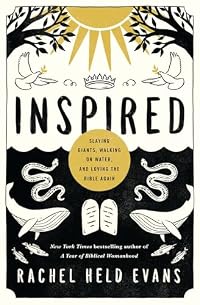
Rachel Held Evans was born Rachel Grace Held in Alabama on June 8, 1981. She received a bachelor's degree in English from Bryan College in 2003. She started working for The Herald-News in 2004. In 2007, she won an award from the Tennessee Press Association for the best personal humor column. An Episcopalian, she left the evangelical church in 2014 show more to find what she considered a truer, more authentic Christianity. She wrote four books including Faith Unraveled: How a Girl Who Knew All the Answers Learned to Ask Questions; A Year of Biblical Womanhood: How a Liberated Woman Found Herself Sitting on Her Roof, Covering Her Head, and Calling Her Husband Master; and Inspired: Slaying Giants, Walking on Water, and Loving the Bible Again. She died from extensive brain swelling on May 4, 2019 at the age of 37. (Bowker Author Biography) show less
Awards and Honors
Awards
Common Knowledge
- Canonical title
- Faith Unraveled: How a Girl Who Knew All the Answers Learned to Ask the Questions
- Original title
- Evolving in Monkey Town: How a Girl Who Knew All the Answers Learned to Ask the Questions
- Original publication date
- 2010
- Dedication
- To Mom and Dad,
for believing in me enough
to make me promise at the age of eight
to dedicate my first book to you - First words
- Monkeys make me nervous.
- Quotations
- Faith is a journey, and every generation contributes its own sketches to the map.
Those who say that having childlike faith means not asking questions haven't met too many children. - Last words
- (Click to show. Warning: May contain spoilers.)God must really love us, because he always answers with such long stories
- Original language
- English
- Disambiguation notice
- Faith Unraveled is the more recent title. Evolving in Monkey Town is the original title of the same book.
Classifications
Statistics
- Members
- 547
- Popularity
- 53,978
- Reviews
- 22
- Rating
- (4.41)
- Languages
- English, Spanish
- Media
- Paper, Audiobook, Ebook
- ISBNs
- 9
- UPCs
- 3
- ASINs
- 5