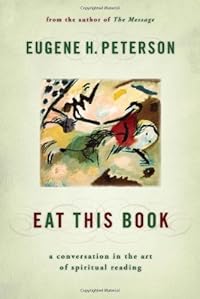
Eat This Book: A Conversation in the Art of Spiritual Reading
by Eugene H. Peterson
Eugene Peterson's Spiritual Theology (2), 讀經生活化
On This Page
Description
Eat This Book challenges us to read the Scriptures on their own terms, as God's revelation, and to live them as we read them. With warmth and wisdom Peterson offers greatly needed, down-to-earth counsel on spiritual reading. In these pages he draws readers into a fascinating conversation on the nature of language, the ancient practice of lectio divina, and the role of Scripture translations, included here is the "inside story" behind Peterson's own popular Bible translation, The Message.Tags
Recommendations

Member Reviews
I found this both challenging and convicting in how I read the Scriptures. It prompted a lot of soul searching and, I hope, will stay with me as I dive deeper into the Word moving forward.
I really appreciated the insights into the development and translation/paraphrase of _The Message_; while I still can't say I'm super wild about it, per se (finding its casualness and American-isms somewhat off-putting at times--almost like a contest with itself to see how many 20th-century idioms could be inserted in a given phrase), I did come away with a more positive outlook in it than I'd had in a long time. Those American-isms were kind of his point, lol, and knowing that helps me appreciate it for what it is. Not totally my jam, but neither is show more the KJV :D, so I do have a newfound appreciation for both literal (word-for-word) _and_ thought-for-thought translation.
The uber-point/takeaway for me? Eat the book--such that it truly influences you and your (me and my) life from the inside out. show less
I really appreciated the insights into the development and translation/paraphrase of _The Message_; while I still can't say I'm super wild about it, per se (finding its casualness and American-isms somewhat off-putting at times--almost like a contest with itself to see how many 20th-century idioms could be inserted in a given phrase), I did come away with a more positive outlook in it than I'd had in a long time. Those American-isms were kind of his point, lol, and knowing that helps me appreciate it for what it is. Not totally my jam, but neither is show more the KJV :D, so I do have a newfound appreciation for both literal (word-for-word) _and_ thought-for-thought translation.
The uber-point/takeaway for me? Eat the book--such that it truly influences you and your (me and my) life from the inside out. show less
“Eat this book,” Peterson implores his readers. We cannot simply approach the Bible searching for facts and self-help tips; rather, we must devour the text for the spiritual nourishment so essential to our life of faith – read prayerfully and personally, looking to live and obey. Peterson’s work here does not offer ‘five simple steps to reading the Bible right,’ but instead explores the rhyme and reason of scripture: its spirit, its world, its theology, its story, its reading. Undergirded by solid exegesis, spiritual reading lifts the text from the sacrilege of “upward desecration” (taking the text out of the world) and reminds us that the Word is both living and personal. A
Considering how short a book this was, I was totally lazy about reading it. But it's a great book...definitely NOT a set of step by step instructions on "how to" read the Bible. Thank goodness...as if anyone can actually tell you that. It IS full of ideas about good and bad ways of approaching Scripture which are thoughtful and interesting.
You can't rush this book. That's what I discovered. Over a month, I had to bit by bit "taste and savor", reflect and then take the next bite. The last part on translation, however, I read in an hour as it was riveting. Lots to think about and I especially liked his breakdown of lectio divina.
Eat This Book challenges us to read the Scriptures on their own terms, as God’s revelation, and to live them as we read them. With warmth and wisdom, Peterson offers greatly needed, down-to-earth counsel on spiritual reading. In these pages, he draws readers into a fascinating conversation on the nature of language, the ancient practice of lectio divina, and the role of Scripture translations; included here is the “inside story” behind Peterson’s own popular Bible translation, The Message.
The Book of Common Prayer contains a prayer which petitions God to enable us to "hear [holy Scriptures], read, mark and inward digest them." I believe that these actions are also the theme of the Christian scholar Eugene Peterson in this book in which the author encourages the reader to more deeply read the Bible as to be transformative in our lives. However, he doesn't do so without providing some caveats regarding the use of metaphors and being aware of textual context in the writings. Peterson performs an extensive exegesis of the lectio divinia, a Benedictine spiritual discipline. My only complaint was that he took more time in explaining each step than how to do it.
Eugene Peterson has become one of my favorite authors, poets, pastor, guides over the last year or so. This book has taught me how to encounter the Word of God without critical, hermeneutic approaches all the time. The art of spiritual reading (Lectio Divina) is something that will take me the rest of my life to learn, but Eugene Peterson is a welcome friend on the journey. I highly recommend this book to anyone who desires to really dive into the Story of God. The author speaks from an obvious life of reading spiritually!
Members
- Recently Added By
Author Information

230+ Works 31,811 Members
Eugene H. Peterson was born in East Stanwood, Washington on November 6, 1932. He received a bachelor's degree in philosophy from Seattle Pacific University, a bachelor of sacred theology from New York Theological Seminary, and a master's degree in semitic languages from Johns Hopkins University. He founded Christ Our King Presbyterian Church in show more Bel Air, Maryland in 1962, where he served as pastor until retiring in 1991. He then became a professor of spiritual theology at Regent College in Vancouver, British Columbia until retiring in 2006. His first book, A Long Obedience in the Same Direction, was published in 1980. He wrote over 30 books including Christ Plays in Ten Thousand Places, Eat This Book, Tell It Slant, As Kingfishers Catch Fire, and Every Step an Arrival. The Message: The Bible in Contemporary Language won a Gold Medallion Book Award. He died from complications of heart failure and dementia on October 22, 2018 at the age of 85. (Bowker Author Biography) show less
Series


Work Relationships
Has as a student's study guide
Common Knowledge
- Original title
- Eat this book : a conversation in the art of spiritual reading
- Original publication date
- 2006
- Dedication
- For Jon and Cheryl Stine faithful companions in the vineyard of the text
- Last words
- (Click to show. Warning: May contain spoilers.)I am very conscious that I am in a vast company of translators—teachers in classrooms, pastors in pulpits, parents around the supper table, writers in languages all over the world, baptized Christians in workplaces and social gatherings past imagining—all of us at this same work, collaborating in translating the word of God, reading and then living this text, eating this book, and then getting these Scriptures into whatever language is heard and spoken on the street on which we live.
- Blurbers
- Winner, Lauren F.; Sittser, Gerald
Classifications
Statistics
- Members
- 1,602
- Popularity
- 14,079
- Reviews
- 17
- Rating
- (4.10)
- Languages
- Chinese, English, Portuguese, Spanish
- Media
- Paper, Audiobook, Ebook
- ISBNs
- 18
- ASINs
- 10