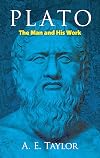
Plato: The Man and His Work
by A. E. Taylor
On This Page
Description
This book provides an introduction to Plato's work that gives a clear statement of what Plato has to say about the problems of thought and life. In particular, it tells the reader just what Plato says, and makes no attempt to force a system on the Platonic text or to trim Plato's works to suit contemporary philosophical tastes. The author also gives an account that has historical fidelity - we cannot really understand the Republic or the Gorgias if we forget that the Athens of the show more conversations is meant to be the Athens of Nicias or Cleon, not the very different Athens of Plato's own manhoo show lessTags
Recommendations



















Member Reviews
A serviceable introduction to the dialogues and synopsis of each, but Taylor maintains strenuously that the theory of forms, etc., were Socrates’ and that Plato never put anything into Socrates’ mouth that didn’t come from Socrates. So caveat emptor – this is a novel theory outside the mainstream of Platonic scholarship, which considers the early dialogues essentially Socratic, with transitional, mid and late ones becoming increasingly Platonic. It’s hard to take this theory seriously considering the picture of Socrates we get from Plato’s early dialogues combined with those of other Socratic dialogue writers, including Xenophon. If Plato’s epistemology, ontology and metaphysics came from Socrates, why don’t the other show more writers indicate anything about them? Oddly, this hardly mars the analysis and commentary. But if anyone (i.e., Pete) has a suggestion for another good overview of the dialogues, I’m all ears. show less
An idiosyncratic and thorough interpretation of Plato's thought. Using a review of the dialogues, Taylor covers a tremendous amount of ideas and concepts presented in the Platonic corpus. With contextual commentary this is a useful adjunct to any serious reading of Plato's dialogues.
http://en.wikipedia.org/wiki/Alfred_Edward_Taylor
This is the Plato translation I FIRST read in history of philosophy at Wheaton. Then I read another one.
Alfred Edward Taylor (December 22, 1869 - October 31, 1945) was a British idealist philosopher most famous for his contributions to the philosophy of idealism in his writings on metaphysics, the philosophy of religion, moral philosophy, and the scholarship of Plato.[1] He was a fellow of the British Academy (1911) and president of the Aristotelian Society from 1928 to 1929. At Oxford he was made an honorary fellow of New College in 1931. In an age of universal upheaval and strife, he was a notable defender of Idealism in the Anglo-Saxon world
This is the Plato translation I FIRST read in history of philosophy at Wheaton. Then I read another one.
Alfred Edward Taylor (December 22, 1869 - October 31, 1945) was a British idealist philosopher most famous for his contributions to the philosophy of idealism in his writings on metaphysics, the philosophy of religion, moral philosophy, and the scholarship of Plato.[1] He was a fellow of the British Academy (1911) and president of the Aristotelian Society from 1928 to 1929. At Oxford he was made an honorary fellow of New College in 1931. In an age of universal upheaval and strife, he was a notable defender of Idealism in the Anglo-Saxon world
Ratings
Members
- Recently Added By
Author Information

45+ Works 988 Members
Some Editions
Series
Belongs to Publisher Series
Meridian Books (MG7)
University Paperbacks (UP009)
Common Knowledge
- Canonical title
- Plato: The Man and His Work
Classifications
Statistics
- Members
- 296
- Popularity
- 109,221
- Reviews
- 3
- Rating
- (4.13)
- Languages
- 5 — Catalan, English, Hungarian, Italian, Spanish
- Media
- Paper, Ebook
- ISBNs
- 25
- UPCs
- 1
- ASINs
- 23