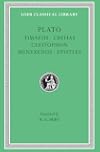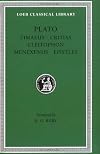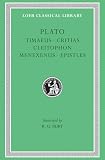
Timaeus, Critias, Cleitophon, Menexenus, Epistles
by Plato
On This Page
Description
The great Athenian philosopher Plato was born in 427 BCE and lived to be eighty. Acknowledged masterpieces among his works are the Symposium, which explores love in its many aspects, from physical desire to pursuit of the beautiful and the good, and the Republic, which concerns righteousness and also treats education, gender, society, and slavery.Tags
Recommendations


Member Reviews
I read the Timaeus for summer Basic Program discussion class in 1997. Plato presents an account of the formation of the universe in the Timaeus. He is deeply impressed with the order and beauty he observes in the universe, and his project in the dialogue is to explain that order and beauty from a teleological perspective. The universe, he proposes, is the product of rational, purposive, and beneficent agency. It is the handiwork of a divine Craftsman (“Demiurge,” dêmiourgos, 28a6), who, imitating an unchanging and eternal model, imposes mathematical order on a preexistent chaos to generate the ordered universe (kosmos). He presents the universe as a whole as well as its various parts arranged as to produce a vast array of good show more effects. It strikes Plato strongly that this arrangement is not fortuitous, but the outcome of the deliberate intent of Intellect (nous), anthropomorphically represented by the figure of the Craftsman who plans and constructs a world that is as excellent as its nature permits it to be. The Timaeus, begins with a summary by Socrates of what appears to be a fragment of the Republic (from Book II to the middle of Book V) and ends with a construction of a universe in which the citizen of Socrates’ best city could have his home. As Plato discusses, the beautiful orderliness of the universe is not only the manifestation of Intellect; it is also the model for rational souls to understand and to emulate. Such understanding and emulation restores those souls to their original state of excellence, a state that was lost in their embodiment. This is a difficult but, ultimately, rewarding work by this foundational philosopher. show less
PLATO:TIMATEUS, CRITIAS, CLEITOPHON, MENEXENUS, EPISTLES
…I read the Timaeus for summer Basic Program discussion class in 1997. Plato presents an account of the formation of the universe in the Timaeus. He is deeply impressed with the order and beauty he observes in the universe, and his project in the dialogue is to explain that order and beauty from a teleological perspective. The universe, he proposes, is the product of rational, purposive, and beneficent agency. It is the handiwork of a divine Craftsman (“Demiurge,” dêmiourgos, 28a6), who, imitating an unchanging and eternal model, imposes mathematical order on a preexistent chaos to generate the ordered universe (kosmos). He presents the universe as a whole as well as its show more various parts arranged as to produce a vast array of good effects. It strikes Plato strongly that this arrangement is not fortuitous, but the outcome of the deliberate intent of Intellect (nous), anthropomorphically represented by the figure of the Craftsman who plans and constructs a world that is as excellent as its nature permits it to be. The Timaeus, begins with a summary by Socrates of what appears to be a fragment of the Republic (from Book II to the middle of Book V) and ends with a construction of a universe in which the citizen of Socrates’ best city could have his home. As Plato discusses, the beautiful orderliness of the universe is not only the manifestation of Intellect; it is also the model for rational souls to understand and to emulate. Such understanding and emulation restores those souls to their original state of excellence, a state that was lost in their embodiment. This is a difficult but, ultimately, rewarding work by this foundational philosopher. show less
…I read the Timaeus for summer Basic Program discussion class in 1997. Plato presents an account of the formation of the universe in the Timaeus. He is deeply impressed with the order and beauty he observes in the universe, and his project in the dialogue is to explain that order and beauty from a teleological perspective. The universe, he proposes, is the product of rational, purposive, and beneficent agency. It is the handiwork of a divine Craftsman (“Demiurge,” dêmiourgos, 28a6), who, imitating an unchanging and eternal model, imposes mathematical order on a preexistent chaos to generate the ordered universe (kosmos). He presents the universe as a whole as well as its show more various parts arranged as to produce a vast array of good effects. It strikes Plato strongly that this arrangement is not fortuitous, but the outcome of the deliberate intent of Intellect (nous), anthropomorphically represented by the figure of the Craftsman who plans and constructs a world that is as excellent as its nature permits it to be. The Timaeus, begins with a summary by Socrates of what appears to be a fragment of the Republic (from Book II to the middle of Book V) and ends with a construction of a universe in which the citizen of Socrates’ best city could have his home. As Plato discusses, the beautiful orderliness of the universe is not only the manifestation of Intellect; it is also the model for rational souls to understand and to emulate. Such understanding and emulation restores those souls to their original state of excellence, a state that was lost in their embodiment. This is a difficult but, ultimately, rewarding work by this foundational philosopher. show less
Jan 2, 2018Spanish
PLATO:TIMATEUS, CRITIAS, CLEITOPHON, MENEXENUS, EPISTLES
…I read the Timaeus for summer Basic Program discussion class in 1997. Plato presents an account of the formation of the universe in the Timaeus. He is deeply impressed with the order and beauty he observes in the universe, and his project in the dialogue is to explain that order and beauty from a teleological perspective. The universe, he proposes, is the product of rational, purposive, and beneficent agency. It is the handiwork of a divine Craftsman (“Demiurge,” dêmiourgos, 28a6), who, imitating an unchanging and eternal model, imposes mathematical order on a preexistent chaos to generate the ordered universe (kosmos).
He presents the universe as a whole as well as its show more various parts arranged as to produce a vast array of good effects. It strikes Plato strongly that this arrangement is not fortuitous, but the outcome of the deliberate intent of Intellect (nous), anthropomorphically represented by the figure of the Craftsman who plans and constructs a world that is as excellent as its nature permits it to be. The Timaeus, begins with a summary by Socrates of what appears to be a fragment of the Republic (from Book II to the middle of Book V) and ends with a construction of a universe in which the citizen of Socrates’ best city could have his home.
As Plato discusses, the beautiful orderliness of the universe is not only the manifestation of Intellect; it is also the model for rational souls to understand and to emulate. Such understanding and emulation restores those souls to their original state of excellence, a state that was lost in their embodiment. This is a difficult but, ultimately, rewarding work by this foundational philosopher. show less
…I read the Timaeus for summer Basic Program discussion class in 1997. Plato presents an account of the formation of the universe in the Timaeus. He is deeply impressed with the order and beauty he observes in the universe, and his project in the dialogue is to explain that order and beauty from a teleological perspective. The universe, he proposes, is the product of rational, purposive, and beneficent agency. It is the handiwork of a divine Craftsman (“Demiurge,” dêmiourgos, 28a6), who, imitating an unchanging and eternal model, imposes mathematical order on a preexistent chaos to generate the ordered universe (kosmos).
He presents the universe as a whole as well as its show more various parts arranged as to produce a vast array of good effects. It strikes Plato strongly that this arrangement is not fortuitous, but the outcome of the deliberate intent of Intellect (nous), anthropomorphically represented by the figure of the Craftsman who plans and constructs a world that is as excellent as its nature permits it to be. The Timaeus, begins with a summary by Socrates of what appears to be a fragment of the Republic (from Book II to the middle of Book V) and ends with a construction of a universe in which the citizen of Socrates’ best city could have his home.
As Plato discusses, the beautiful orderliness of the universe is not only the manifestation of Intellect; it is also the model for rational souls to understand and to emulate. Such understanding and emulation restores those souls to their original state of excellence, a state that was lost in their embodiment. This is a difficult but, ultimately, rewarding work by this foundational philosopher. show less
Jan 2, 2018 (Edited)Spanish
Ratings
Members
- Recently Added By
Author Information

2,715+ Works 100,326 Members
Plato was born c. 427 B.C. in Athens, Greece, to an aristocratic family very much involved in political government. Pericles, famous ruler of Athens during its golden age, was Plato's stepfather. Plato was well educated and studied under Socrates, with whom he developed a close friendship. When Socrates was publically executed in 399 B.C., Plato show more finally distanced himself from a career in Athenian politics, instead becoming one of the greatest philosophers of Western civilization. Plato extended Socrates's inquiries to his students, one of the most famous being Aristotle. Plato's The Republic is an enduring work, discussing justice, the importance of education, and the qualities needed for rulers to succeed. Plato felt governors must be philosophers so they may govern wisely and effectively. Plato founded the Academy, an educational institution dedicated to pursuing philosophic truth. The Academy lasted well into the 6th century A.D., and is the model for all western universities. Its formation is along the lines Plato laid out in The Republic. Many of Plato's essays and writings survive to this day. Plato died in 347 B.C. at the age of 80. (Bowker Author Biography) show less
Some Editions
Series
Belongs to Publisher Series
Loeb Classical Library (234)
Common Knowledge
- Canonical title
- Timaeus, Critias, Cleitophon, Menexenus, Epistles
Classifications
Statistics
- Members
- 202
- Popularity
- 161,329
- Reviews
- 3
- Rating
- (3.92)
- Languages
- English, Finnish, Greek (Ancient)
- Media
- Paper, Ebook
- ISBNs
- 2
- ASINs
- 4