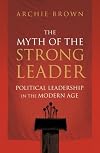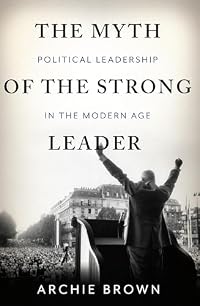
The Myth of the Strong Leader: Political Leadership in the Modern Age
by Archie Brown
On This Page
Description
Selected as one of the Best Books of 2016 by Bill GatesAll too frequently, leadership is reduced to a simple dichotomy: the strong versus the weak. Yet, there are myriad ways to exercise effective political leadership-as well as different ways to fail. We blame our leaders for economic downfalls and praise them for vital social reforms, but rarely do we question what makes some leaders successful while others falter. In this magisterial and wide-ranging survey of political leadership over show more the past hundred years, renowned Oxford politics professor Archie Brown challenges the widespread belief that strong leaders - meaning those who dominate their colleagues and the policy-making process - are the most successful and admirable.
In reality, only a minority of political leaders will truly make a lasting difference. Though we tend to dismiss more collegial styles of leadership as weak, it is often the most cooperative leaders who have the greatest impact. Drawing on extensive research and decades of political analysis and experience, Brown illuminates the achievements, failures and foibles of a broad array of twentieth century politicians. Whether speaking of redefining leaders like Franklin Delano Roosevelt, Lyndon Johnson, and Margaret Thatcher, who expanded the limits of what was politically possible during their time in power, or the even rarer transformational leaders who played a decisive role in bringing about systemic change - Charles de Gaulle, Mikhail Gorbachev and Nelson Mandela, among them - Brown challenges our commonly held beliefs about political efficacy and strength.
Overturning many of our assumptions about the twentieth century's most important figures, Brown's conclusions are both original and enlightening. The Myth of the Strong Leader compels us to reassess the leaders who have shaped our world - and to reconsider how we should choose and evaluate those who will lead us into the future. show less
Tags
Recommendations








Member Reviews
Fascinating review of 20th century history
The book starts with a simple statement which to me was only obvious after I had read it: concentrating power in a “strong leader” means allocating it arbitrarily to the leader’s personal assistants.
Because no single human can cope with the increased volume of information and decisions - despite the myths these “strong leaders” like to perpetuate about themselves - the decisions get made by the close staff of these leaders.
This leaves out the other people who should have led on these decisions, eg cabinet members who are of higher calibre and expertise and experience than the advisers.
Furthermore, more discussion with more people gets better decisions. This is obvious with the likes show more of Hitler, Mussolini, Mao and Stalin as leaders who accumulated power. But the book is full of examples of other leaders to make the case.
I wish history at schools was taught about these leaders and events, the 20th century is about more than Hitler but sadly that’s too often all children are taught about.
I don’t know that the author’s case is conclusively proven - it’s hard to make this into a scientific argument. But it’s fascinating to read and - especially as the author dislikes Tony Blair greatly - to read it in light of Jeremy Corbyn’s leadership style. A really enjoyable and thoughtful book. show less
The book starts with a simple statement which to me was only obvious after I had read it: concentrating power in a “strong leader” means allocating it arbitrarily to the leader’s personal assistants.
Because no single human can cope with the increased volume of information and decisions - despite the myths these “strong leaders” like to perpetuate about themselves - the decisions get made by the close staff of these leaders.
This leaves out the other people who should have led on these decisions, eg cabinet members who are of higher calibre and expertise and experience than the advisers.
Furthermore, more discussion with more people gets better decisions. This is obvious with the likes show more of Hitler, Mussolini, Mao and Stalin as leaders who accumulated power. But the book is full of examples of other leaders to make the case.
I wish history at schools was taught about these leaders and events, the 20th century is about more than Hitler but sadly that’s too often all children are taught about.
I don’t know that the author’s case is conclusively proven - it’s hard to make this into a scientific argument. But it’s fascinating to read and - especially as the author dislikes Tony Blair greatly - to read it in light of Jeremy Corbyn’s leadership style. A really enjoyable and thoughtful book. show less
A polished exposition of the idea that a strong leader need not necessarily be a successful one. It gets a bit long-winded toward the middle, but the point is well made with examples from 19th and 20th century European and American political history. However, his contention that people seldom choose individual leaders is not that convincing, especially seeing the current situation in many parts of the world.
This book covers a great deal on political leadership and helps the reader to understand the political landscape of multiple nations. The crux of this, it is not a strong leader that brings a net positive change, but a leader who is flexible, who understands the situation well, goes into the details, establishes that the processes, and follows it through that will bring the net positive change. The way, the different leaders have accomplished is quite varied, and depends on the situation and the time.
This book introduces some amazing real life characters like, Adolfo Suárez of spain who transformed the country to Democracy from the previously established monarchy in a peaceful manner. It also shares how Deng Xioping is the person show more behind the economic advancement of China from 1970 onward. It shares the perspective on how Fidel Castro overthrew the dictatorship in his country, and how lived by his principles, and did not accumulate any wealth for himself.
One thing that struck with me, when this book was written, Obama was the president of USA, and even then, the system in place in USA was such that, no one particular person was ultimately responsible everything in the government. It has been understood that answer for "who controls the whitehouse of USA", seems " no one knows". This is not a snarky comment, but a statement that workings of the government in USA is very complex, and there are multiple forces in effect at any time, including political parties, supporters, lobbyists, and corporations with interests, and it will be too much to give credit and put focus on a single person.
This book covers lot. It covers Britain, USA, Europe, South America, South Africa, China, Russia, touches upon New-Zealand, India and other nations. The author explores how various leaders in these countries have shaped the political landscapes of these places for better. show less
This book introduces some amazing real life characters like, Adolfo Suárez of spain who transformed the country to Democracy from the previously established monarchy in a peaceful manner. It also shares how Deng Xioping is the person show more behind the economic advancement of China from 1970 onward. It shares the perspective on how Fidel Castro overthrew the dictatorship in his country, and how lived by his principles, and did not accumulate any wealth for himself.
One thing that struck with me, when this book was written, Obama was the president of USA, and even then, the system in place in USA was such that, no one particular person was ultimately responsible everything in the government. It has been understood that answer for "who controls the whitehouse of USA", seems " no one knows". This is not a snarky comment, but a statement that workings of the government in USA is very complex, and there are multiple forces in effect at any time, including political parties, supporters, lobbyists, and corporations with interests, and it will be too much to give credit and put focus on a single person.
This book covers lot. It covers Britain, USA, Europe, South America, South Africa, China, Russia, touches upon New-Zealand, India and other nations. The author explores how various leaders in these countries have shaped the political landscapes of these places for better. show less
Ratings
Members
- Recently Added By
Author Information
23 Works 861 Members
Archie Brown is Emeritus Professor of Politics at Oxford University and an Emeritus Fellow of St Antony's College Oxford.
Classifications
- Genres
- Nonfiction, Politics and Government, Business, General Nonfiction, History
- DDC/MDS
- 303.340904 — Society, Government, and Culture Social sciences, sociology & anthropology Social processes Coordination and control Leadership
- LCC
- JC330.3 .B75 — Political Science Political theory Political theory. The state. Theories of the state
- BISAC
Statistics
- Members
- 193
- Popularity
- 169,047
- Reviews
- 3
- Rating
- (4.19)
- Languages
- English, German, Spanish
- Media
- Paper, Audiobook, Ebook
- ISBNs
- 14
- ASINs
- 6