On This Page
Description
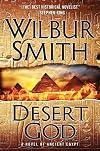
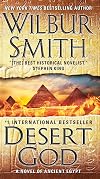
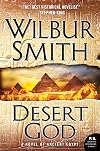
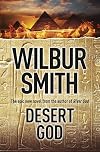
Taita the fusspot slave, spiritual wiseman and advisor to the Pharaoh is caught in a maelstrom of passion and danger in his efforts to destroy the Hyksos army by forming a dubious alliance with Crete.Tags
Recommendations





















Member Reviews
The fifth in Wilbur Smith’s Egyptian series was eagerly anticipated by his fans. Three previous novels had followed the fortunes of the eunuch Taita, while the modern day treasure hunt in The Seventh Scroll had added a further dimension to the tale. All had impressed me with their vision, the attention to detail, and the craft of a storyteller weaving intricate layers of plot within an adventure story that I never wanted to end.
But then came Desert God.
Sorry Wilbur, but this particular fan is bitterly disappointed. I genuinely hope there will be no more Taita adventures, because this tale is a big let down.
It starts promisingly enough, with Taita leading a raiding party against the Hyksos foe that we have encountered in most of the show more previous stories. Again we are immersed in a world of ancient times, immediately swept away with our hero’s audacious endeavours to support the cause of his pharaoh. We are introduced to more characters to which we are sympathetic, although there are (for my taste) several similarities in the descriptions given to characters from River God. On this occasion Taita must travel to Babylon before escorting two royal princesses to the island of Crete in an audacious plan to find new allies and finally rid Egypt of the marauding Hyksos.
I bought this book just before going on holiday to Turkey, but it didn’t come back with me. I deliberately left it behind because I did not want it to disgrace my bookshelf... I learned after my return that Wilbur Smith has occasionally used ‘ghostwriters’ to assist in completing his novels. If that is true, then it was never more obvious than in Desert God. I don’t know precisely where it happened (as I can no longer look through the pages!), but at some point Wilbur definitely lost the plot and someone else picked it up again. The storyline rambles without direction somewhere before we reach Babylon, and from thereon we are steered away from anything resembling Smith’s detailed and thorough plotting found in earlier books.
The final chapters are puerile and belong firmly in the slushpile of nonsense. I really cannot believe in the character of Taita any more. Earlier stories had imbued his personality with the elements of a mystic, but Desert God leaves us with an impression of someone better suited to the fantasy creatures found in Marvel Comic Books.
I’m sorry to depart from the voices of universal acclaim that usually greet Smith’s work, because I have been a genuine fan. But this book is a disaster (in my view), and if anyone reading this has previously enjoyed the earlier Egyptian stories, and is contemplating reading Desert God, my advice is “Don’t bother!” show less
But then came Desert God.
Sorry Wilbur, but this particular fan is bitterly disappointed. I genuinely hope there will be no more Taita adventures, because this tale is a big let down.
It starts promisingly enough, with Taita leading a raiding party against the Hyksos foe that we have encountered in most of the show more previous stories. Again we are immersed in a world of ancient times, immediately swept away with our hero’s audacious endeavours to support the cause of his pharaoh. We are introduced to more characters to which we are sympathetic, although there are (for my taste) several similarities in the descriptions given to characters from River God. On this occasion Taita must travel to Babylon before escorting two royal princesses to the island of Crete in an audacious plan to find new allies and finally rid Egypt of the marauding Hyksos.
I bought this book just before going on holiday to Turkey, but it didn’t come back with me. I deliberately left it behind because I did not want it to disgrace my bookshelf... I learned after my return that Wilbur Smith has occasionally used ‘ghostwriters’ to assist in completing his novels. If that is true, then it was never more obvious than in Desert God. I don’t know precisely where it happened (as I can no longer look through the pages!), but at some point Wilbur definitely lost the plot and someone else picked it up again. The storyline rambles without direction somewhere before we reach Babylon, and from thereon we are steered away from anything resembling Smith’s detailed and thorough plotting found in earlier books.
The final chapters are puerile and belong firmly in the slushpile of nonsense. I really cannot believe in the character of Taita any more. Earlier stories had imbued his personality with the elements of a mystic, but Desert God leaves us with an impression of someone better suited to the fantasy creatures found in Marvel Comic Books.
I’m sorry to depart from the voices of universal acclaim that usually greet Smith’s work, because I have been a genuine fan. But this book is a disaster (in my view), and if anyone reading this has previously enjoyed the earlier Egyptian stories, and is contemplating reading Desert God, my advice is “Don’t bother!” show less
This was my first foray into Wilbur Smtih's ancient Egypt and I liked it quite a bit. The characters and world-building were excellent and have inspired me to pick up the previous books in the series. The main thing holding it back from a higher star rating for me was that it sometimes got bogged down in details, which put the brakes on the plot. The battle scenes, in particular, were obviously well-thought-out, but I didn't feel it necessary to have every single move spelled out on the page. I, personally, could have done with an overview or summary. However, I am aware that other readers won't feel the same and this may well be a Smith trademark, without which his faithful readers would be alienated. Overall, this was a rich, show more enjoyable satisfying read full of characters I didn't always like, but always cared about. show less
Much Better than 'The Quest' by far. A strong beginning and end with something of a weak and long middle, Desert God takes on the gap period between the end of 'River God' and 'Warlock' under the reign of Pharaoh Tamose.
Smith's depiction of Egypt's neighboring civilizations - notably the Sumerians and Minoans - is unique in modern historical fiction. His take on Ancient Crete is a nice departure from his familiar environment of Upper Egypt, and contains a dramatic ending that might be Smith's best.
Not as spectacular as River God, but a strong move back to the right direction after an uninspired showing with 'The Quest.' Some parts are still a bit unnecessary or downright strange, but the true areas of historical fiction are show more magnificently written. show less
Smith's depiction of Egypt's neighboring civilizations - notably the Sumerians and Minoans - is unique in modern historical fiction. His take on Ancient Crete is a nice departure from his familiar environment of Upper Egypt, and contains a dramatic ending that might be Smith's best.
Not as spectacular as River God, but a strong move back to the right direction after an uninspired showing with 'The Quest.' Some parts are still a bit unnecessary or downright strange, but the true areas of historical fiction are show more magnificently written. show less
This book is the continuation of the story of Taita, the extraordinary eunuch who served the Pharaoh's wife and now his two daughters. In danger from the Hyksos, the kingdom of Egypt is in peril of being wiped out and Taita has hatched a plan to help bring it back to its former glory. He intercepts a huge shipment of Minoan silver making it appear as if it had been taken by the Hyksos. He then brings a small portion of the booty along with the two beautiful princesses to Crete to form alliance with Minos against the Hyksos. Pretty darn clever, huh?
As in the prior books, we get a glimpse into the life of the Egyptians and their advances in war and how they plied the seas. Taita, a eunuch who has dedicated his life to the service of the show more Pharaoh, shows off his prestigious intellect and ability to think outside the box in his plans. The Pharaoh gives him full rein to enact these plans and safeguard the princesses on their journey to Crete. show less
As in the prior books, we get a glimpse into the life of the Egyptians and their advances in war and how they plied the seas. Taita, a eunuch who has dedicated his life to the service of the show more Pharaoh, shows off his prestigious intellect and ability to think outside the box in his plans. The Pharaoh gives him full rein to enact these plans and safeguard the princesses on their journey to Crete. show less
While I did enjoy the historical aspect the book itself was like reading a Clive Cussler novel with the protagonist far too perfect at everything and far too liked by all the secondary characters to ever be believable or interesting.
I always get caught up in Wilbur Smith's adventure novels and I did in this one too . I loved River God. Desert God does not come close to it but it does follows Taita who is a larger then life character who i adore. I fun read.
I did not enjoy the author's writing style or the topic of the book. Others may enjoy this book.
Members
- Recently Added By
Lists

mom
729 works; 1 member
Author Information

152+ Works 38,538 Members
Awards and Honors
Awards
Series

Common Knowledge
- Canonical title
- Desert God
- Original title
- Desert God
- Important places
- Ancient Egypt
Classifications
- Genres
- Fiction and Literature, General Fiction, Historical Fiction, Fantasy
- DDC/MDS
- 823.914 — Literature & rhetoric English & Old English literatures English fiction 1900- 1901-1999 1945-1999
- LCC
- PR9405.9 .S5 .D47 — Language and Literature English English Literature English literature: Provincial, local, etc.
- BISAC
Statistics
- Members
- 687
- Popularity
- 41,898
- Reviews
- 10
- Rating
- (3.49)
- Languages
- 11 — Czech, Danish, Dutch, English, Finnish, French, Hungarian, Italian, Polish, Portuguese, Spanish
- Media
- Paper, Audiobook, Ebook
- ISBNs
- 59
- ASINs
- 12