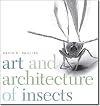
Art and Architecture of Insects
by David M. Phillips
On This Page
Description
Clad in spiked and scaled armor, lance-like pincers at the ready, alien creatures are in our gardens, our floorboards, and our bedsheets. David M. Phillips has taken his life-long love of insect biology and microscopy and produced a mesmerizing look into the hidden world of the insect form. The 150 photographs in this book, all taken using an electron microscope, reveal an amazing variety of anatomical structures normally invisible to the human eye: a wax surface that prevents evaporation, show more antennae that sense molecules that are undetectable by other animals, and feet that allow insects to walk upside down on almost any surface. Organized with the nonscientific reader in mind, Art and Architecture of Insects explores the intricate structures of some of our planet's most fascinating residents. This book's stunning photography and entertaining facts will fill readers with a sense of wonder at the unseen universe that surrounds them. Whether young or old, jaded insect-lover or new to the awe-inspiring strangeness of insect exoskeletons, one thing is certain: You will never look at insects in the same way again. show lessTags
Recommendations





















Member Reviews
I wanted this book for the photographs. I found to my satisfaction that the pictures, taken with an electron microscope, were even better than I’d expected. A person could learn a great deal about insects by browsing through this book just studying the photos and reading the captions. However, to do this would be to miss out on the excellent text of this book! It is evident that the author is not only educated in his subject, he is also a very good writer and illuminating teacher. I think anyone intrigued by the fascinating interplay of some often overlooked forms of life on earth would enjoy this book. Art and Architecture of Insects receives my highest praise in that it fully met my desire to learn more about insects while sparking show more several new points of interest in which I may continue my study. show less
 This review was written for LibraryThing Early Reviewers.
One of the downsides of the Early Reviewers program is that one often ends up judging books by their titles (and covers), for better or for worse. Consequently, I was originally interested in this book because I like art and architecture. Alas, this book might have been better titled "The High Resolution Photography of the Parts of Insects" or "The Evolutionary Design of Insects" because it really has nothing to do with art or architecture.
However, once I got past this initial disappointment, I was very interested to learn about the design of insects, particularly some of the tradeoffs in design. E.g., many insects have very small, rudimentary eyes, because they gain most of their information about the world through smell or touch. show more However, houseflies have large compound eyes because they are capable of flight, and so must be able to gather information about their environment more quickly than by smelling it and before they actually touch it. Still, their eyes are not capable of focusing on images that are far away, so their sight is limited to objects that are close to them.
So, even though this book wasn't exactly what I'd expected or hoped for, I still enjoyed reading it and would recommend it to others. show less
However, once I got past this initial disappointment, I was very interested to learn about the design of insects, particularly some of the tradeoffs in design. E.g., many insects have very small, rudimentary eyes, because they gain most of their information about the world through smell or touch. show more However, houseflies have large compound eyes because they are capable of flight, and so must be able to gather information about their environment more quickly than by smelling it and before they actually touch it. Still, their eyes are not capable of focusing on images that are far away, so their sight is limited to objects that are close to them.
So, even though this book wasn't exactly what I'd expected or hoped for, I still enjoyed reading it and would recommend it to others. show less
This review was written for LibraryThing Early Reviewers.A beautifully written and photographed book about the inner and outer workings of insects geared to the lay audience. Clearly a labor of love from a retired biomedical researcher who shares his passion for entomology. The black and white photographs of the insects taken by electron microscopes are fascinating and mesmerizing and the facts about the insects parts and functions are very well written.
My one caveat: because the insects in the photography are so detailed and intricate that they creeped me out in a goose fleshy way. So while I admire the aesthetic beauty of the photos, at a more primitive level, I couldn't stare too long at them without getting the shudders.
My one caveat: because the insects in the photography are so detailed and intricate that they creeped me out in a goose fleshy way. So while I admire the aesthetic beauty of the photos, at a more primitive level, I couldn't stare too long at them without getting the shudders.
This review was written for LibraryThing Early Reviewers.I received a copy of this book via the Library Thing Early reviewers program.
I cannot tell you how JEALOUS I am of the author! An electron microscope to basically play with for a personal project like this! So envious.
The photographs in the book are spectacular. I really wish there was an electronic version, so I could zoom in and out, although I'm sure unauthorized digital copies would be copied all over.
Having said that--the text of the book seems accurate, but the prose is just not that inspiring. I kept finding that I had skipped over sections. It's not bad writing; it's just not very engaging either. It's a bit like a lecture or list of factoids.
I cannot tell you how JEALOUS I am of the author! An electron microscope to basically play with for a personal project like this! So envious.
The photographs in the book are spectacular. I really wish there was an electronic version, so I could zoom in and out, although I'm sure unauthorized digital copies would be copied all over.
Having said that--the text of the book seems accurate, but the prose is just not that inspiring. I kept finding that I had skipped over sections. It's not bad writing; it's just not very engaging either. It's a bit like a lecture or list of factoids.
This review was written for LibraryThing Early Reviewers.With copious images to spur the imagination, David M. Phillips's Art and Architecture of Insects is a visual feast for anyone curious about what insects truly look like. The computer based photos are detailed and offer a compelling look into a world most of us rarely think about. The writing is fluid, informative, and a times even witty. However, the title of the book is a bit misleading. While of enormous use to anyone drawing or seeking biomorphic knowledge of insects, the book itself doesn't really explore the art or architecture of the insect world. A more accurate title would have been "Insect Design" as the book focuses on the body parts and movement of various bugs. Still, despite this, it is a lovely book that will prove an show more inspiration to anyone wanting to see the micro world as it truly is. Bravo, Mr. Phillips. show less
This review was written for LibraryThing Early Reviewers.A wonderful book with great pictures. The text that accompanies the pictures is simple, describing the insect (or part of the insect) with simple language that isn't dumbed down for the reader. In a way, the text is quite elegant.
The black and white micrograph (these are not photographs) at first seem a bit... old fashioned, especially when compared to the computer generated colours of today’s micrographs, but they very quickly grow on a reader. The gray-scale actually enhances the features of the insect. David Phillips is very talented at this small scale photography.
My only issue with the book is how the font-size to image scale seems off. Maybe a larger font would have helped.
The black and white micrograph (these are not photographs) at first seem a bit... old fashioned, especially when compared to the computer generated colours of today’s micrographs, but they very quickly grow on a reader. The gray-scale actually enhances the features of the insect. David Phillips is very talented at this small scale photography.
My only issue with the book is how the font-size to image scale seems off. Maybe a larger font would have helped.
This review was written for LibraryThing Early Reviewers.This brook provides a unique look at insects, both through the amazing images and the not-too-technical descriptions. The clever design features behind how insects work so they can survive, such as why fleas are so hard to squash, was eye opening. The only room for improvement I saw was maybe to add regular photos to compare to the special images included, particularly for insects that might not be so familiar. Bottom line: delightful and a tad creepy, but in a good way.
This review was written for LibraryThing Early Reviewers.Members
- Recently Added By
Lists

Summer Reads 2014
207 works; 70 members
Author Information
3 Works 51 Members
Classifications
Statistics
- Members
- 40
- Popularity
- 731,696
- Reviews
- 10
- Rating
- (3.81)
- Languages
- English
- Media
- Paper
- ISBNs
- 1