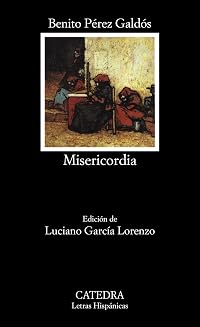
Misericordia
by Benito Pérez-Galdós
On This Page
Description
The story is set in Madrid at the end of the 19th century. Benina is Doña Paca's elderly maid, widow of a senior government official who has fallen into the worst misery. To feed Doña Paca and her children, Antoñito and Obdulia, Benina begins to beg, pretending to her mistress that her income comes from the half-service she performs in the house of an imaginary priest, Don Romualdo. Benina also extends her charitable activity to Frasquito Ponte, an old dandy who has fallen into poverty, show more and to Almudena, a blind Moroccan colleague of hers. Benina also patiently endures the tantrums of Doña Paca, unaware of the sacrifices made by her maid, and the jealousy of Almudena who would like Benina to become her wife. show lessTags
Recommendations





















Member Reviews
For those of you who don't know it, Benito Pérez Galdós was possibly the most important novelist of the Realism in Spain - he's our very own Gustave Flaubert. You probably don't know this, because he very nearly received the Nobel prize, but ultimately didn't. Something to do with politics.
At any rate, some of his best novels draw a very interesting outline of the lives of the middle and lower classes in 19th century Madrid. This is one of them.
The story revolves around Benina, the old servant of an Andalusian lady who now lives on the verge of poverty. Benina loves her dearly, and uses every resource she has to make sure that she gets something to eat at the end of the day. To this purpose she walks up and down the poorest show more neighborhoods in Madrid, where her path crosses with a great variety of characters - many of which she ends up helping as well, with what little she has to offer.
Mind you, Benina's not a classical heroine. She doesn't practice charity in the name of religion, or pities herself for her misfortunes. She's a brave woman with a great sense of humor, and she does what she does because she's strong and street-smart, and somebody's got to take care of these poor bastards right?
Galdós was famous for having a special sensitivity for popular language, which was his strongest descriptive tool. This is specially true in this particular case. Benina talks in a very characteristic way - fast and amusing and so very local. It makes this book taste of Madrid, which I guess is the whole point of a Realist novel. 5/5. show less
At any rate, some of his best novels draw a very interesting outline of the lives of the middle and lower classes in 19th century Madrid. This is one of them.
The story revolves around Benina, the old servant of an Andalusian lady who now lives on the verge of poverty. Benina loves her dearly, and uses every resource she has to make sure that she gets something to eat at the end of the day. To this purpose she walks up and down the poorest show more neighborhoods in Madrid, where her path crosses with a great variety of characters - many of which she ends up helping as well, with what little she has to offer.
Mind you, Benina's not a classical heroine. She doesn't practice charity in the name of religion, or pities herself for her misfortunes. She's a brave woman with a great sense of humor, and she does what she does because she's strong and street-smart, and somebody's got to take care of these poor bastards right?
Galdós was famous for having a special sensitivity for popular language, which was his strongest descriptive tool. This is specially true in this particular case. Benina talks in a very characteristic way - fast and amusing and so very local. It makes this book taste of Madrid, which I guess is the whole point of a Realist novel. 5/5. show less
This is an odd but touching Spanish Realist novel from 1897 that looks at the plight of the poor. Benina is the main character and is the loyal servant of a Dona Paca who has squandered her money and now lives in utter poverty. Benina remains loyal to her and takes care of her by begging on the streets and also keeping her spirits up. In order to not shame Dona Paca, Benina lies about where the money comes from, inventing the story that she has a job working for a Priest, Don Remualdo. Benina takes in several other people, seemingly a magnet for the unfortunate. Every pesata she comes upon is used to make others happy, though she does always reserve a small percentage for her personal stash. Towards the end of the book, the fictional show more Don Remualdo actually shows up at Dona Paca's home and shares that she has inherited an annuity from a distant relative. Dona Paca immediately falls into her old spending ways and also throws Benina aside.
The book explores poverty, compassion, and loyalty through some great characters. I did feel that I would have gotten more out of it if I had a better background in Spanish culture and history. Also, I get the feeling that the dialects the different characters use were important in the original Spanish and probably didn't translate very well. I did enjoy it overall, though. show less
The book explores poverty, compassion, and loyalty through some great characters. I did feel that I would have gotten more out of it if I had a better background in Spanish culture and history. Also, I get the feeling that the dialects the different characters use were important in the original Spanish and probably didn't translate very well. I did enjoy it overall, though. show less
Por el momento es mi favorita de Galdós. Un relato entre tierno e irónico (cruel a veces, incluso) sobre la miseria, moral y real, de un grupo de personas. El final es una lección de humildad, a la vez que una crítica feroz a la hipocresía humana.
Estantería pasillo, columna tercera, estante 2.
8471550067
Ver mi resumen y comentario en Pequeña Biblioteca Comentada, Misericordia.
Es curioso: el argumento y el tratamiento de los personajes inducen al sentimentalismo. Es una historia conmovedora y los personajes emocionan precisamente porque son y actúan como seres humanos, ni demasiado malos ni demasiado buenos (ni siquiera la protagonista, significativamente llamada Benigna). Pero la descripción de ambientes y un cierto tono general de despego "realista", incluso irónico, evitan caer en la sensiblería. Yo me temía un novelón lloroso, y me he encontrado con algo que apela a los sentimientos más nobles de las personas, pero sin pasarse en ningún momento. Ha contribuido mucho el excelente prólogo (quizá un poco pedante en algunos momentos). que propone dos lecturas "en clave": una en la que los personajes show more principales encarnarían grupos sociales, tal como los ve Galdós; y otra en la que los personajes son trasuntos de valores evangélicos. Esta última interpretación me ha parecido de lo más sugerente, y la que mejor se entiende hoy, que ya estamos un poco alejados de la sociología decimonónica, proponiendo una victoria espiritual de la bondad precisamente cuando es, en sus aspectos materiales, peor tratada; una auténtica Redención por la Cruz. show less
Aug 11, 2011Spanish
Members
- Recently Added By
Lists

My TBR
371 works; 3 members

Philip Ward's Lifetime Reading Plan
592 works; 22 members
Author Information

607+ Works 9,614 Members
Perez Galdos was Spain's outstanding nineteenth-century novelist. At a time when most Spanish novelists were limited by their regional backgrounds, Galdos possessed the intellect and vision to embrace the Spanish people as a nation. In 1873 he began the Episodios nacionales (National Episodes), a 46--volume series of historical novels in which he show more was concerned less with details and facts of history than with their impact on the lives of ordinary people. His works are sometimes divided into two periods: novels of the first period and contemporary Spanish novels. His early novels, Dona Perfecta (1876), Gloria (1877), Marianela (1878), and The Family of Leon Roch (1879), may be characterized as realistic with touches of romanticism. The novels are united by common characters and themes in the manner of Balzac's Human Comedy. Dona Perfecta is a denunciation of intolerance. Marianela explores the irony and tragedy of the destruction of love by scientific progress. Fortunata and Jacinta (1886-87), a four-volume masterpiece of the second period, contrasts two women - Jacinta, wife of the wealthy middle-class Juanito Santa Cruz, and Fortunata, his mistress. Both are admirable characters, but it is Fortunata who bears a son, demonstrating the vitality of the lower classes. The character of Maxi reveals Galdos's interest in mental illness and his naturalistic strain. Born and educated in the Canary Islands, Perez Galdos studied law briefly and spent most of his adult life in Madrid. His study of lower-class Spanish life and his attempts to improve it led him to the advocacy of more equal distribution of wealth and outspoken opposition to the Catholic church. While always popular with the people, he fared less well in literary circles. In 1889 he sought admission to the Royal Academy, an honor he was refused until 1897, and the Nobel Prize went to a contemporary, Jose Echegaray, a writer of considerably less talent. Galdos died poor and blind. Although the government refused him a state funeral, the entire Spanish nation mourned him. English translations of his novels now out of print are The Disinherited Lady (1881), Miau (1888), Compassion (1897), and Tristana. (Bowker Author Biography) show less
Some Editions
Awards and Honors
Series
Belongs to Publisher Series
Work Relationships
Is contained in
Common Knowledge
- Canonical title*
- Misericordia
- Original title
- Misericordia
- Original publication date
- 1897
- Related movies*
- Misericordia (1953 | IMDb)
- Original language*
- Español
*Some information comes from Common Knowledge in other languages. Click "Edit" for more information.
Classifications
Statistics
- Members
- 516
- Popularity
- 58,267
- Reviews
- 17
- Rating
- (3.89)
- Languages
- 5 — Dutch, English, French, Italian, Spanish
- Media
- Paper, Audiobook, Ebook
- ISBNs
- 60
- ASINs
- 17